
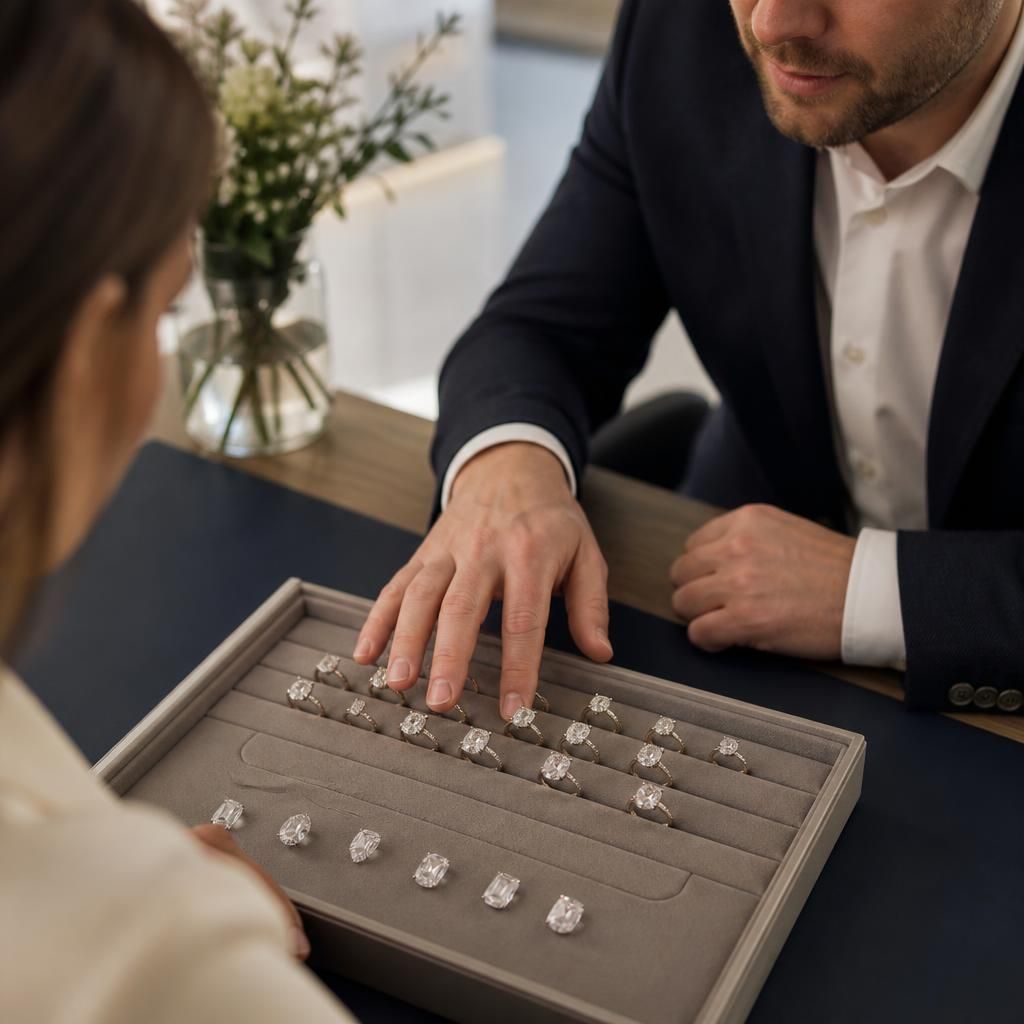
What are the unique characteristics of different diamond cuts and how do they influence the overall appearance of an engagement ring?
Different diamond cuts create distinct levels of brilliance, fire and visual shape: round cuts maximise traditional sparkle, while oval, pear, marquise and emerald cuts offer different profiles and light effects. The chosen cut influences how large the diamond appears, how it suits the setting and whether the finished engagement ring looks classic, elongated, modern or understated.
Different diamond cuts influence an engagement ring’s appearance through their shape, brilliance, fire, apparent size and the way they interact with the setting. A round brilliant usually gives the most traditional sparkle, while fancy shapes such as oval, pear, marquise, emerald and cushion create distinct outlines and light effects. The best choice depends on the balance of visual style, finger proportions, durability, diamond quality and the setting selected.
Strictly speaking, a diamond’s shape is its outline, whereas its cut describes how successfully its facets are proportioned, aligned and polished to handle light. In everyday jewellery terminology, however, names such as round cut, oval cut or emerald cut are commonly used to describe both. Two diamonds with the same shape can look noticeably different if their cut quality, proportions or facet arrangement differ.
Round brilliant cut
The round brilliant is designed to return a high level of white brilliance and coloured fire. Its symmetrical outline suits almost any engagement ring setting, from a simple solitaire to a halo or a more detailed shoulder design. The circular shape gives a balanced, classic appearance and tends to draw attention directly to the centre stone.
Because round diamonds are especially effective at reflecting light, they can be a practical choice when sparkle is the main priority. Their outline does not make the finger appear longer in the way some elongated shapes can, but it offers strong versatility and timeless proportions. A round brilliant also works well with many wedding band styles, particularly where a clean, traditional profile is preferred.
Oval cut
An oval diamond combines the brilliance associated with a round brilliant with a longer outline. The elongated shape can create the impression of greater coverage across the finger, while its curved edges retain a soft and refined appearance. Oval diamonds suit solitaire, three-stone and halo settings, and can look either classic or contemporary depending on the proportions and metal.
Some oval diamonds display a darker bow-tie area across the centre. This is caused by the way light travels through the stone and is not automatically a fault, but its strength and visibility should be assessed in person or through reliable imagery. The effect varies from diamond to diamond, so an oval should be chosen for its individual appearance rather than its outline alone.
Pear cut
The pear cut, sometimes called a teardrop shape, combines a rounded end with a pointed tip. This gives an engagement ring an individual profile and can create a lengthening effect when the point is directed towards the fingertip. Turning the point towards the hand produces a different visual balance and may feel more understated.
Pear diamonds are often set with a protective claw at the pointed end because the tip is more vulnerable to impact and accidental damage. The setting must hold the stone securely without obscuring the shape. As with ovals, pear diamonds can show a bow-tie effect, so the distribution of brightness across the stone is an important part of selection.
Marquise cut
The marquise has two pointed ends and a long, curved outline. It can make the finger appear longer and gives a ring a distinctive, elegant direction. A north-to-south orientation creates a slender profile, while an east-to-west orientation produces a wider and more fashion-led appearance.
The points require careful protection within the setting. A marquise can also show a bow-tie effect, and poorly balanced proportions may make the stone look too narrow, too broad or uneven. Symmetry is particularly important because any difference between the two halves is easy to see.
Emerald cut
The emerald cut has a rectangular outline with cropped corners and broad, stepped facets. Rather than producing the intense, fragmented sparkle of a brilliant cut, it creates flashes of light and a clear, glass-like appearance. Its long lines give an engagement ring a clean, architectural and understated character.
Because the facets act like open windows into the stone, inclusions and body colour may be more visible than they would be in a highly brilliant cut. Emerald-cut diamonds therefore benefit from careful assessment of clarity and colour. The cropped corners improve resistance to chipping compared with sharp corners, although the stone still needs suitable protection in its setting.
Asscher cut
The Asscher cut is a square, step-cut shape with cropped corners and a concentric facet pattern. When viewed from above, its facets can create a strong geometric or hall-of-mirrors effect. It has a vintage-influenced appearance but can look highly contemporary in a simple setting.
Like an emerald cut, an Asscher cut prioritises clarity, symmetry and facet definition over maximum scintillation. The quality of its outline is easy to judge, so balanced proportions and accurately aligned corners are essential.
Princess cut
The princess cut is generally square or slightly rectangular, with sharp corners and a brilliant-style facet arrangement. It offers substantial sparkle while maintaining a crisp, modern outline. Its straight edges can sit neatly alongside other stones, making it suitable for channel-set shoulders, geometric designs and some three-stone arrangements.
The pointed corners are the main vulnerability. A secure setting, often with corner protection, helps reduce the risk of damage. If a wedding band is intended to sit closely against the engagement ring, the square outline and setting design should be considered together.
Cushion cut
The cushion cut has a square or rectangular outline with softened, rounded corners. It can be produced with different facet styles, so some cushions show broad, romantic flashes while others give a livelier, more brilliant appearance. This variation means that two cushion diamonds can have quite different personalities even when their outlines are similar.
The softened corners give the ring a gentler look than a sharp square shape, while the broader outline can make the centre stone appear substantial. Cushion cuts work particularly well in halo settings, where the surrounding stones can emphasise the curved corners, but they are equally effective as a simple solitaire.
Radiant cut
The radiant cut usually has a rectangular or square outline, cropped corners and brilliant-style facets. It combines the clean geometry of a step-cut outline with more active sparkle. This makes it useful for someone who wants a modern, elongated shape without the quieter light pattern of an emerald cut.
Radiant diamonds vary considerably in length-to-width proportion. A longer radiant creates a more elongated appearance, while a squarer version feels more compact and balanced. The corner shape offers some protection, although the setting should still be designed to suit the diamond’s proportions.
How the cut changes the overall ring design
Diamond quality remains important regardless of shape. For brilliant cuts, look for lively light return, even brightness and a pleasing pattern without an overly obvious dark area. For step cuts, examine clarity, colour, symmetry and the definition of the broad facets. For elongated shapes, check that the outline is balanced and that the stone does not appear noticeably dark across its centre.
The setting should be selected with the diamond rather than treated as a separate decision. A solitaire places emphasis on the outline and proportions of the centre stone; a halo makes the diamond appear broader and adds additional sparkle; shoulder stones can reinforce an elongated profile or create more overall brightness. Bezel settings provide continuous edge protection, while claw settings expose more of the diamond but must be carefully positioned around corners and points.
When comparing diamonds, view each stone in different lighting conditions and from several angles. Look for consistent brightness, a balanced outline and a setting plan that protects vulnerable areas without hiding the shape. A consultation can then assess how the preferred cut works with the ring’s metal, shoulder design, wedding band and intended everyday use. This approach ensures that the finished engagement ring reflects not only the diamond’s technical characteristics but also the way it is meant to be worn.
A diamond’s cut influences how it handles light, while its shape determines the outline seen in the engagement ring. Brilliant-style cuts, such as round, oval, pear, princess, cushion and radiant, are designed to create lively sparkle through numerous facets. Step cuts, including emerald and Asscher, use broad, parallel facets that produce larger flashes and a clearer, more reflective appearance rather than intense scintillation.
This difference changes the character of the finished ring. A round or oval brilliant can look bright and energetic, while an emerald cut often appears more refined and architectural. Elongated shapes may create greater visual coverage across the finger, but their appearance depends on balanced proportions and even light return. Oval, pear and marquise diamonds should be checked for a noticeable bow-tie effect, where the centre appears darker because of the way light enters and leaves the stone.
When comparing diamonds, assess more than the outline. View the stone from different angles and in varied lighting, checking that the brightness is well distributed and that the proportions suit the proposed setting. A halo can increase apparent width, a solitaire will emphasise the centre stone’s outline, and protective claws or a bezel may be particularly important for pointed corners and tips. The most suitable cut is therefore the one whose light performance, shape and setting work together for the intended style and everyday wear.
- Perceived size: Elongated shapes such as oval, pear, marquise and some radiant cuts can cover more of the finger from end to end. This is a visual effect and should not be confused with greater diamond weight or superior quality.
- Sparkle: Brilliant-style cuts generally produce more visible scintillation than step cuts. Emerald and Asscher diamonds offer broader flashes and greater transparency, so their appeal is based more on facet pattern and clarity than on maximum sparkle.
- Finger proportions: Longer outlines can create a lengthening effect, whereas round and square shapes give a more centred, symmetrical appearance. Comfort, hand shape and personal preference are more important than rigid styling rules.
- Setting compatibility: Sharp corners need protection, while unusual outlines require appropriately positioned claws or a bezel. Halo settings can emphasise a shape, but they also add visual width and detail around the centre stone.
- Metal and contrast: White metals can create a bright, continuous appearance around a colourless diamond. Yellow or rose gold introduces warmth and can make the contrast between the setting and stone more noticeable. The chosen metal also affects the ring’s practical durability and maintenance.
- Wedding band fit: A round or softly curved centre stone may allow a close-fitting wedding band more easily than a large pear, marquise or square diamond. A shaped band, raised setting or custom-fitted design may be needed where the outlines meet.
Discuss the right diamond cut for your engagement ring
Discuss the right diamond cut for your engagement ring with our team, considering its light performance, proportions, setting and intended everyday wear. Arrange a personal consultation for expert guidance on selecting or creating a design that suits your preferences.
Speak to your personal jeweller
Every commission begins with a conversation. Arrange an appointment in the Birmingham Jewellery Quarter or talk it through by phone.