
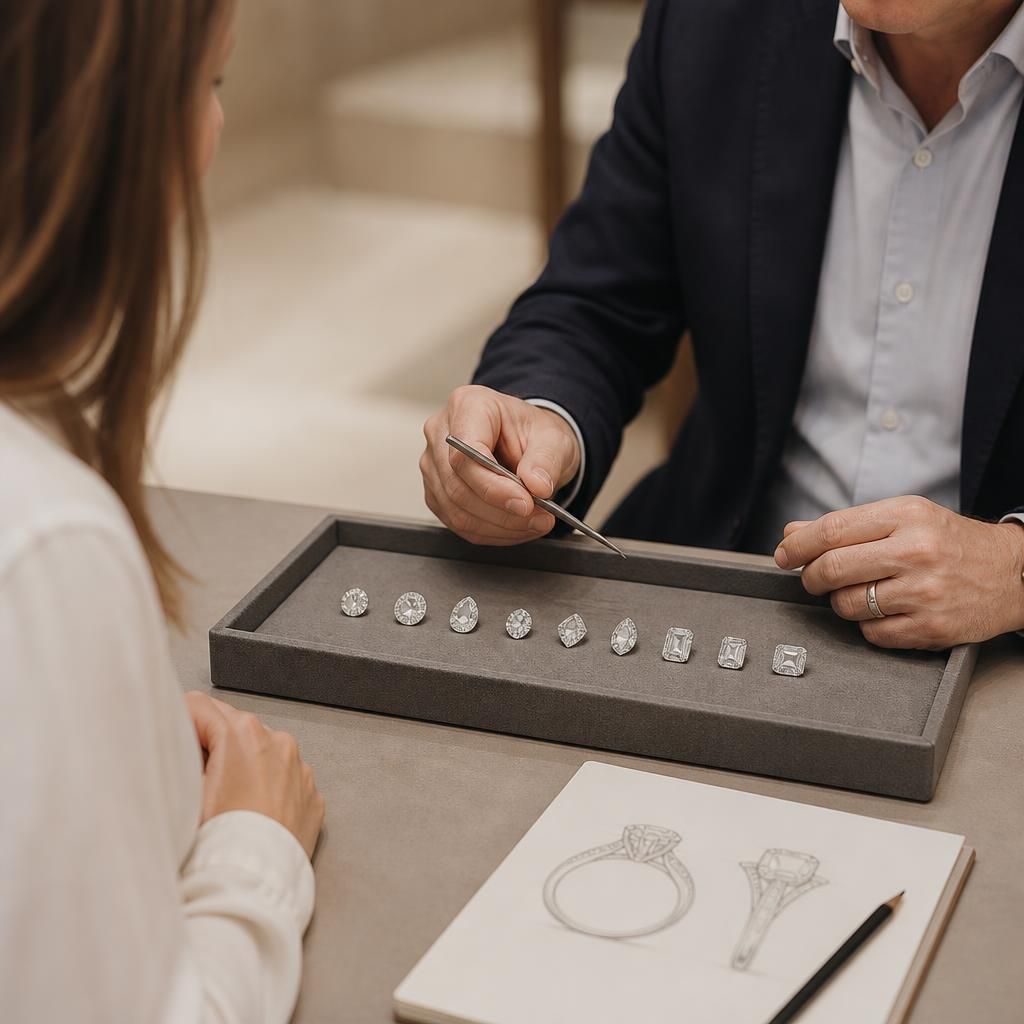
What are the key differences between diamond cuts for engagement rings?
Diamond cuts differ in their facet arrangement, proportions and ability to reflect light, which affects brilliance, fire and sparkle. Round brilliant cuts typically offer the most intense sparkle, while shapes such as oval, emerald, pear, marquise and cushion cuts create distinct looks with differing levels of brilliance, clarity visibility and apparent size.
Diamond cuts differ in their facet arrangement, proportions and ability to return light, so each produces a different balance of brilliance, fire, scintillation, apparent size and style. The round brilliant cut is generally the most consistently brilliant, while oval, pear, marquise, cushion, emerald, Asscher and radiant cuts offer distinct appearances and different practical considerations for an engagement ring.
It is useful to distinguish between a diamond’s cut and its shape . Cut describes how successfully the stone has been proportioned, polished and faceted to interact with light. Shape refers to its outline, such as round, oval or pear. In everyday jewellery terminology, however, people commonly use “diamond cut” to mean the shape as well. Both aspects matter when comparing engagement ring diamonds.
Round brilliant cut
The round brilliant is designed to maximise the return of white light, coloured flashes and lively sparkle. Its symmetrical outline and carefully arranged triangular and kite-shaped facets make it particularly effective at producing brilliance and scintillation. This makes a round diamond a practical choice when sparkle is the main priority.
Round diamonds also suit a wide range of settings, from traditional solitaires to halo, trilogy and shoulder-set designs. Their balanced outline is relatively easy to protect with claws, although the pointed junction between the crown and girdle should still be assessed when choosing the setting. Because the round brilliant is in high demand and involves more of the original rough crystal being removed during cutting, it can command a higher price than some fancy shapes of comparable carat weight.
Oval cut
Oval diamonds use a brilliant-style facet arrangement but have an elongated outline. They can therefore offer strong sparkle while appearing longer across the finger than a round diamond of similar weight. The length-to-width ratio has a noticeable effect on the look: a shorter oval appears fuller, while a longer oval creates a more slender impression.
A key point with ovals is the possibility of a darker area running through the centre, commonly called a bow-tie effect. Some bow-tie shading is normal, but it should not dominate the stone when viewed in normal lighting. Examining the diamond in person, or using reliable imagery from several angles, helps assess whether its light performance is even.
Pear and marquise cuts
Pear-shaped diamonds combine a rounded end with a point, creating a teardrop outline. Marquise diamonds have two points and a curved, elongated body. Both are brilliant-style shapes and can appear larger across the finger because their outlines cover more length than a round diamond.
The points on both shapes require particular attention. They are more exposed to accidental knocks and should usually be protected by a claw or another secure part of the setting. Pear diamonds can be worn with the point facing towards or away from the hand, while the direction of a marquise can be selected to suit the design and the wearer’s preference. Both may show a bow-tie effect, so the individual stone should be assessed rather than judged by shape alone.
Cushion cut
Cushion diamonds have a square or rectangular outline with rounded corners. They may use a modern brilliant-style facet arrangement or a chunkier pattern that creates broader flashes of light. As a result, two cushion diamonds can look noticeably different even when their dimensions and carat weights are similar.
The rounded corners give a cushion a softer appearance than a square step-cut stone, while its larger, broader facets can produce attractive flashes rather than the fine, rapid sparkle associated with a round brilliant. Elongated cushions can provide more finger coverage, whereas square cushions create a compact, classic outline. A cushion’s clarity should be checked carefully because its larger facets may make inclusions easier to see.
Emerald and Asscher cuts
Emerald and Asscher diamonds are step cuts. Instead of many small facets arranged primarily to maximise sparkle, they use broad, parallel facets that create a hall-of-mirrors effect. Their appeal lies in clean flashes, transparency and geometric structure rather than intense scintillation.
An emerald cut is usually rectangular with cropped corners, while an Asscher cut is square with more pronounced stepped corners. Both can make a diamond look elegant and architectural, but their broad, open facets reveal body colour, inclusions and cutting irregularities more readily than many brilliant cuts. Clarity and colour selection are therefore particularly important, as is checking that the steps appear even and well aligned.
Radiant cut
The radiant cut combines a rectangular or square outline, cropped corners and brilliant-style faceting. It is intended to provide substantial sparkle while retaining a more linear shape than a round diamond. Its faceted corners are less exposed than the points of pear and marquise diamonds, which can offer useful flexibility when planning a ring setting.
Radiants are available in a broad range of length-to-width ratios. A rectangular radiant gives a more elongated appearance, while a squarer version can resemble a cushion or Asscher in outline. As with other elongated brilliant cuts, the stone should be inspected for uneven light distribution, including any noticeable central bow-tie effect.
How the cuts differ in light performance
Brilliant-style cuts, including round, oval, pear, marquise, cushion and radiant diamonds, generally produce more visible sparkle because they contain facet patterns designed to return light in many directions. Step cuts such as emerald and Asscher diamonds usually show fewer, broader flashes and greater transparency. Neither approach is objectively better: the choice depends on whether you prefer lively sparkle or a more understated, glass-like appearance.
Light performance also depends on the quality of the individual cut. Poor proportions can cause light to escape through the bottom of a diamond, making it appear dull regardless of its shape. Symmetry, polish, pavilion depth, table size and girdle thickness should therefore be assessed alongside the outline. A well-selected fancy shape can perform better visually than a poorly cut round diamond.
Apparent size and finger coverage
Different shapes distribute their weight differently. Elongated forms, particularly oval, pear and marquise diamonds, can cover more of the finger from top to bottom and may appear larger for their carat weight. Emerald and radiant cuts can also provide strong finger coverage when rectangular. A deep-set stone may carry more of its weight below the girdle, reducing the visible surface area, so measurements are often more informative than carat weight alone when comparing designs.
Durability and setting considerations
Shape affects how a diamond should be protected. Round, oval, cushion and emerald cuts have no sharp points, although their girdles and corners still need appropriate protection. Pear, marquise and radiant diamonds have areas that require careful setting design, while the cropped corners of a radiant or emerald reduce—but do not eliminate—corner vulnerability.
The setting should support the cut rather than obscure its strengths. A solitaire gives an elongated or unusual outline room to be appreciated, a halo can increase the apparent scale of a centre stone, and shoulder stones can reinforce a rectangular or symmetrical profile. Bezel settings offer protection around vulnerable edges, while claw placement should be planned to balance security with visibility.
Choosing the right diamond cut
Begin by deciding which visual quality matters most: maximum sparkle, broad flashes, clean geometric lines, an elongated appearance or a distinctive outline. Then compare individual stones in different lighting, checking for even brightness, distracting dark areas, visible inclusions and secure proportions. Consider the wearer’s preferred jewellery style, hand proportions, lifestyle and the practical demands of the proposed setting.
There is no single best diamond cut for every engagement ring. The strongest choice is the one whose light performance, shape, durability and setting work together. A detailed consultation allows these factors to be assessed alongside metal choice, ethical sourcing requirements and the intended design, so the finished ring is both visually considered and suitable for everyday wear.
The key differences between diamond cuts for engagement rings are found in their facet arrangement, outline and proportions, which determine how the stone reflects light and appears on the finger. Brilliant-style cuts, such as round, oval and pear, are designed for lively sparkle, while step cuts, including emerald and Asscher, create broader flashes and a more transparent, geometric appearance.
Shape also affects practical considerations. Elongated cuts such as oval, marquise and pear can provide greater finger coverage for their carat weight, but pointed ends need careful protection in the setting. Emerald and Asscher cuts show inclusions and body colour more readily because of their broad, open facets, whereas the facet pattern of a round brilliant can make minor imperfections less noticeable.
When comparing stones, assess the individual diamond rather than relying on its shape alone. Look for even brightness, good symmetry, suitable proportions and any distracting dark areas, then consider how the setting will protect and present the cut. The best choice balances the preferred appearance with durability, finger coverage and everyday wear.
Find the Right Diamond Cut for Your Engagement Ring
Arrange a consultation with Steven Charles Quance to compare diamond cuts, assess their light performance and discuss the setting that best suits your preferred style and everyday wear.
Speak to your personal jeweller
Every commission begins with a conversation. Arrange an appointment in the Birmingham Jewellery Quarter or talk it through by phone.