
What technologies are used in laser engraving jewellery?
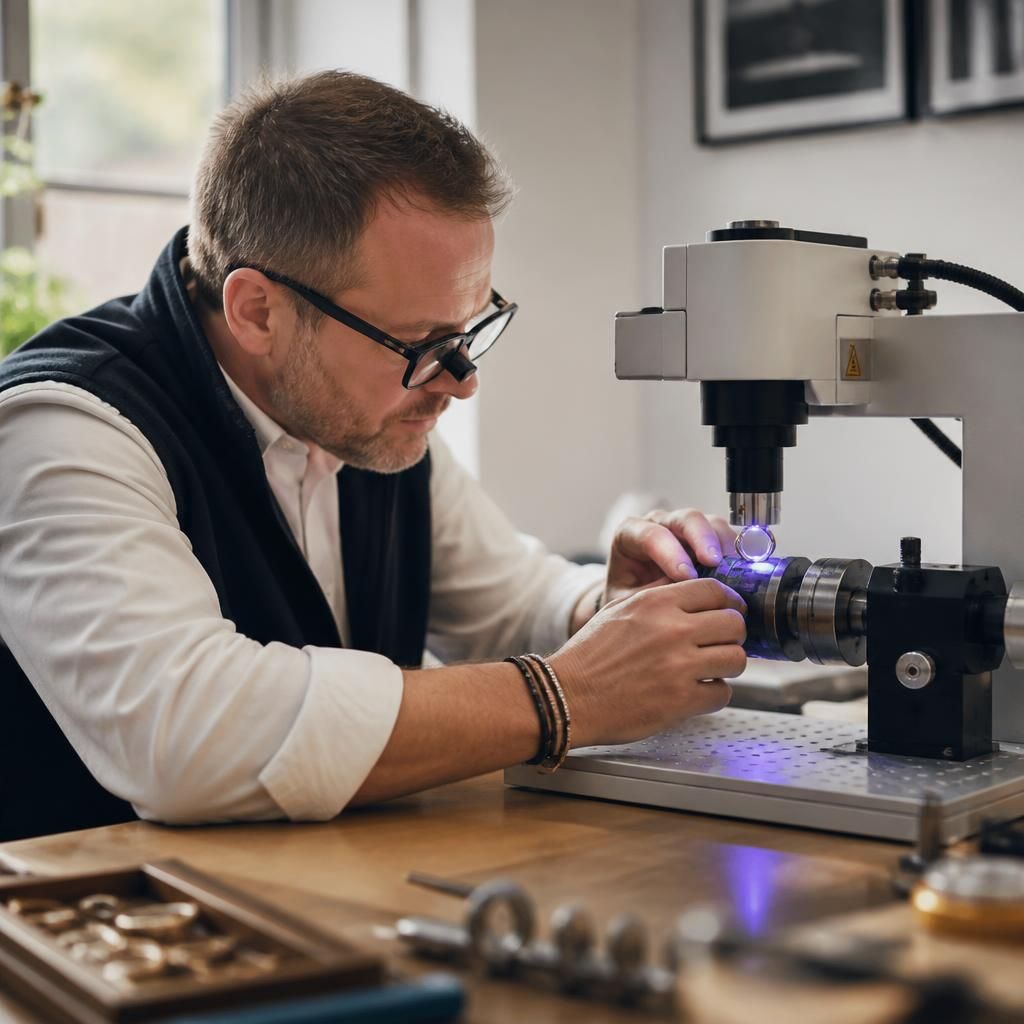
Laser engraving jewellery commonly uses precision fibre lasers for marking precious metals, with UV lasers sometimes selected for delicate materials or particularly fine, high-contrast detail. Computer-aided design software and specialist positioning or rotary equipment guide the beam, allowing accurate engraving on flat, curved and irregular surfaces.
Laser engraving jewellery primarily uses computer-controlled fibre laser technology to create precise marks in precious metals. Depending on the material, finish and level of detail required, a jeweller may also use ultraviolet (UV), green or other specialist laser systems. Design software, optical positioning equipment and rotary attachments work alongside the laser to engrave lettering, symbols and artwork accurately on flat, curved or irregular surfaces.
Fibre lasers are the main technology used for engraving gold, platinum, silver and many other jewellery metals. The laser produces a highly concentrated beam that can remove a controlled amount of material, creating a recessed engraving, or alter the surface finish to produce a contrasting mark. Its precision makes it suitable for small inscriptions, fingerprints, dates, handwriting, coordinates, logos and detailed line artwork.
A fibre laser can be adjusted for different results. Lower-energy settings may create a surface mark or annealed finish, where the colour or reflectivity of the metal changes without removing significant material. Higher-energy settings can cut into the surface to produce a more tactile, deeper engraving. The jeweller controls factors such as power, speed, pulse frequency, focus and the number of passes. These settings must be selected for the specific alloy and finish rather than applying one standard programme to every piece.
UV lasers use a shorter wavelength and can deliver particularly fine, controlled marking with a relatively small heat-affected area. They may be considered for delicate components, thin coatings, heat-sensitive materials or designs where very fine contrast is important. UV technology is not automatically the best choice for every item; the appropriate system depends on the material, its surface treatment and whether the requested result is a shallow mark, a colour contrast or a deeper cut.
Green lasers can be useful for certain reflective metals and specialist applications. Gold, silver and other polished surfaces can reflect some laser wavelengths more readily than others, so a different wavelength may give better control in particular circumstances. The choice is made according to the item being engraved, its alloy, surface finish and the required appearance.
CO2 lasers are more commonly associated with non-metal materials such as wood, acrylic, leather and some plastics. They are therefore less suitable for directly engraving most precious metals, although they can have a role in related workshop processes or in engraving suitable non-metal components. Jewellery should always be assessed before selecting a laser source, particularly when it includes resin, enamel, lacquer, rubber or another material alongside metal.
Laser engraving also relies on supporting technologies that guide and control the beam:
Some machines can produce a three-dimensional engraving by varying the laser parameters and removing material in controlled layers. This is useful for deeper lettering, textured patterns and relief-style designs. Other settings create a frosted, polished, darkened or contrasting appearance without producing a strongly recessed cut. The visible result depends on the metal’s composition, existing polish, lighting and whether the engraving is intended to remain natural or receive a separate infill.
Before engraving, the jewellery is inspected, cleaned and secured in a fixture. The design is checked for scale, orientation and placement, then the operator establishes the correct focus and runs the selected programme. On a valuable or complex piece, a test mark may be made on a sample of the same or a closely matching material. After engraving, the item is cleaned and inspected under magnification. Any required polishing must be carried out carefully, as excessive polishing can soften fine detail or reduce the depth of the engraving.
The technology cannot compensate for unsuitable placement or an unsuitable design. Very narrow rings, highly domed surfaces, articulated links and areas close to gemstones may restrict the available engraving space. Heat-sensitive stones, treated materials, plating and coatings require particular care, and some items may be better engraved by hand or left unengraved. Existing hallmarks, manufacturer marks and structural features must also be preserved.
For a bespoke piece, the most suitable technology is selected after considering the metal, dimensions, curvature, surface finish, design detail and desired depth. A professional assessment is especially important for an heirloom, a set stone, a watch case or jewellery with plating and mixed materials. The result should be agreed in advance, including the position, scale, style and whether the finish should be subtle or strongly contrasting.
Laser engraving jewellery most commonly uses a computer-controlled fibre laser, which creates precise marks on metals such as gold, platinum and silver. The beam can either remove a controlled layer of metal for a recessed engraving or alter the surface finish to create a contrasting mark.
The laser works with design software, focusing equipment and, for rings or bangles, a rotary attachment that turns the jewellery as the engraving is applied. This allows lettering, handwriting, symbols and fine artwork to follow a curved surface accurately. UV or green laser systems may be selected where the material, coating or required level of detail calls for a different wavelength. The most suitable technology depends on the jewellery’s metal, finish, shape and the depth and appearance required.
- Computer-aided design software converts text, drawings, handwriting and digital artwork into paths the laser can follow. It allows the operator to scale, position and preview the design before engraving.
- Galvanometer scanning mirrors move the beam rapidly across the engraving area. Their accuracy helps produce clean edges and consistent lettering, particularly on small pieces.
- Rotary attachments turn rings, bangles and other cylindrical items while the laser marks the surface. This helps maintain the correct alignment and spacing around a curved circumference.
- Camera or vision systems can assist with positioning the design in relation to hallmarks, settings, existing engraving or a specific feature of the jewellery.
- Height sensing and focusing systems help place the laser’s focal point at the correct distance from the surface. Accurate focus is important for fine detail and an even finish.
- Extraction and filtration equipment removes fumes and particles produced during the process, helping protect the operator and prevent contamination of the workshop.
Discuss the right laser engraving technology for your jewellery
If you are considering laser engraving for a ring, watch or another jewellery item, discuss the metal, shape, finish and desired depth with us before proceeding. We can assess the piece and recommend the most suitable engraving technology and finish for your design.
Speak to your personal jeweller
Every commission begins with a conversation. Arrange an appointment in the Birmingham Jewellery Quarter or talk it through by phone.