
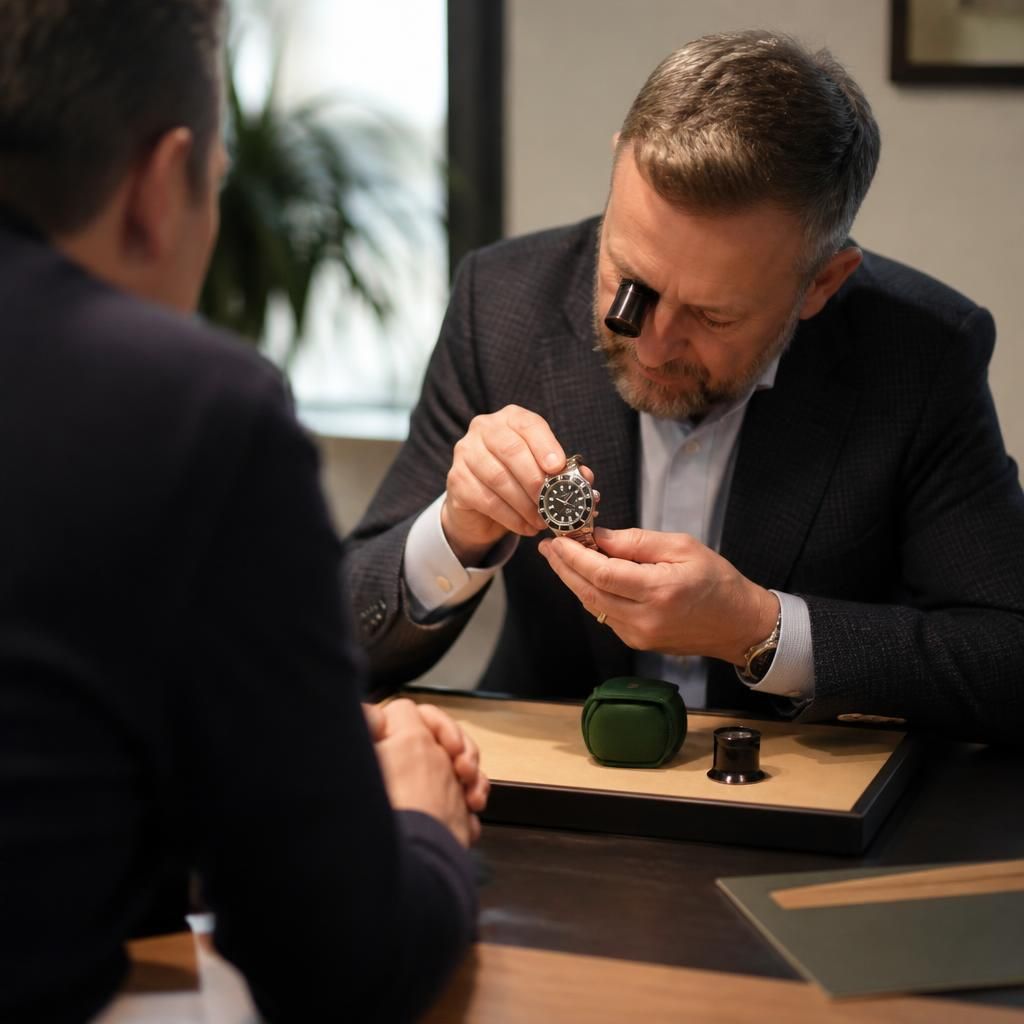
Are your used Rolex watches authentic?
Yes, our used Rolex watches are authenticated before sale through detailed examination of the movement, case, dial, bracelet, markings and serial information. We also assess provenance and service history where available, so you can buy with a clear understanding of the watch’s authenticity and condition.
Yes. Our used Rolex watches are authenticated before sale through a detailed examination of the movement, case, dial, hands, bracelet, clasp, markings and serial information. We also review provenance and service history where available. Authentication is carried out alongside a condition assessment, so you can understand not only whether a watch is genuine, but also which components may have been replaced or refinished during its lifetime.
A pre-owned Rolex should not be authenticated by appearance alone. Counterfeit watches can replicate the general shape of a Submariner or Sea-Dweller convincingly, while more sophisticated examples may contain modified or mixed components. A proper assessment considers the watch as a complete assembly and compares its features with the specifications applicable to the particular reference and production period.
What is checked during authentication?
Do papers and a box prove that a Rolex is genuine?
No. Original packaging, a guarantee card, service documents and receipts can support provenance, but they are not conclusive proof of authenticity because documents and accessories can be separated from a watch or falsified. Conversely, a genuine older Rolex may no longer have its original box or papers. The watch itself must be examined, and the documentation should be consistent with its reference, serial information and known history.
Can a genuine Rolex contain replacement parts?
Yes. Rolex watches are designed to be serviced, and components such as crystals, crowns, bezels, hands, dials and bracelet parts may have been replaced during their service life. Replacement with a genuine part does not make the watch inauthentic, but it can affect its originality and collectability. We distinguish between a counterfeit watch, a genuine watch with authentic replacement parts and a watch containing non-genuine or incorrect components.
This distinction is particularly relevant when assessing vintage or discontinued Submariner and Sea-Dweller models. A watch can be genuine yet have been polished, fitted with a service dial or equipped with a later bracelet. Those details should be explained clearly rather than treated as evidence of a counterfeit watch without further examination.
Why is specialist examination important?
Authentication requires more than checking a serial number or looking for a logo. It involves knowledge of changing Rolex specifications, movement architecture, case construction, dial variations and the service parts used across different periods. The watch may need to be opened using the correct equipment so that the movement, internal markings and case condition can be inspected without causing damage.
Function tests are also useful, although they do not prove authenticity on their own. Winding, setting, date operation, bezel movement, timekeeping and power reserve can reveal mechanical problems or incorrect components. For a diving model, water resistance should be tested with suitable equipment rather than assumed from the model name or the condition of the seals. A watch can be genuine and still require servicing or fail a pressure test.
What should you receive when buying a used Rolex?
When buying privately, be cautious of a price that is inconsistent with the model, pressure to complete the transaction quickly, unclear photographs, missing identifying details or claims that papers alone establish authenticity. A seller who will not allow an independent examination or provide sensible provenance presents a higher risk. Photographs can be useful for an initial opinion, but they cannot replace an in-person inspection of the movement and components.
Our authentication process is intended to give you a reliable assessment before purchase, while our condition report helps you make an informed decision about servicing, originality and long-term ownership. If you would like us to assess a Rolex you already own, or you are considering a particular used Submariner or Sea-Dweller, we can discuss the watch’s reference, documentation, service history and inspection requirements before proceeding.
Original papers and a box support a Rolex’s provenance, but they do not prove authenticity on their own. Documents can be separated from a watch, incorrectly matched or falsified, while a genuine pre-owned Rolex may no longer have its original accessories. The watch itself must be examined against its reference, production period and available service history.
During authentication, particular attention is given to the movement, case, dial, hands, bezel, bracelet, clasp and serial information. These components are assessed together because a genuine Rolex may contain legitimate replacement parts following servicing, but incorrect or non-genuine components can affect originality, condition and value. Where appropriate, the movement and internal markings should be inspected directly rather than relying on photographs or the presence of paperwork.
- The movement: The calibre, construction, finishing, engravings and component layout are examined. The movement is one of the most important authentication points because a genuine Rolex movement has specific technical characteristics that cannot be confirmed from photographs alone.
- The case: Case shape, proportions, crown guards, lugs, bezel construction and finishing are checked against the relevant model. Excessive polishing can alter the original lines, so this inspection also helps identify whether the case has been heavily refinished.
- The dial and hands: Printing, fonts, luminous material, markers, coronet details and alignment are assessed. The dial must be appropriate for the reference and period. A genuine watch may have a replacement dial or hands fitted during servicing, so originality and authenticity are related but not always identical.
- The bezel and crystal: On a Submariner or Sea-Dweller, the graduated bezel, insert, pearl and crystal are checked for correct design, fit and operation. These parts can be replaced over time, particularly during servicing, and their presence is recorded as part of the condition assessment.
- The bracelet and clasp: End links, links, clasp markings, coronet details and construction are examined. A bracelet may be genuine but not the one originally supplied with the watch, which can affect originality and value without necessarily making the watch counterfeit.
- Serial and reference information: Case and movement identifiers are checked for consistency with the watch, its model and any available documentation. Markings that appear poorly formed, incorrectly positioned or inconsistent with the period require further investigation.
- A clear description of the model, reference and overall condition.
- An explanation of whether the watch has been serviced, polished or fitted with replacement components where this is known.
- Details of the box, papers, service records and other accessories included with the sale.
- Confirmation that the serial and reference information have been checked against the watch.
- Appropriate sales documentation and any applicable guarantee or aftercare information.
Discuss Your Used Rolex Authentication
If you are considering a used Rolex Submariner or Sea-Dweller, discuss its reference, documentation and service history with us before purchase. We can explain the authentication and condition checks required, or assess a Rolex you already own.
Speak to your personal jeweller
Every commission begins with a conversation. Arrange an appointment in the Birmingham Jewellery Quarter or talk it through by phone.