
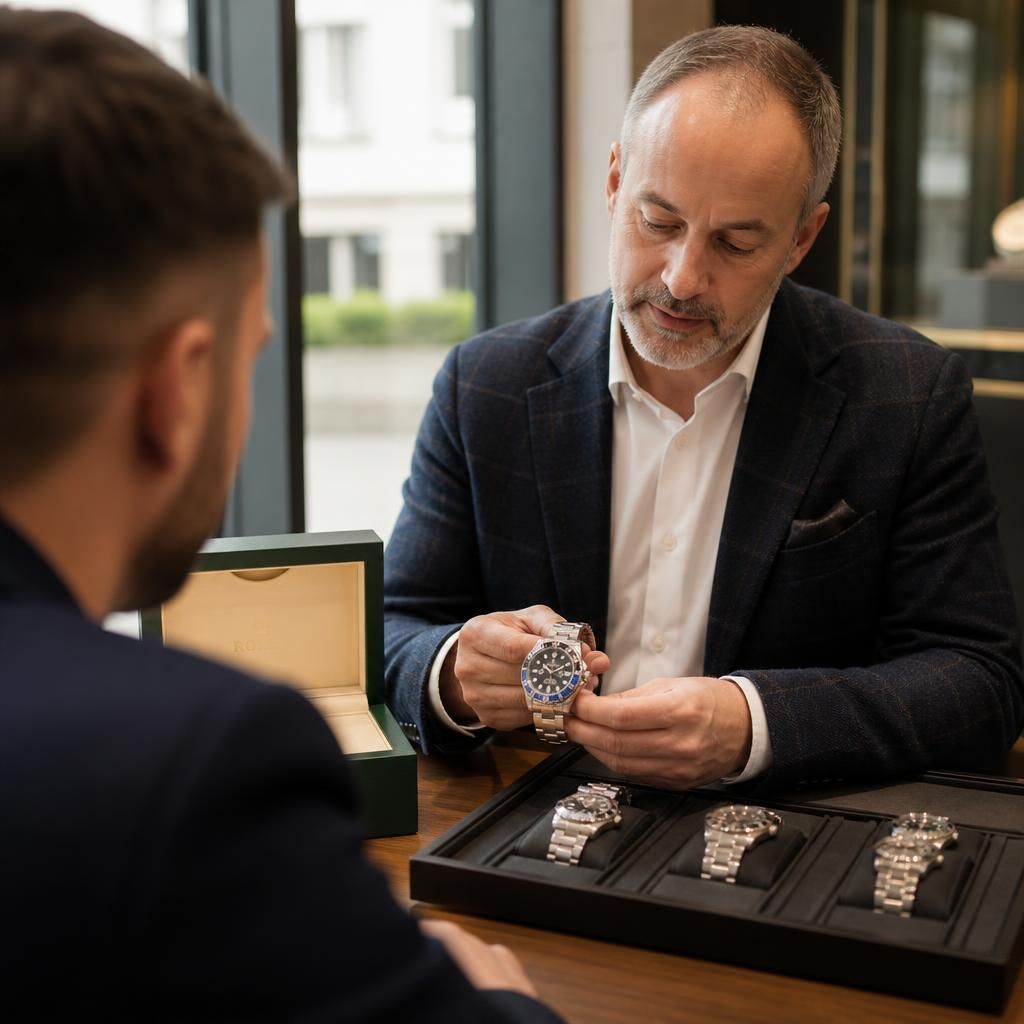
Why should I choose a pre-owned Rolex GMT Master II over a new model?
A pre-owned Rolex GMT-Master II can offer better value, distinctive character and access to discontinued or harder-to-find references than a current new model. Provided its authenticity, condition, service history and provenance are properly checked, it is a practical choice for buyers seeking a proven luxury watch with established market appeal.
A pre-owned Rolex GMT-Master II can be the better choice when you value access, model selection and established character over having the latest watch directly from new. A carefully sourced example may offer a more attractive price than an equivalent unworn model, while also giving you access to discontinued references, older bezel combinations and configurations that are no longer available through current production. The decision depends on the specific reference, condition, provenance, service history and price—not simply whether the watch is new or used.
Potentially better value
A new Rolex GMT-Master II is often difficult to obtain at its official retail price, particularly in sought-after configurations. The price of a pre-owned watch reflects its reference, materials, dial and bezel combination, completeness, condition and demand in the secondary market. In some cases, a pre-owned example may provide better value than an unworn watch being offered at a substantial premium. However, values vary considerably, and a pre-owned Rolex is not automatically the cheaper option. Compare like for like, including the bracelet, box, papers, warranty position and service requirements.
Pre-owned ownership can also reduce the immediate depreciation associated with buying certain luxury watches. This is not a guarantee of future performance: Rolex values can change with market conditions, availability, model updates and buyer preferences. A watch should be selected primarily for its suitability and condition rather than as a guaranteed investment.
Access to discontinued and less common references
Buying new limits you to current production, whereas the pre-owned market includes references that have been discontinued or replaced. This can be important if you prefer:
The GMT-Master II has evolved over time, so small changes can matter to an informed buyer. Details such as the case proportions, bezel construction, bracelet, clasp, dial markings and movement generation can distinguish one reference from another. A reputable specialist can explain these differences and help establish whether a particular variation is correct for its reference.
Distinctive character and ownership history
A pre-owned GMT-Master II may show the natural signs of previous ownership, such as light marks or evidence of careful wear. Some buyers prefer this established character to the completely untouched appearance of a new watch. Others will want a near-mint or unworn example. Neither preference is objectively right, but the condition should be described accurately and assessed in person or through clear, detailed images.
Previous ownership can also provide useful information. A documented service history, original purchase records and a consistent ownership trail may help demonstrate how the watch has been maintained. These details do not replace professional authentication, but they contribute to a more complete picture of the watch’s background.
More choice in condition and budget
With a pre-owned GMT-Master II, you can choose between different condition grades and price points. For example, a lightly worn watch with complete accessories may suit someone who wants a well-preserved, collectable example, while a watch with visible wear may be appropriate for an owner who intends to use it regularly. The important point is to understand what you are buying.
Inspect the case, bezel, crystal, dial, hands, bracelet and clasp for damage, excessive polishing, stretching or replacement parts. A polished case is not necessarily a problem, but excessive polishing can soften the original lines and affect collectability. Any non-original component, refinishing or modification should be disclosed and reflected in the valuation.
What a new model offers instead
A new GMT-Master II provides the assurance of current production, untouched condition and the latest specification. It will normally be supplied with its original packaging and documentation, and an applicable manufacturer warranty. You also avoid uncertainty about how the watch has been worn or stored. For some buyers, that simplicity is worth paying for.
New availability can nevertheless be limited, and the current range may not include the exact reference or aesthetic you want. Buying new can also mean accepting a higher price or waiting for an opportunity to arise. A pre-owned watch can provide a broader and more immediate choice, provided the seller’s checks are thorough.
The importance of authenticity and provenance
The main disadvantage of buying pre-owned is that condition, authenticity and history require closer examination. Before committing, confirm that:
Box and papers are useful, but they are not conclusive proof of authenticity because documentation can be separated from a watch or falsified. The watch itself should be examined by an experienced professional, with movement and serial checks carried out where appropriate. A clear written description and a meaningful warranty or returns policy provide additional protection.
Service and ownership costs
A pre-owned Rolex GMT-Master II may require servicing sooner than a new watch, depending on its age, use and previous maintenance. Ask when it was last serviced, what work was completed and whether water-resistance testing was carried out. If there is no reliable service history, allow for the possibility of an inspection or service after purchase. Other costs can include bracelet adjustment, replacement links, repairs, insurance and valuation documentation.
These costs should be considered alongside the purchase price. A well-maintained pre-owned watch with complete records may be a stronger proposition than a cheaper example requiring immediate attention. Professional aftercare, including servicing, repairs, bracelet work and valuation, can help preserve the watch’s condition and provide a clear ownership record.
Which option is right for you?
The strongest pre-owned purchase is not simply the oldest or lowest-priced watch. It is the correct reference, honestly described, properly authenticated and priced in line with its condition and completeness. Reviewing those points with an experienced jeweller makes it easier to compare a pre-owned Rolex GMT-Master II fairly with a new model and choose the watch that best meets your requirements.
A pre-owned Rolex GMT-Master II gives you access to references and configurations that are no longer available as new. This may include discontinued bezel colours, older bracelet details, different case designs or previous movement generations, allowing you to choose a specification based on its features rather than limiting your search to the current collection.
Compare each watch by reference, condition, originality and completeness. Check that the dial, hands, bezel, bracelet and movement are appropriate for that reference, and ask whether any components have been replaced or the case polished. A professionally inspected example with clear provenance can offer greater choice and established character, while still providing the reassurance of an accurate description and suitable aftercare.
- a particular bezel colour or material combination;
- an older dial, case or bracelet detail;
- a reference with a specific movement or generation of design;
- a model that is no longer supplied to retailers; or
- a configuration that is difficult to find as new.
- the reference and serial details are consistent with the watch and its documentation;
- the movement, dial, hands, bezel and bracelet are appropriate for that reference;
- the watch has not been altered with unsuitable or undisclosed parts;
- the seller has inspected the watch and can explain its provenance;
- any stated service history is supported by appropriate records; and
- the price accounts for missing accessories, wear, servicing or necessary repairs.
- Choose new if you want the current reference, untouched condition, manufacturer warranty and the clearest purchase history.
- Choose pre-owned if you want a discontinued model, a wider choice of configurations, established character or potentially better value.
- Choose a professionally inspected pre-owned example if you want the benefits of the secondary market without taking unnecessary risks over authenticity or condition.
Explore pre-owned Rolex GMT-Master II options
Explore our pre-owned Rolex GMT-Master II options to compare references, condition, provenance and completeness. Contact Steven Charles Quance for expert guidance on selecting a professionally checked model suited to your requirements.
Speak to your personal jeweller
Every commission begins with a conversation. Arrange an appointment in the Birmingham Jewellery Quarter or talk it through by phone.