
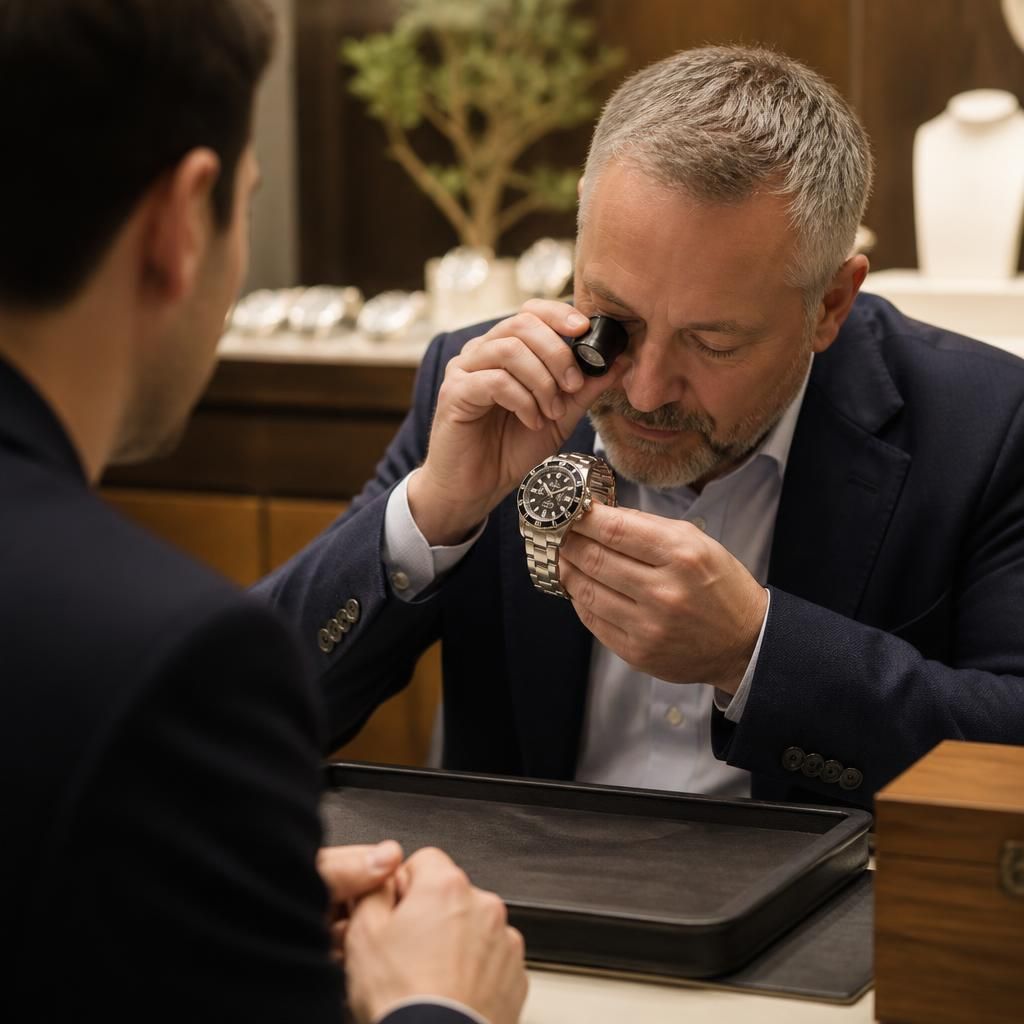
What should I look for when assessing the condition of a pre-owned Rolex GMT Master II?
When assessing a pre-owned Rolex GMT-Master II, examine the case, bezel, crystal, dial, hands, bracelet and clasp for wear, damage or incorrect replacement parts, then check that the movement operates correctly and the watch keeps reliable time. A documented service history, matching reference and serial details, original components where appropriate, and evidence of professional inspection are also important when judging its condition and value.
Assessing a pre-owned Rolex GMT-Master II involves examining its external condition, operation, originality, service history and supporting documentation as a complete package. Look closely at the case, bezel, crystal, dial, hands, bracelet and clasp, then confirm that the movement, GMT function and timekeeping perform correctly. A watch with honest, documented wear can be a sound purchase, while extensive polishing, damaged components, moisture ingress or unrecorded replacement parts may affect both value and reliability.
Start with the case and lugs
Inspect the case under good, even lighting. Light surface marks are normal on a pre-owned watch, but deeper scratches, dents, corrosion or evidence of impact deserve closer attention. Pay particular attention to the lugs, crown guards, case edges and the area around the case back. These parts should retain the correct shape and definition for the watch’s reference.
Over-polishing can be more significant than ordinary scratches. Excessive polishing may soften the transitions between brushed and polished surfaces, round the lug tips or reduce the sharpness of the case profile. A professionally refinished watch is not automatically a poor example, but the amount and quality of any refinishing should be reflected in the assessment. An untouched case is not always preferable if it has suffered substantial damage, so the important point is whether the current finish is appropriate and well executed.
Examine the bezel and 24-hour insert
The GMT-Master II’s bezel is a key functional and visual component. Check that it rotates smoothly in both directions, remains secure and aligns correctly when set. It should not feel excessively loose, gritty or uneven. On models with a ceramic Cerachrom insert, look for chips, cracks, scratches and damage around the numerals or edges. Ceramic is highly resistant to everyday scratching but can chip if struck.
Older models may have metal or aluminium inserts, which can show fading, marks or colour changes. These may be consistent with age and can contribute to a watch’s character, but an insert that has been replaced should be identified clearly. Confirm that the insert is correct for the reference and period, particularly where originality affects collectability.
Check the crystal, cyclops lens and dial
The sapphire crystal should be free from cracks, chips and deep scratches. Small marks can be difficult to see at first, so inspect it from different angles. Check the magnifying cyclops lens over the date window for scratches, clouding or damage, and make sure the date appears clearly centred beneath it.
Examine the dial for moisture marks, discolouration, dust beneath the crystal, lifting or damaged hour markers and uneven lume. The hands should match the dial in style, finish and luminous appearance where appropriate. On an older watch, naturally aged lume may be entirely consistent with its history; mismatched hands or markers can instead suggest later replacement. Any dial restoration, service dial or non-original hand set should be disclosed because it can affect originality and value.
On newer examples, inspect the rehaut and dial details for consistency with the reference, but do not treat one visual feature as conclusive proof of authenticity or condition. A proper examination considers the whole watch, its movement and its paperwork.
Assess the bracelet and clasp
Bracelet condition has a noticeable effect on comfort, security and value. Check the links for excessive stretch by gently holding the bracelet and observing how much it sags. Some movement is normal, particularly on an older example, but pronounced looseness may indicate worn link pins, tubes or other components.
Inspect the links for deep scratches, dents, sharp edges and signs of poor refinishing. Make sure the bracelet reference and end links are correct for the watch, and check that the clasp closes positively and remains secure. The clasp should not feel loose when closed, and the adjustment system should operate without forcing it. Missing links, aftermarket links or a mismatched bracelet should be recorded, as replacing original Rolex components can be costly and may not restore the watch fully to its original configuration.
Test the crown, winding and functions
The winding crown should screw down smoothly and sit correctly against the case. It should not feel gritty, cross-threaded or unusually loose. With the crown unscrewed, winding should feel even rather than rough or intermittent. Avoid forcing any control that does not operate normally.
Set the hour hand through its independent adjustment range and check that the date changes correctly. On a GMT-Master II, the additional 24-hour hand should move as expected and remain aligned with the bezel when the watch is set. Check the date-change behaviour, hand alignment and smoothness of the crown positions. The exact operation varies between generations, so a watchmaker should assess any uncertainty rather than relying solely on a brief demonstration.
Consider timekeeping and movement condition
A watch can look excellent while requiring mechanical attention. Observe whether it starts readily, winds consistently and keeps reliable time over a suitable period. An occasional check is useful, but a professional timing test is more informative because it can assess rate, amplitude, beat error and positional variation. These results help indicate the movement’s general health, although they do not replace a full service inspection.
Ask whether the movement has been inspected for magnetism, worn components, dried lubricants, damage or moisture ingress. If the case back has been opened, it should have been handled by a suitably qualified professional using appropriate tools and procedures. Water resistance should never be assumed from appearance or age; it should be tested, particularly if the watch is intended for regular wear or exposure to water.
Review service history and replaced parts
A dated service receipt or detailed service record is more useful than a general statement that the watch has been “serviced”. Look for information about the work carried out, components replaced, water-resistance testing and the person or workshop responsible. A recent service is not automatically better if its scope is unclear, and an older watch without recent service may simply need an allowance for inspection and maintenance.
Ask specifically whether the crystal, bezel insert, dial, hands, bracelet, clasp or movement components have been replaced. Replacement parts may improve reliability or appearance, but the distinction between original, period-correct and later service components should be understood before assessing the watch’s value. Aftermarket parts require particular caution because they can affect originality, future servicing and resale.
Compare the watch with its reference and documents
The reference number, serial details and configuration should be consistent with the case, dial, bezel, bracelet and movement. Documentation should support the watch rather than substitute for an examination. Check the purchase or service history, warranty information where applicable, and any valuation or previous condition report. Missing papers do not by themselves prove that a watch is defective, but they may make provenance and originality harder to establish.
Any discrepancy between the watch and its documents should be explained before purchase. This includes a different bracelet, missing links, a replacement bezel, a later service dial or a serial detail that is difficult to read. A professional inspection is advisable where the watch is valuable, unusually old, heavily polished or presented with incomplete history.
Separate cosmetic wear from serious faults
Hairline scratches, light clasp marks and modest bracelet wear are expected on many pre-owned watches and can be dealt with during normal servicing or refinishing. Cracks in the crystal, corrosion, water damage, loose bezel components, severe bracelet stretch, poor crown engagement and inconsistent movement performance are more material concerns. They may indicate a need for immediate work or a history of inadequate care.
Do not judge condition solely by photographs. Images can conceal case-edge wear, dial damage, bracelet stretch and moisture marks, while strong lighting can make a watch appear better than it is. When viewing the watch in person, ask for close inspection of every surface and for the functions to be demonstrated. If buying remotely, request clear photographs, a written condition report, details of the return terms and confirmation of any inspection or warranty provided.
Use a qualified inspection before committing
The most reliable assessment combines a careful visual examination with movement and water-resistance testing by a competent watch professional. The inspection should record the cosmetic condition, originality of visible components, bracelet and clasp security, winding and setting functions, GMT operation, timekeeping and any recommended work. This gives you a practical basis for comparing examples and budgeting for ownership.
For a pre-owned GMT-Master II, the best condition is not necessarily the example with no visible marks. It is the watch whose wear, originality, mechanical performance, service history and price are clearly understood. Ask us to explain any condition points in plain terms, including whether a mark is cosmetic, whether a component is original or replaced, and whether servicing is advisable before regular use.
Over-polishing is an important condition point when assessing a pre-owned Rolex GMT-Master II. Light marks can often be addressed during professional refinishing, but excessive polishing may round the lugs, soften the case edges and reduce the distinction between brushed and polished surfaces.
Examine the case profile from several angles and compare its shape with the correct reference. A professionally refinished watch is not automatically unsuitable, but the quality and extent of the work should be disclosed and reflected in the assessment. A qualified inspection can distinguish normal wear from removed metal, previous damage or an inappropriate case finish.
Arrange a professional Rolex GMT-Master II condition assessment
Arrange a professional Rolex GMT-Master II condition assessment with us before committing to a purchase or regular wear. We can review the watch’s originality, cosmetic condition, functions, timekeeping and service requirements, then explain our findings clearly.
Speak to your personal jeweller
Every commission begins with a conversation. Arrange an appointment in the Birmingham Jewellery Quarter or talk it through by phone.