
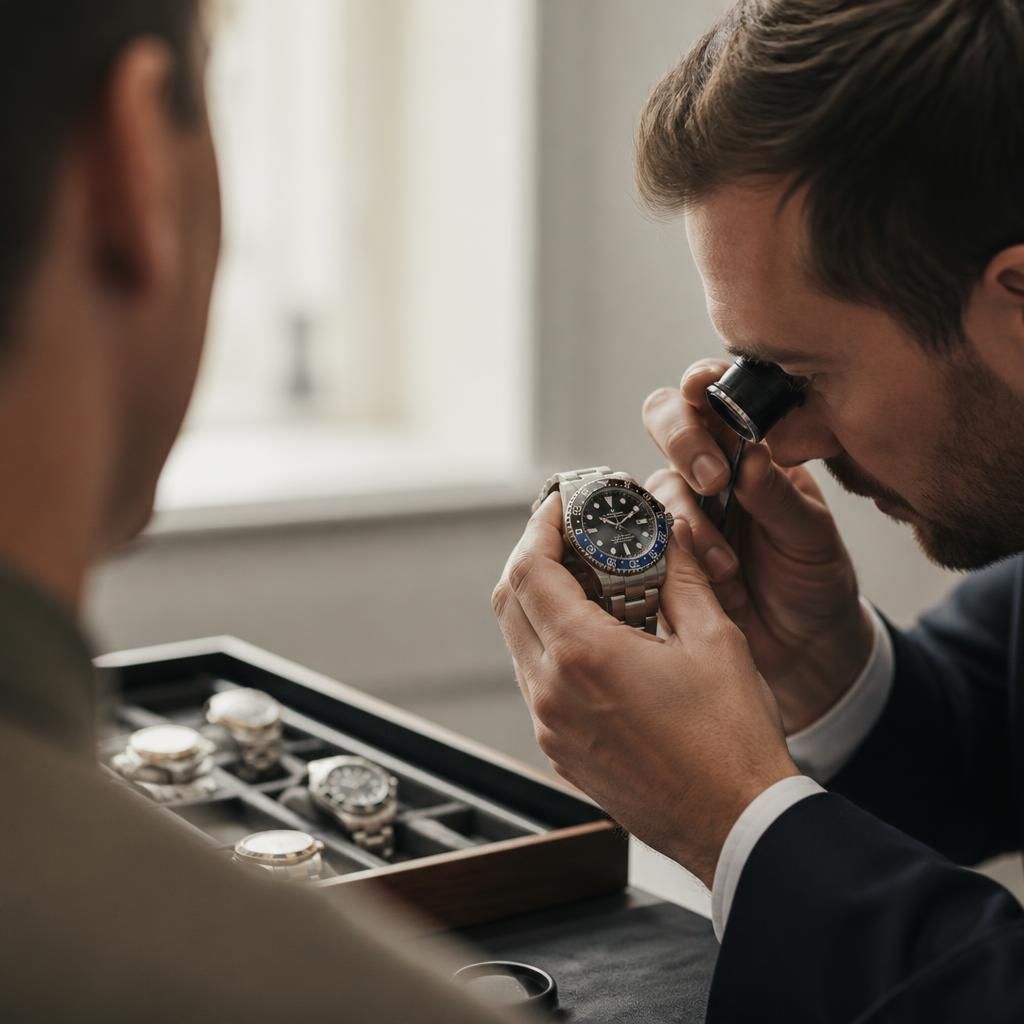
What should I look for in the condition of a used Rolex GMT Master II?
When assessing a used Rolex GMT Master II, examine the case, crystal, dial, hands, bezel, bracelet and clasp for excessive wear, damage or signs of poor polishing, then confirm that the movement operates correctly and the watch has credible service history. Original paperwork, matching serial details and an inspection by a qualified watch specialist can help establish condition, authenticity and whether any immediate maintenance is required.
The condition of a used Rolex GMT Master II should be assessed across the movement, case, crystal, dial, bezel, bracelet, clasp and accompanying service history. Light, honest wear is expected on a pre-owned watch, but deep scratches, over-polishing, corrosion, damaged components, excessive bracelet stretch or poor timekeeping may indicate costly remedial work or a history of inadequate care.
Start with the overall condition and originality. Compare the watch with the correct specification for its reference and production period. The dial, hands, bezel insert, crown, bracelet and clasp should be consistent with one another. Replacement parts are not automatically a problem, particularly where Rolex has fitted them during servicing, but the seller should explain what has been changed and whether original components are available. A watch assembled from mismatched or poorly fitted parts requires careful investigation.
Inspect the case for wear and polishing. Look at the lugs, crown guards, case sides and edges under good lighting. A well-preserved case normally retains clear transitions between its polished and brushed surfaces. Rounded lugs, softened edges, uneven chamfers, deep scratches or a case that appears unusually thin can indicate excessive polishing. Polishing is sometimes carried out during servicing, but removing too much metal can permanently alter the watch’s shape and reduce its originality. Freshly refinished surfaces should also be checked for consistent grain and symmetry.
Check the case back and the area around the serial and reference markings for damage or excessive abrasion. The markings should be legible and consistent with the accompanying paperwork where paperwork is supplied. Any evidence that numbers have been altered, removed or poorly engraved is a serious warning sign. Do not rely on a serial number alone as proof of authenticity; it must be considered alongside the watch’s construction, movement, documents and provenance.
Examine the crystal carefully. The sapphire crystal should be clear and free from chips, cracks and distracting scratches. Inspect the edges, especially where the crystal meets the bezel, because damage can be less obvious when viewed from above. Small marks may be cosmetic, whereas a crack or chipped edge can affect water resistance and should be addressed promptly. Check that the date magnification is correctly aligned and that the date appears sharp and centred when viewed through the crystal.
Assess the dial and hands. The dial should be clean, evenly finished and free from moisture marks, staining, dust beneath the crystal or signs of corrosion. Hour markers and hands should be correctly aligned and appropriate to the model. Luminous material may age naturally, but inconsistent colour between the dial and hands can suggest that components have been replaced. Any condensation beneath the crystal is a clear indication that moisture has entered the case and warrants immediate professional assessment.
Test the bezel and GMT function. The GMT Master II’s bidirectional bezel should turn smoothly and positively, with no excessive looseness, grinding or hesitation. The bezel insert should sit securely and align correctly with the dial. Look for chips, cracks, fading, discolouration or lifting around the insert. Some colour variation may be consistent with age, but it should be described accurately rather than presented as proof of rarity or originality.
Set the local hour hand and check that it moves correctly through its independently adjustable positions. Confirm that the date changes as expected and that the twenty-four-hour hand tracks the selected reference time. The crown should wind smoothly, screw down securely and feel firm without cross-threading or slipping. Avoid forcing any control if it feels abnormal, as resistance can indicate damage or a need for servicing.
Check the movement and timekeeping. A seller should be able to confirm that the movement has been inspected and is operating within an acceptable tolerance for its condition. Warning signs include inconsistent running, stopping, difficulty winding, an unstable seconds hand, unusual noise or a date mechanism that changes reluctantly. A visual inspection through the case back is not possible on most GMT Master II models, so meaningful assessment requires appropriate testing by a qualified watchmaker.
Ask when the movement was last serviced and request an explanation of what that service involved. A complete service is more useful than a vague statement that the watch has been “checked”. Ideally, the records should identify the work completed, parts replaced and tests performed. If there is no reliable service history, allow for the possibility that the watch will need inspection, pressure testing or servicing after purchase, even if it appears cosmetically excellent.
Inspect the bracelet and clasp for structural wear. Check every link for deep scratches, stretched or loose joints, missing screws and uneven gaps. Bracelet stretch can develop gradually through wear and may be more apparent when the bracelet is held between the hands. Excessive sagging, lateral movement or rattling can affect comfort, security and value. Confirm that the bracelet is the correct type for the watch and that any spare links are included if they are available.
The clasp should close firmly and release cleanly, without excessive play. Examine the clasp blades, hinge, coronet and adjustment mechanism for distortion or heavy wear. A bracelet that looks bright after aggressive refinishing may have lost some of its original surface definition. Check that the watch sits securely on the wrist and that the spring bars, end links and crown operate correctly.
Do not confuse cosmetic wear with mechanical or structural damage. Fine hairline marks and small surface scratches are normal on many used watches and may be preferable to extensive refinishing. Deep dents, bent lugs, corrosion, cracked components, water damage and severe bracelet stretch are more significant. The key questions are whether the watch remains structurally sound, whether its important parts are original or properly replaced, and what work is likely to be required to return it to dependable use.
Review the paperwork and provenance alongside the physical inspection. Where supplied, the warranty card, service documents, purchase records, instruction material and presentation items should be consistent with the watch. Matching details are helpful, but a complete box and papers do not compensate for poor condition or establish authenticity by themselves. A watch without its original paperwork can still be genuine and well maintained, provided its identity, history and condition are properly verified.
Ask specifically whether the watch has been polished, serviced, repaired, exposed to water, fitted with replacement parts or used in demanding conditions. The answers should be clear and consistent with what you can see. Be cautious if the seller cannot explain the watch’s history, avoids close-up photographs, describes serious wear as “patina” without qualification, or pressures you to proceed before an inspection.
Have the watch examined before committing to the purchase. A qualified watch specialist can check the movement, amplitude, beat error, rate stability, winding and setting functions, bracelet condition and water resistance using suitable equipment. Pressure testing is particularly important if you intend to wear the watch around water, although a passed test reflects the watch’s condition at the time of testing and does not remove the need for sensible care.
For a higher-value purchase, request a written condition report identifying faults, replaced parts, service requirements and any limitations on the assessment. The report can also help distinguish an acceptable pre-owned example from one whose apparent saving is likely to be consumed by restoration work. At Steven Charles Quance, we can discuss the condition, originality, service history and likely aftercare requirements of a used Rolex GMT Master II so that the decision is based on the watch itself rather than photographs or paperwork alone.
A professional movement inspection is one of the most reliable ways to assess the true condition of a used Rolex GMT Master II. A watch can look excellent externally while requiring servicing because of poor timekeeping, worn winding components or dried lubricant.
Ask for evidence of the last service and clarify whether the movement was tested for rate stability, winding, date change and GMT-hand operation. If the service history is incomplete, arrange an examination by a qualified watchmaker before purchase. This can identify hidden mechanical work and help establish whether the asking price reflects any immediate maintenance required.
Arrange a Professional Condition Assessment
Arrange a professional condition assessment of your used Rolex GMT Master II with Steven Charles Quance. We can review its movement, originality, service history and likely aftercare requirements before you commit to the purchase.
Speak to your personal jeweller
Every commission begins with a conversation. Arrange an appointment in the Birmingham Jewellery Quarter or talk it through by phone.