
What documentation should accompany a pre-owned Rolex GMT Master II?
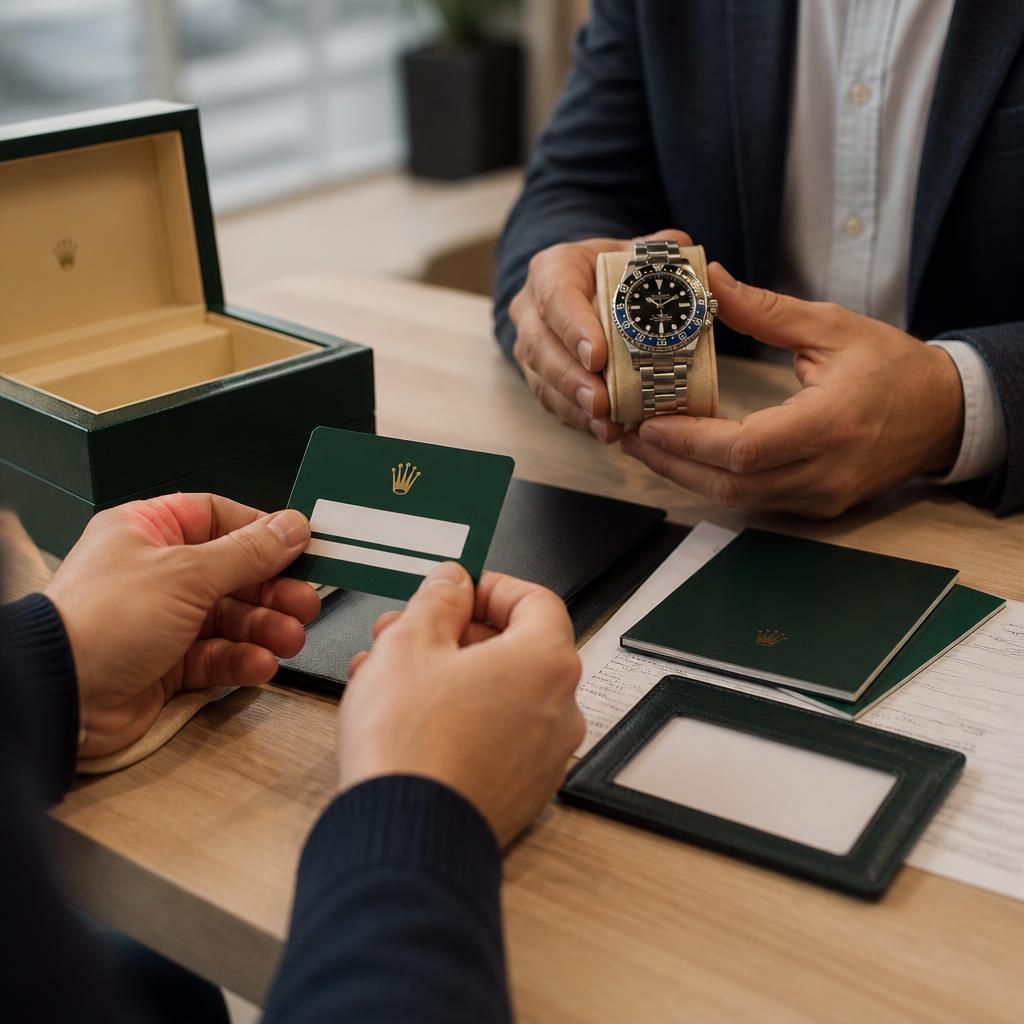
A pre-owned Rolex GMT Master II should ideally be accompanied by its original warranty card, purchase documentation, service records, instruction booklets and presentation box, where available. Check that the card and paperwork correspond with the watch’s reference and serial details; documents support provenance and value, but only a professional inspection can confirm authenticity.
A pre-owned Rolex GMT-Master II should ideally be accompanied by its Rolex warranty card, original purchase or sales documentation, service records, instruction booklets and presentation box, where available. The documents should correspond with the watch’s reference, serial details and configuration. They support the watch’s provenance and value, but paperwork alone cannot prove authenticity; the watch itself should be examined by a suitably qualified professional.
Rolex warranty card
The warranty card is usually the most important document supplied with a modern pre-owned GMT-Master II. Depending on its age, it may show details such as the model or reference, serial number, date of sale and authorised retailer information. Check that the information is consistent with the markings on the watch and with the model being offered.
A card may be undated, separately supplied or absent, particularly with older watches. This does not automatically mean that the watch is inauthentic, but it reduces the available evidence of its original sale and history. A warranty card should not be treated as proof in isolation, as counterfeit or mismatched cards can circulate separately from genuine watches.
Original purchase invoice or sales receipt
An original retailer invoice or receipt can help establish when and where the watch was first purchased. It may include the reference and serial number, although older documents do not always record every identifying detail. For a later private sale, a clear purchase invoice should identify the watch, the seller, the buyer where appropriate, the date of sale and the agreed price.
When personal information is supplied with the watch, sensitive details can be redacted provided that the document still shows enough information to connect it to the timepiece. A sales invoice from the current seller should accurately describe the watch’s condition, included accessories, serial details where appropriate and any stated warranty or return terms.
Service and repair records
Service invoices, estimates and service guarantees provide useful evidence of how the GMT-Master II has been maintained. They may show the date of work, the movement or watch reference, the work completed and any parts replaced. Records can also help explain visible differences, such as a replacement bracelet, bezel insert, crystal or dial.
Look for a coherent history rather than a single document. A service receipt is more useful when it clearly relates to the watch and is supported by a professional assessment. The absence of service records is common with pre-owned watches and does not by itself indicate poor condition, but it should be reflected in the questions you ask and in the price you are prepared to pay.
Instruction booklets and model literature
Original instruction booklets, warranty information and model-specific literature are useful supporting items. They can help confirm how the GMT function, rotating 24-hour bezel and date display should operate, but they are not authentication documents. Generic or replacement booklets should be described accurately rather than presented as original accessories.
Presentation box, swing tags and accessories
The original Rolex presentation box, outer box, swing tags, wallet, calendar card and bezel protector may accompany a complete set. These items can add desirability and help demonstrate how the watch was originally supplied, although boxes and accessories can also be bought separately. Their presence must not replace a physical inspection of the watch.
Check that accessories are appropriate for the watch’s age and reference. A modern box paired with a substantially older watch is not necessarily evidence of a problem, but it may indicate that items have been replaced or assembled from different sources. The description should make clear whether each accessory is original, period-correct, replacement or merely included for presentation.
Evidence of provenance
Where available, additional provenance may include previous insurance schedules, valuation documents, inheritance paperwork, export or import records and correspondence relating to earlier servicing. These documents are particularly useful for a high-value watch or one with a complex ownership history. They should be handled carefully because they may contain personal addresses, policy numbers or other confidential information.
Import and customs documents can be relevant where a watch has been brought into the United Kingdom from another country. They may help establish that the watch entered the country lawfully and that any applicable duties or taxes were addressed. They do not, however, confirm that the watch is genuine or that every component is original.
How to compare the documents with the watch
For older GMT-Master II watches, documentation may be incomplete or entirely absent. Vintage and discontinued examples often have histories that have been assembled over time, and accessories may no longer be with the watch. In these cases, condition, originality, movement inspection, serial and reference details, and the credibility of the seller become especially important.
Do not rely on photographs of documents alone when buying remotely. Ask for clear images that do not expose unnecessary personal information, and confirm that the seller is willing to provide a written description and appropriate purchase documentation. Be cautious if a seller refuses to explain a mismatch, pressures you to pay before checks are completed or claims that a warranty card guarantees authenticity.
The safest approach is to assess the complete package as a collection of supporting evidence. A genuine warranty card with no matching watch details is a concern, while a watch without its box may still be entirely legitimate when its identity, condition and ownership history have been properly checked. Before committing to a purchase, arrange an inspection by an experienced luxury-watch professional who can examine the case, movement, dial, bezel, bracelet and any replacement parts as well as the documents.
The most useful document accompanying a pre-owned Rolex GMT-Master II is usually its warranty card, provided the details match the watch being offered. Check the reference, serial information, date of sale and authorised retailer details where shown, then compare them with the watch and any accompanying invoice or service record.
A warranty card supports provenance, but it does not prove authenticity on its own. Cards can be separated from genuine watches, replaced or mismatched, so the case, movement, dial, bezel and bracelet should also be examined by an experienced luxury-watch professional. If the card is missing, particularly on an older example, ask for other evidence such as purchase documentation, service records and a clear written invoice from the current seller.
- Compare the serial details on the watch with those recorded on the warranty card, invoice or service paperwork. If the watch has a concealed or difficult-to-access serial, do not allow it to be opened by an unqualified person merely to check it.
- Confirm that the reference is consistent with the case, bracelet, bezel, dial, movement and other stated specifications.
- Check that the paperwork describes the actual watch rather than another GMT-Master II with a similar appearance.
- Look for unexplained alterations, inconsistent fonts, unusual printing, missing retailer details or documents that appear newer or older than expected.
- Ask whether the watch has been polished, had parts replaced or undergone non-standard modifications, and whether those changes are reflected in the service history.
- Ensure that the invoice or receipt identifies the seller and sets out what is included, particularly if the watch is supplied without its original box or card.
Ask us to check your Rolex GMT-Master II documents
Bring your pre-owned Rolex GMT-Master II documentation to Steven Charles Quance for an expert review of the warranty card, invoices and service records alongside the watch itself. We can help identify inconsistencies and advise on the next steps before you buy or sell.
Speak to your personal jeweller
Every commission begins with a conversation. Arrange an appointment in the Birmingham Jewellery Quarter or talk it through by phone.