
Is it safe to buy a pre-owned Rolex GMT Master II from online sources?
Yes, buying a pre-owned Rolex GMT Master II online can be safe, provided the seller is established and the watch’s authenticity, ownership history, condition and paperwork are independently checked. Use secure payment and clear returns protection, and seek an expert inspection before completing the purchase if any details are uncertain.
Yes, buying a pre-owned Rolex GMT-Master II online can be safe, but only when the seller, watch, ownership history, payment method and after-sales protections have all been checked. Photographs and a persuasive listing are not enough on their own. A reputable seller should be willing to provide clear evidence of authenticity, explain the watch’s condition accurately and give you meaningful protection if the watch is not as described.
Start by assessing the seller
Before considering the particular watch, establish who you are buying from and how long they have been trading. A professional jeweller or specialist watch dealer should provide a verifiable business address, full contact details, clear terms of sale and a written warranty or returns policy. Check that the business identity shown on the website matches its payment details and any company information available through public records.
Look for evidence of consistent trading rather than relying solely on reviews or social media activity. A trustworthy seller should answer specific questions about the watch without applying pressure to pay immediately. Be cautious if the seller refuses a telephone or video discussion, gives evasive answers about ownership, or claims that checks cannot be carried out because of urgency or confidentiality.
Verify the watch independently
Authentication should involve more than checking whether the dial, bezel and bracelet look correct in photographs. A genuine Rolex GMT-Master II should be assessed as a complete watch, including its case, movement, dial, hands, bezel assembly, bracelet, clasp and reference-specific details. Parts may have been replaced during servicing, and some replacement parts can be genuine while the watch no longer corresponds exactly to its original configuration.
Ask for detailed, high-resolution photographs of the watch from several angles, including the dial, rehaut where applicable, case sides, lugs, clasp, bracelet markings, case back and any visible serial or reference markings. Photographs should be recent and should show the actual watch being offered, not catalogue images. Images can identify obvious inconsistencies, but they cannot replace an examination by a suitably experienced watchmaker or specialist.
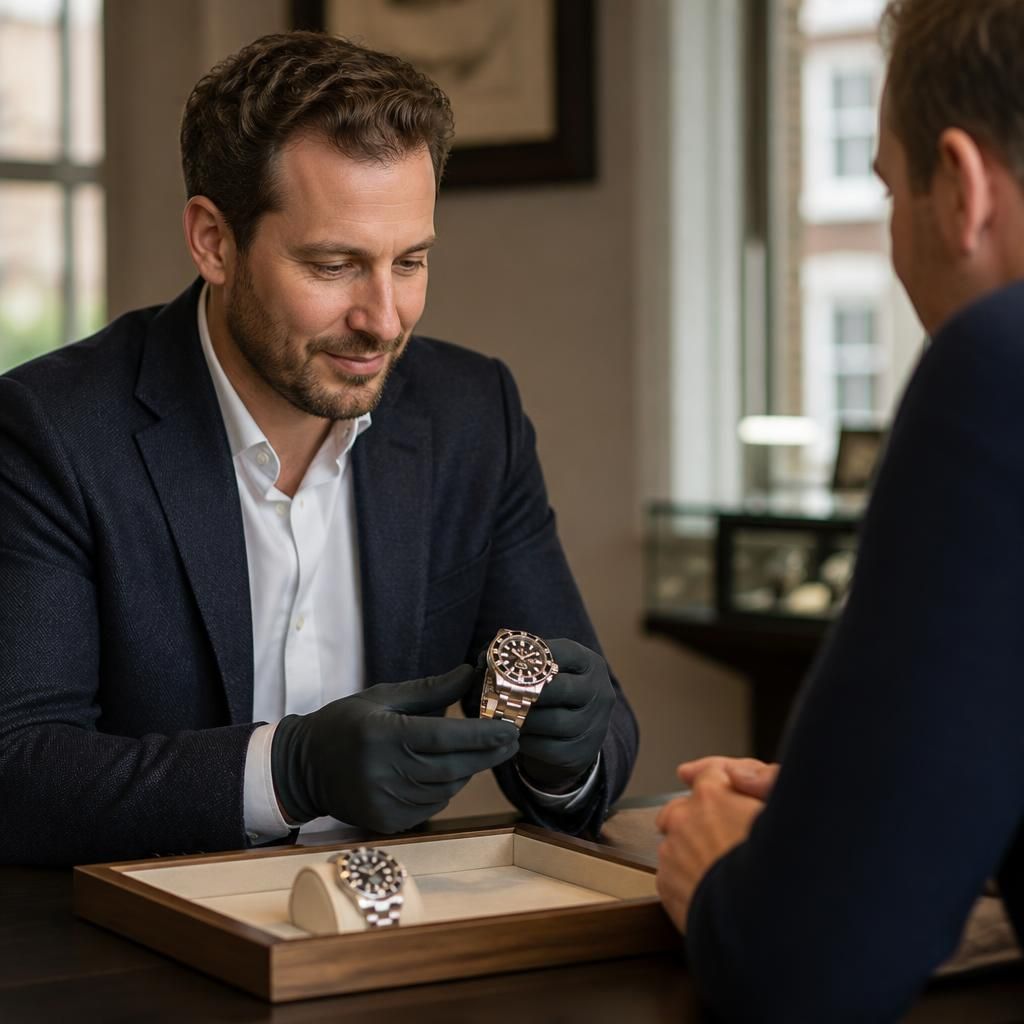
Where the value or circumstances warrant it, arrange an independent inspection before the transaction is finalised. The inspection should confirm that the movement is appropriate for the reference, that the watch has not been assembled from incompatible parts and that its functions operate correctly. A GMT-Master II should be checked for timekeeping, date change, independent hour-hand adjustment, GMT hand operation, bezel function, winding, power reserve and water-resistance condition where relevant.
Check provenance and ownership
Ask what documentation is available to support the watch’s history. This may include an original purchase receipt, warranty card, service documentation, valuation, previous sales records or records from an authorised service centre. Papers are useful, but they are not conclusive proof of authenticity: documents can be separated from a watch or falsified, and a genuine watch may no longer have its original paperwork.
The serial and reference information should be consistent across the watch, documents and seller’s description. You should also ask whether the seller has completed appropriate checks to ensure that the watch is not recorded as lost or stolen. If the seller will not explain how ownership has been established, or if the provenance contains unexplained gaps, treat that as a significant warning sign.
A watch that has been owned by several people is not necessarily problematic. What matters is whether the chain of ownership is credible and whether the seller can transfer good title. If a seller is acting on behalf of someone else, ask who will appear on the invoice and whether the seller has authority to sell the watch.
Read the condition description carefully
Pre-owned watches can vary considerably in condition. Ask the seller to distinguish between light surface wear, deeper scratches, dents, polishing, stretched bracelet links, chipped or marked ceramic, replaced components and signs of moisture. A watch described as being in excellent condition should still be accompanied by a precise explanation of what that description means.
Pay particular attention to the bezel, bracelet and clasp, as these areas often show the most use. Check whether the case retains its intended shape and proportions, whether the lugs have been over-polished and whether the bracelet has excessive play. Ask whether the dial, hands, bezel insert, crystal or bracelet has been replaced, and whether any replacement is an original Rolex component or an aftermarket part.
Service history is also relevant. A recent service may be beneficial, but the phrase “serviced” should be supported by an invoice or a clear description of the work completed. A basic regulation is not the same as a full service. If there is no recent service evidence, allow for the possibility of future maintenance and ask whether the seller has tested the watch before sale.
Confirm what is included
Establish exactly what will arrive with the watch. The package may include a presentation box, outer box, warranty card, instruction material, swing tags, spare links, service paperwork and an authenticity or valuation document. These accessories can affect desirability and value, but they should not distract from the watch itself. A complete set is not automatically safer or more authentic than a watch supplied without its original accessories.
Ask whether the serial details on any card or paperwork have been obscured in online photographs for security reasons, and request confirmation that they will be visible on the documents supplied with the purchase. The invoice should identify the watch clearly, state its condition, list the included accessories and record the agreed price, warranty and returns terms.
Use secure payment and delivery arrangements
Pay through a method that provides appropriate transaction records and protection. The account receiving payment should correspond with the named seller or business. Avoid cash transfers to unrelated individuals, cryptocurrency payments, unusual payment requests or pressure to complete the transaction outside the seller’s normal checkout process.
For a high-value watch, delivery should be fully insured, tracked and subject to an appropriate signature. Confirm who carries the risk while the watch is in transit and inspect the parcel promptly on arrival. Keep the packaging until you have checked the watch and are satisfied that it matches the description. If the parcel appears damaged or has been tampered with, document this before opening it and contact the delivery company and seller immediately.
Understand returns, warranty and online purchasing rights
Read the seller’s returns policy before paying, including the period for notifying the seller, the condition in which the watch must be returned, responsibility for return shipping and any restocking or administration charges. The process should not prevent you from carrying out reasonable checks, although unauthorised alterations or damage may affect your rights.
When buying from a business in the UK online, consumer protection may apply in addition to the seller’s own warranty. The watch should correspond with its description, be of satisfactory quality and be fit for its stated purpose. If buying from an overseas seller, check which law applies, how disputes will be handled and whether import VAT, customs charges or other costs may arise before delivery.
A seller’s warranty should state what is covered and excluded. Clarify whether it includes the movement, water resistance, bracelet and clasp, and whether the seller will pay for inspection, collection and return if a fault is found. A warranty that only covers selected internal components may not provide the protection you expect.
Recognise common warning signs
None of these points alone proves that a watch is counterfeit or stolen, but several together should stop the purchase until the concerns have been resolved. It is safer to lose an opportunity than to rely on assurances that cannot be verified.
A practical pre-purchase process
Buying from an established specialist reduces the risks because the seller should already have processes for authentication, provenance checks, condition assessment and secure fulfilment. Even then, ask questions and make sure the written description reflects what you are buying. A pre-owned Rolex GMT-Master II can be a sound purchase through an online channel, provided the transaction is treated with the same care as an in-person purchase and every important claim is supported by evidence.
An independent inspection is one of the most effective safeguards when buying a pre-owned Rolex GMT-Master II online. Photographs and paperwork can help identify inconsistencies, but they cannot confirm the movement, replacement parts, condition or correct operation. Where there is any uncertainty, arrange for an experienced watchmaker or specialist to examine the actual watch before the purchase is finalised.
The inspection should include the reference-specific movement, case, dial, hands, bezel, bracelet and clasp, together with timekeeping, date change, GMT function, winding and power reserve. Ask the seller to confirm in writing who will carry out the inspection and what happens if the watch is not authentic or does not match its description. A seller who supports reasonable independent checks provides stronger protection than one relying only on assurances.
- The price is substantially below comparable pre-owned examples without a clear explanation.
- The seller uses stock photographs or will not provide current photographs and a video of the actual watch.
- Serial or reference information is inconsistent, missing or explained vaguely.
- The seller refuses an independent inspection or will not discuss the watch’s service history.
- The description uses terms such as “Rolex-style”, “custom” or “aftermarket” without clearly identifying non-original components.
- The seller creates urgency, asks for payment to a different person or proposes an off-platform transaction.
- There is no written invoice, warranty, returns policy or evidence of a genuine trading address.
- The watch is said to be unworn or fully serviced, but no supporting explanation or documentation is provided.
- Confirm the seller’s identity, address, trading history and terms of sale.
- Request the watch’s reference, serial details, current photographs and complete condition description.
- Compare the watch, paperwork and accessories for consistency.
- Ask about provenance, ownership and checks against lost or stolen watch records.
- Clarify service history, replaced parts, water-resistance testing and warranty coverage.
- Arrange an independent inspection where the seller, value or condition creates any uncertainty.
- Pay securely, obtain a detailed invoice and use insured, signed delivery.
- Inspect the watch promptly and retain all records, packaging and correspondence.
Speak to us about buying a pre-owned Rolex GMT-Master II
Speak to us for practical guidance when buying a pre-owned Rolex GMT-Master II, including authenticity, condition, provenance and aftercare checks. We can help you assess the watch and understand the documentation before you proceed.
Speak to your personal jeweller
Every commission begins with a conversation. Arrange an appointment in the Birmingham Jewellery Quarter or talk it through by phone.