
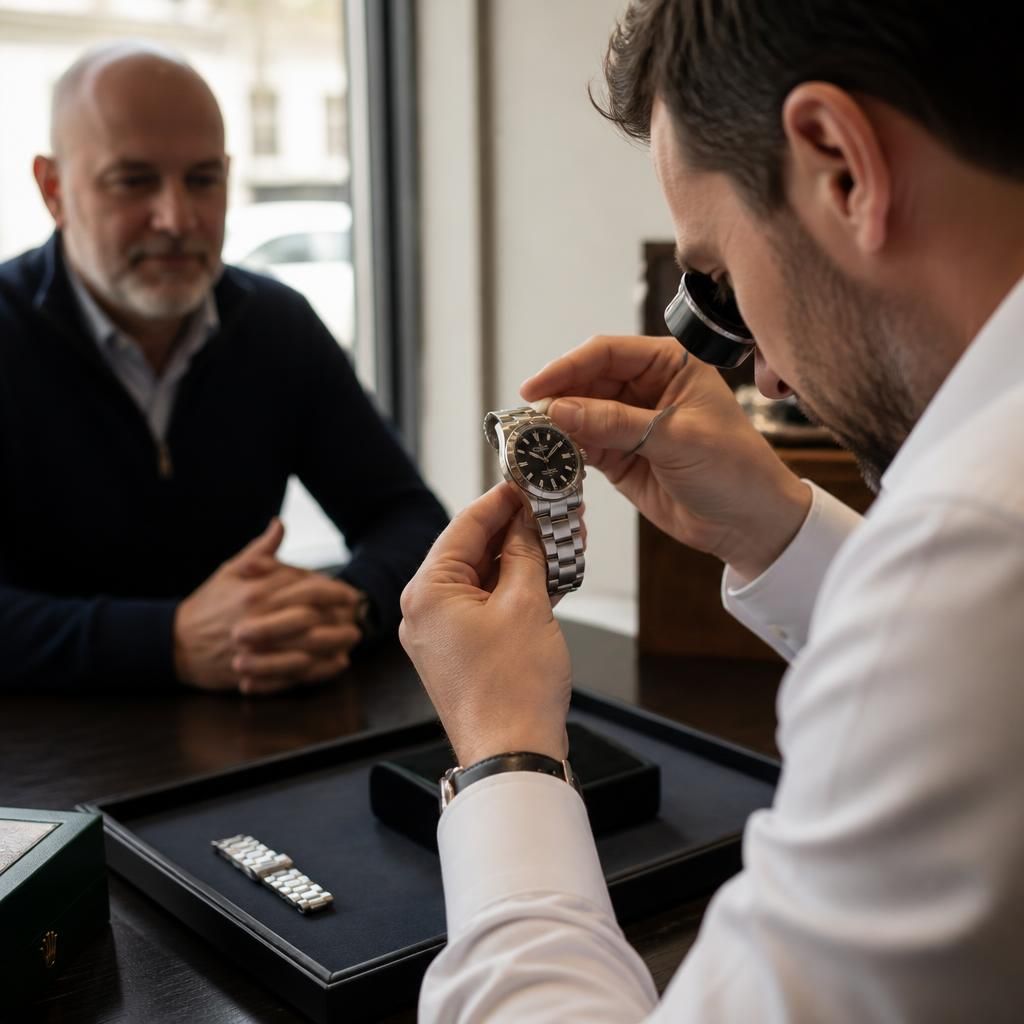
What should I know about the authenticity and market certifications when selling my used Rolex?
When selling a used Rolex, authenticity is confirmed through examination of its movement, case, serial details and parts, while original papers, service records and an independent valuation or condition report can support provenance and market confidence. These documents do not replace professional authentication, but presenting them with the watch can help establish its history, condition and fair resale value.
Authenticity is established through a professional examination of the watch, while market certifications and supporting documents help confirm its history, condition and saleability. When selling a used Rolex, the most important evidence is the watch itself: its movement, case, serial and reference details, dial, hands, bracelet, clasp and any replacement parts must be consistent with the model. Original paperwork, service records and an independent valuation can strengthen buyer confidence, but they do not replace a physical authentication.
A proper assessment should consider whether the watch is genuine, whether its components are original or correctly matched, and whether it has been modified or repaired. Rolex watches can contain genuine replacement parts from different production periods, as well as aftermarket components fitted during previous ownership. These details may not make a watch counterfeit, but they can affect its desirability and value.
What is checked during authentication?
Authentication is not the same as checking whether a watch is running. A watch may appear genuine externally but contain an incorrect movement or altered parts, so a serious valuation should not rely solely on photographs, a serial number or a quick visual inspection.
Which documents can support a sale?
What does “certified” mean in the used-watch market?
The term certification can refer to different forms of documentation, so it is important to identify what has actually been certified. A professional valuation may state an estimated market value for a defined purpose, such as sale, insurance or probate. A condition report may record the visible condition, operation and known defects. An authentication report may explain why the watch and its components are considered genuine. These documents serve different purposes and should not be treated as interchangeable.
A watch’s original chronometer certification, where applicable, relates to the specification and testing of the movement at the time of manufacture. It is not a guarantee that the watch remains within the same performance tolerances after years of use, nor does it confirm that every current component is original. Similarly, a Rolex service document can demonstrate that work was carried out, but it should not be presented as a blanket certificate covering the watch’s entire history.
There is no universal used-Rolex certificate that overrides a detailed examination. The most useful market documentation is clear about who inspected the watch, what was inspected, the date of the assessment, the condition recorded, any replaced or aftermarket parts, and the purpose of the valuation. Be cautious of documents using broad claims such as “100% genuine” without explaining the examination behind them.
How do authenticity and certification affect the valuation?
A genuine Rolex with a consistent specification, strong condition and credible provenance is generally easier to value and present to a buyer. Original papers, a matching set and well-documented servicing can support confidence and may improve the price compared with an otherwise similar watch without them. The effect depends on the model, age, rarity, condition and current demand.
Missing documents do not automatically mean that a watch is counterfeit or without value. Many genuine watches have been separated from their boxes and papers over time. In that situation, the watch can still be assessed independently, but the absence of documentation may require more careful provenance checks and can reduce the level of certainty available to a buyer.
Conversely, paperwork should not conceal condition issues. A watch with original papers but a heavily polished case, damaged dial, stretched bracelet, moisture damage or non-original parts may be worth less than a comparable watch with fewer accessories but better condition. Accurate disclosure protects the valuation and helps avoid problems after the sale.
What should you provide when requesting a valuation?
For security, keep serial details and full photographs private until you are dealing with a reputable buyer or professional jeweller. Do not post clear images of warranty cards, receipts or identifying engravings publicly, as they can expose personal information or be misused.
At Steven Charles Quance, the valuation process should begin with an examination of the watch and the supporting evidence rather than an assumption based on the model name alone. The findings can then be used to discuss authenticity, condition, completeness, service requirements and the most appropriate route for selling or trading in the watch. If documentation is incomplete, this can be taken into account without treating its absence as automatic proof of a problem.
The safest approach is to describe the watch accurately, present all available records and use a current professional assessment. That gives you a clearer understanding of what you own, avoids overstating the significance of a certificate, and supports a fairer, more secure sale.
Market certification supports a used Rolex sale by documenting its authenticity, condition or estimated value, but it does not replace a physical examination of the watch. A professional assessment should compare the movement, case, serial and reference details, dial, bracelet and any replacement parts with the correct specification.
Original warranty documents, service records, receipts and an earlier valuation can strengthen provenance and buyer confidence. They should be reviewed alongside the watch, as paperwork alone cannot confirm that every current component is genuine or original. Any refinishing, aftermarket parts, repairs or missing documents should be recorded clearly so the valuation reflects the watch accurately.
- Reference and serial details: The reference number helps identify the model, case configuration and intended specification. Serial information can support an assessment of the watch’s production period and should be consistent with the case, paperwork and known model details. Engravings may be examined for clarity, position and finish.
- Movement: The calibre, construction, finishing, markings and operation are inspected. The movement should be appropriate for the model and consistent with genuine Rolex manufacture. A movement examination may also reveal signs of water ingress, corrosion, tampering or non-original parts.
- Case and finishing: The shape, proportions, crown, bezel, case back and machining are assessed. Over-polishing, incorrect replacement components or poor previous work can affect both authenticity and value.
- Dial, hands and date display: Printing, applied markers, lume, hand shape, fonts and alignment are compared with the correct specification for the model and period. A refinished, restored or replaced dial should be disclosed because collectors may value it differently from an original example.
- Bracelet and clasp: The bracelet reference, end links, clasp markings, construction and stretch are considered. A genuine Rolex watch may be supplied with a later or replacement bracelet, but this should be recorded accurately.
- Function and condition: Winding, timekeeping, power reserve, calendar operation, chronograph functions and water-resistance indicators may be checked where appropriate. A watch can be authentic but still require servicing or repair before it is suitable for a particular buyer.
- Original guarantee or warranty card: This can support the watch’s provenance and may help confirm the model details, purchase route or original sale date, depending on the document. It should be assessed alongside the watch rather than accepted as conclusive proof on its own.
- Service records: Invoices, service documentation and records from an authorised service provider can show that maintenance has taken place. They may also identify parts replaced during servicing. Recent, clearly documented servicing can be useful, although the condition of the watch still needs to be inspected.
- Purchase receipt: A receipt can help establish ownership history and provenance, particularly when the details correspond with the watch and accompanying documents. Remove or protect personal information before sharing copies more widely.
- Previous valuation or insurance document: This may provide useful historical information, but an old valuation is not a current market price. Values change according to demand, condition, completeness and the prices achievable through the intended sales channel.
- Original box, booklets and accessories: These can improve completeness and may add value, particularly for sought-after references. They do not authenticate a watch by themselves, as boxes and papers can be separated from the original watch or reproduced.
- Bring the watch, bracelet and any spare links together with the original box, papers, cards, booklets and receipts.
- Include service invoices and details of repairs, polishing, part replacements or modifications that you know about.
- Explain how and when the watch was acquired, where relevant, and disclose if it was inherited, purchased privately or obtained as part of an exchange.
- Do not attempt to open the case, clean the movement or remove bracelet links yourself. Unauthorised handling can cause damage and may remove useful evidence.
- Ask what type of assessment is being provided: authentication, valuation, condition report, service recommendation or a combination of these.
- Request that any material findings, including aftermarket parts, replacement components, missing documents and condition concerns, are recorded clearly.
Arrange Your Used Rolex Valuation
Arrange your used Rolex valuation with Steven Charles Quance for a professional assessment of its authenticity, condition, completeness and supporting documentation. Bring the watch and any original papers, service records or accessories so we can help you understand its current market value and the most suitable selling or trade-in options.
Speak to your personal jeweller
Every commission begins with a conversation. Arrange an appointment in the Birmingham Jewellery Quarter or talk it through by phone.