
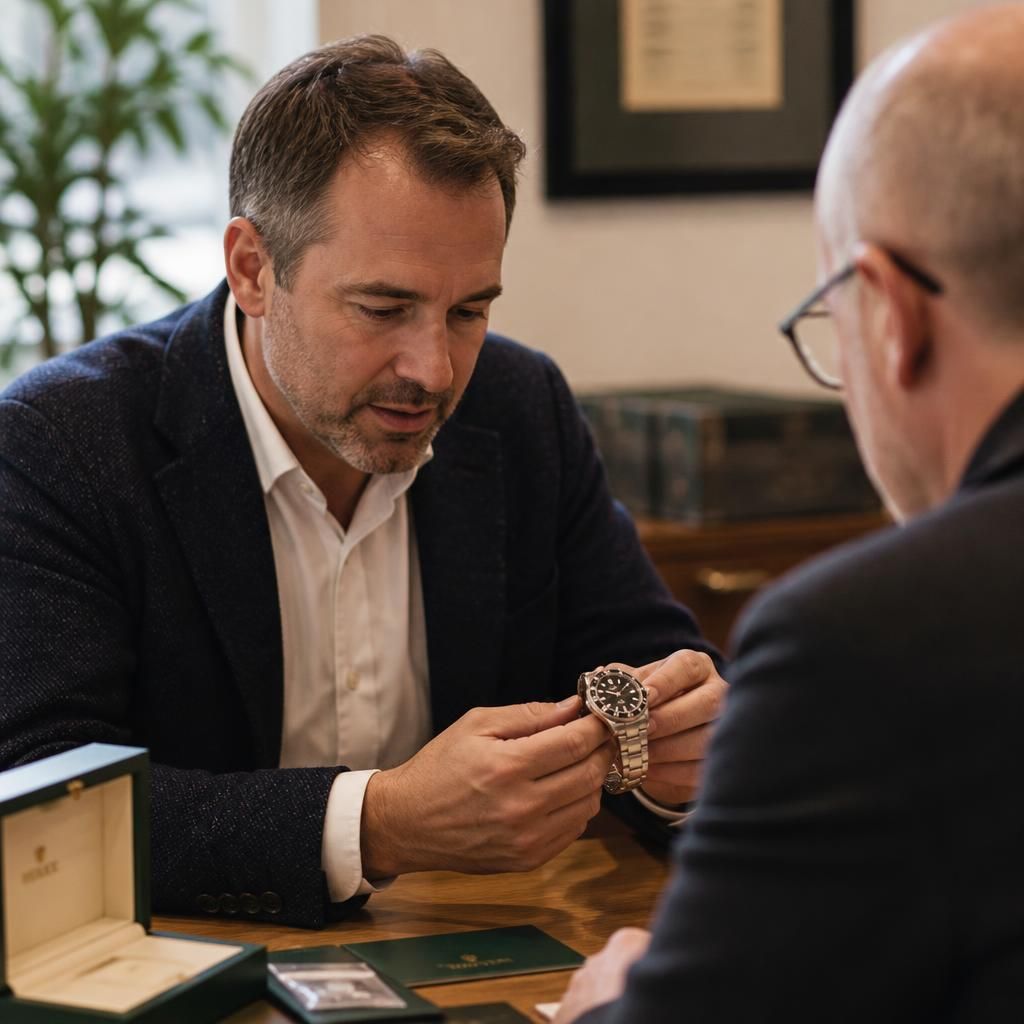
What is the best way to prepare my second hand Rolex for sale?
Prepare your second-hand Rolex for sale by having it professionally assessed, gathering its original box and documentation, and ensuring it is clean and in good working order. Avoid polishing or carrying out repairs without expert advice, as unnecessary alterations can affect originality and value.
The best way to prepare a second-hand Rolex for sale is to preserve its originality, collect its supporting documentation and have it professionally assessed before agreeing to any cleaning, repair or servicing. A careful preparation process helps establish the watch’s condition and provenance without making alterations that could reduce its appeal to a knowledgeable buyer.
Gather the original accessories and paperwork
Collect everything that came with the watch, including the original presentation box, warranty card, instruction booklets, service records, swing tags, spare links and any additional bracelet or strap components. The original documentation can help confirm the model details and ownership history, while the box and accessories provide useful context for the sale.
If paperwork is missing, do not attempt to replace it or make any changes to the watch to compensate. A reputable valuer can assess the Rolex on its own merits. Keep personal information and identifying details secure, and only provide documents to a trusted professional during the valuation process.
Handle cleaning carefully
Remove surface dust with a clean, soft, lint-free cloth. If the bracelet is visibly soiled, limit cleaning to gentle external wiping and avoid immersing the watch in water. Water resistance can deteriorate with age or after maintenance, even when the crown appears to be closed. Do not use household chemicals, abrasive cloths, polishing compounds, ultrasonic cleaners or pointed tools.
Do not polish the case or bracelet before valuation. Polishing can soften original edges, alter the case shape and remove evidence of the watch’s original finishing. Light marks may be preferable to an over-polished case, particularly on older or collectible models. A professional should advise whether any refinishing is appropriate.
Check the watch without opening it
Confirm that the watch starts, runs and sets correctly, and note any obvious issues with the crown, clasp, bezel, crystal, bracelet or hands. Avoid repeatedly winding, setting or testing a watch that feels stiff, makes an unusual noise or stops unexpectedly. Never remove the case back or attempt movement work yourself, as this can introduce damage, affect water resistance and raise questions about the watch’s condition.
Do not assume that a watch needs a full service simply because it is being sold. Servicing can be worthwhile in some cases, but unnecessary work may not be recovered in the sale price. It is generally better to obtain an expert opinion first, especially where the Rolex is vintage, has unusual patina or may contain original parts.
Preserve originality
Keep any replacement parts, aftermarket additions or previous repair details and disclose them during the valuation. This may include a non-original bracelet, replacement dial, modified bezel, aftermarket stones or refinished components. Concealing alterations can delay authentication and lead to a revised valuation later.
For older Rolex watches, originality and consistency between the case, dial, hands, bezel, bracelet and movement can be particularly important. Marks, fading and patina should not be removed simply to make the watch appear newer. The correct approach depends on the reference, age, condition and service history.
Prepare useful information for the valuation
Do not engrave, remove marks or attempt to improve identifying details. A professional can examine the watch and verify its reference, condition and authenticity using appropriate methods. Any serial or identifying information should be shared securely rather than displayed publicly in photographs or online listings.
Take clear photographs if requested
Photographs should show the dial, case, bracelet, clasp and any visible marks in good natural light. Include the box and documentation separately if they are available, but avoid images that reveal sensitive personal information. Do not use filters or edit out scratches, engravings or replaced components; accurate images make an initial assessment more useful.
Obtain an independent, condition-based assessment
A professional valuation should consider authenticity, reference, age, condition, originality, service history, completeness and current demand. A valuation for insurance purposes is not necessarily the same as a resale valuation, so explain that you are preparing the watch for sale. The watch should normally be inspected in person before a final offer is made.
Before handing it over, confirm how the watch will be stored, examined and returned if you decide not to proceed. Use secure transport and retain a written record of the watch’s condition and the accessories provided. Once the assessment is complete, you can make an informed decision about whether any repair or service is justified and whether to sell the Rolex as it stands.
In practical terms, the safest preparation is to clean only the exterior gently, keep every original item, avoid polishing or unauthorised repairs, disclose any alterations and arrange an expert valuation. This protects the watch’s originality and gives the buyer a clear, reliable account of what is being offered.
The most important part of preparing a second-hand Rolex for sale is preserving its originality. Keep the case, bracelet, dial, hands and bezel as they are until an expert has assessed the watch, because polishing or replacing parts can alter its character and affect its value.
Clean only the exterior with a soft, lint-free cloth. Avoid abrasive products, household chemicals, ultrasonic cleaners and water, as the watch’s water resistance may have changed with age. Gather the original box, warranty card, service records, spare links and other accessories, and disclose any replacement parts or previous repairs during the valuation. A clear record of the watch’s condition gives the buyer confidence and helps ensure the assessment reflects what is actually being offered.
- Record the model and reference details where they are already visible on the paperwork or existing records.
- Provide the watch’s service history, purchase information and any previous repair invoices.
- Explain whether the watch has been worn regularly, stored for a long period or exposed to water, impact or magnetism.
- Identify missing accessories, replaced parts or known faults.
- Keep the watch, box, papers and spare links together until the assessment is complete.
Arrange Your Second-Hand Rolex Valuation
Arrange a professional second-hand Rolex valuation with Steven Charles Quance to assess its authenticity, condition, originality and supporting documentation before you sell. Contact us to discuss your watch and the next steps for a secure, condition-based assessment.
Speak to your personal jeweller
Every commission begins with a conversation. Arrange an appointment in the Birmingham Jewellery Quarter or talk it through by phone.