
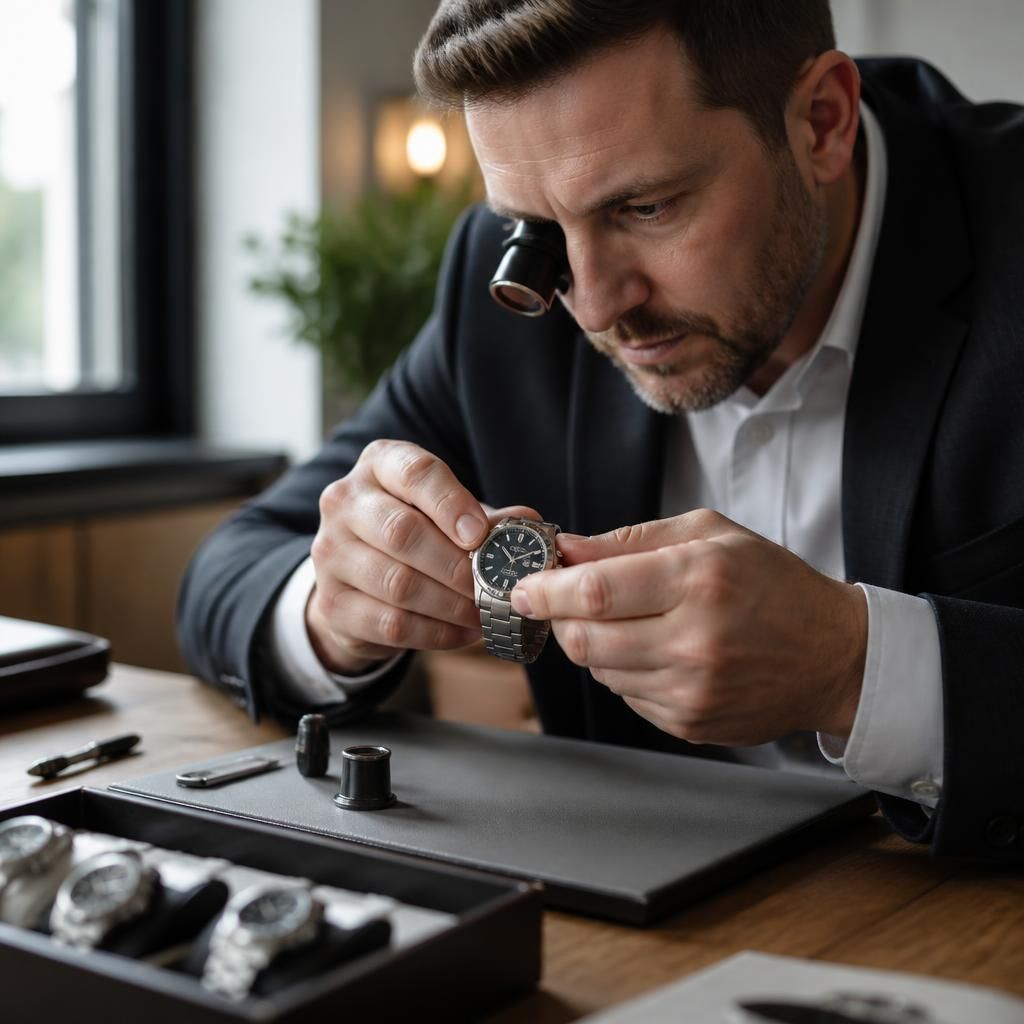
What should I look for in terms of physical condition when buying a luxury watch?
When buying a luxury watch, inspect the case, crystal, dial, hands, crown, bracelet or strap and clasp for scratches, dents, corrosion, loose components or signs of careless polishing. Also ask for movement condition and service history, then have the watch examined by a qualified professional if its authenticity, water resistance or mechanical performance is uncertain.
When assessing the physical condition of a luxury watch, examine the case, crystal, dial, hands, bezel, crown, bracelet or strap, clasp and movement, then compare the findings with the watch’s age, model and stated history. Minor marks may be expected on a pre-owned watch, but deep damage, excessive polishing, corrosion, loose components or poor mechanical performance can affect value, reliability and future servicing costs.
Start with the case. Inspect the watch under good, even lighting and look at each surface and edge. Light hairline scratches are normal on a worn watch, whereas dents, deep gouges and sharp impact marks may indicate a significant knock. Pay particular attention to the lugs, crown guards, case back and the area around the crown, as damage in these locations can affect the case’s structure or water resistance.
Check that the case retains its intended shape and that the transitions between polished and brushed surfaces are clear. Uneven edges, rounded lugs or blurred finishing can indicate heavy or careless polishing. Polishing is not automatically a problem: a professionally refinished case may be entirely acceptable. However, excessive material removal can alter the original proportions and reduce collectability. If the watch is described as unpolished, examine that claim carefully rather than relying on the description alone.
Inspect the crystal and bezel. Look across the crystal at an angle to identify scratches, chips, cracks or clouding. Small marks on a sapphire crystal may be superficial, but chips around the edge can compromise its integrity. Acrylic crystals can often be polished, while a damaged sapphire crystal will normally require replacement. Ask whether the crystal is original and whether any replacement was carried out during servicing.
The bezel should turn as designed, where applicable, without excessive looseness, grinding or unexplained resistance. A rotating bezel that does not align correctly may need attention. Check for dents, worn markings, discolouration or a bezel insert that is lifting or poorly fitted. Replacement bezel parts can be legitimate service components, but they should be disclosed because they may affect originality and value.
Assess the dial and hands. The dial should be clean, evenly finished and correctly positioned. Look for moisture spots, staining, corrosion, scratches, dust beneath the crystal, flaking finish or signs that the dial has been refinished. A refinished dial is not necessarily defective, but it should be identified accurately because it may be less desirable than an original dial.
Check that the hands are the correct style for the model and that they sit securely and align properly at the relevant positions. On a watch with a date display, the date should change cleanly and at the appropriate point in the cycle. Discolouration or ageing may be genuine patina, particularly on older watches, but inconsistent colour between the dial, hands and hour markers can suggest replacement parts or exposure to moisture.
Examine the crown, pushers and case back. The crown should wind and set the watch smoothly, without slipping, wobbling or feeling unusually loose. If the watch has chronograph pushers, they should operate positively and return correctly. Do not force any control during an inspection. A crown that is difficult to turn, or a pusher that sticks, may indicate worn seals, damaged threads or a movement problem.
Inspect the case-back edges and any visible engravings. Scratched or damaged threads, tool marks and an incorrectly seated case back can indicate previous improper opening. Engravings should be clear and consistent with the model, although personal inscriptions may simply reflect the watch’s history rather than a fault. A watch should not be opened casually, particularly if water resistance is important. Internal inspection is best carried out by a qualified watchmaker using the correct tools.
Check the bracelet, strap and clasp. For a metal bracelet, look for stretched links, bent sections, damaged pins, missing screws and excessive lateral movement. Hold the bracelet gently and check whether the links feel secure. Some flexibility is normal, but pronounced sagging can require link replacement or restoration. Examine the end links to ensure they meet the case correctly and do not leave an abnormal gap.
The clasp should close securely and release in a controlled way. Inspect its hinges, safety catch, adjustment holes and contact surfaces for wear. A clasp that opens unexpectedly is a safety concern, not merely a cosmetic issue. Confirm that the bracelet or strap is appropriate for the watch and ask whether it is original, a genuine replacement or an aftermarket item.
Leather and fabric straps should be checked for cracking, flattening, fraying, staining and odour. Rubber straps can harden, split or become sticky with age. Straps are replaceable, but the cost and availability of a suitable replacement should be included when assessing the overall purchase.
Consider movement performance. A watch can look excellent while requiring substantial mechanical work. Listen for unusual rattling or scraping, and check whether the movement starts, winds and sets as expected. A mechanical watch should run consistently, but accuracy cannot be judged reliably from a brief inspection alone. Power reserve, winding efficiency, amplitude and rate stability are best assessed with professional timing equipment.
Ask when the watch was last serviced and whether there is an itemised service record. A service history should ideally identify the work completed, parts replaced and any water-resistance testing carried out. The absence of records does not prove that a watch is faulty, but it should be reflected in the risk assessment and may justify budgeting for an inspection or service. A recent service also does not guarantee that the watch is in perfect condition, so the paperwork should be considered alongside the physical examination.
Look for signs of moisture or impact. Condensation beneath the crystal, rust-coloured marks, green corrosion around the case back or bracelet, and pitting near the crown are important warnings. Moisture can damage the movement and dial even when the watch appears to be running. Evidence of a hard impact includes a damaged crystal, distorted case, loose hands, a rotor that feels noisy or a movement that stops intermittently.
Water resistance should never be assumed from the watch’s appearance or original specification. Seals deteriorate, crowns may wear and a case may have been opened since its last test. If the watch is intended for regular contact with water, request a suitable pressure test from a qualified professional. A pressure test is particularly important after case or crown work, but it should not be performed on a watch showing signs of damage without first establishing whether it is safe to do so.
Distinguish wear from defects. Condition should be judged in context. A vintage watch may reasonably have patina, replaced seals or service parts, while a relatively new watch would normally be expected to show less wear. A polished case, replaced crystal or later bracelet may be acceptable if accurately disclosed and reflected in the price. The important issue is whether the description is complete and whether the watch remains structurally sound, authentic and suitable for its intended use.
Before finalising the purchase, record the serial and reference details, compare the watch with reliable model information and check that the visible components are consistent with it. Documentation, boxes and accessories can support provenance, but they do not replace a condition assessment. If the watch is valuable, unusual, heavily modified or accompanied by limited service history, arrange an examination by an independent, qualified watchmaker before committing to the purchase.
A sensible inspection should therefore establish three things: whether the exterior has damage or excessive wear, whether the movement and controls function correctly, and whether the condition matches the description and price. Any uncertainty about authenticity, previous water damage, case integrity or mechanical performance should be resolved professionally rather than accepted on appearance alone.
When assessing a pre-owned luxury watch, distinguish normal age-related wear from damage that affects structure, function or originality. Light surface marks may be acceptable, but deep dents, corrosion, loose components and excessive polishing warrant closer investigation.
Pay particular attention to the case edges, lugs and transitions between brushed and polished surfaces. Rounded edges or uneven finishing can indicate that too much metal has been removed during polishing. Compare the level of wear with the watch’s age and ask whether the case, crystal, bezel, dial and bracelet are original, genuine replacements or aftermarket parts. Any undisclosed alteration should be considered when judging both condition and value.
Arrange a Professional Luxury Watch Condition Assessment
Arrange a professional luxury watch condition assessment with Steven Charles Quance before completing your purchase. We can examine the watch’s case, movement, originality and service requirements, helping you make an informed decision based on its true condition.
Speak to your personal jeweller
Every commission begins with a conversation. Arrange an appointment in the Birmingham Jewellery Quarter or talk it through by phone.