
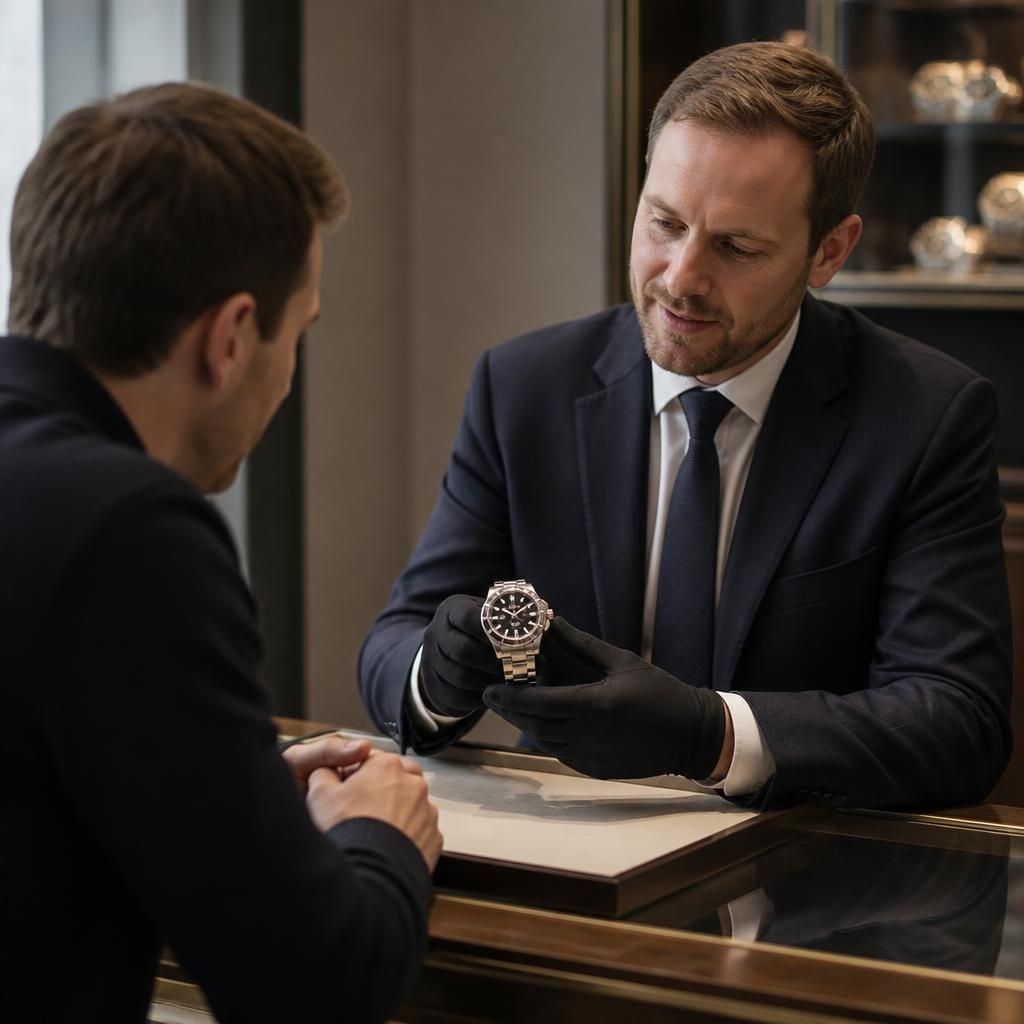
What safety precautions should be taken when meeting to purchase a luxury watch in person?
When meeting to purchase a luxury watch in person, choose a secure, reputable location, ideally a professional jeweller or watch specialist, and avoid carrying large amounts of cash. Before paying, inspect the watch and its serial number, verify the provenance and accompanying paperwork, confirm the seller’s identity, and use a traceable payment method only after independent checks are complete.
When meeting to purchase a luxury watch in person, prioritise your personal safety, meet in a professional and controlled environment, verify the seller and the watch independently, and use a traceable payment method only after all checks are complete. A reputable jeweller or established watch specialist is generally safer than a private meeting arranged through an anonymous listing, particularly where the watch is high in value.
Choose the meeting location carefully. The safest option is a recognised jeweller, watch specialist or another established business with staff, security measures and suitable facilities for examining the watch. Avoid meeting at a private home, secluded car park, hotel room or unfamiliar address. If a private meeting is unavoidable, choose a busy public location during opening hours and confirm in advance that there is suitable lighting and a secure place to inspect the watch and paperwork.
Tell someone you trust where you are going, who you are meeting and when you expect to return. Keep your phone charged, arrange a check-in call and consider taking a companion. Do not allow the seller to change the location at short notice without a clear and reasonable explanation. A sudden request to meet somewhere more private, an insistence on urgency or pressure to proceed before you have inspected the watch should be treated as a warning sign.
Confirm the seller’s identity before travelling. Ask for the seller’s full name and a reliable means of contact. For a business, check its trading details, physical address, reputation and whether the person you are dealing with is authorised to sell on its behalf. For a private seller, ask to see appropriate identification and ensure the name is consistent with the payment account and any ownership documents. Do not rely solely on a social media profile, an anonymous marketplace account or photographs of identification sent electronically.
Where the seller claims to represent an owner, estate or business, ask why the watch is being sold and request evidence of their authority to complete the transaction. Be cautious if the seller refuses reasonable questions, provides inconsistent information or says that a friend or courier will attend instead. Never send a copy of your own passport, driving licence or other sensitive documents unless there is a genuine, clearly explained legal or business requirement.
Arrange the checks before discussing final payment. Ask for clear images and details in advance, including the reference, serial number where appropriate, dial and movement information, dimensions, accessories, service history and known faults. Compare these details with the watch when you meet. A genuine-looking case or presentation box does not prove that the watch itself is authentic, as boxes, papers and parts can be separated from the original watch or obtained separately.
Inspect the watch in good light and, where possible, have it examined by a suitably qualified professional. Check that the case, dial, hands, bracelet, clasp and movement are consistent with the stated model and period. Look for signs of over-polishing, replacement parts, damage, tampering or an altered serial number. The serial and reference markings should be legible and free from evidence of removal or re-engraving. Do not accept a watch simply because it appears to operate correctly; counterfeit or incorrectly assembled watches can still show the time and use functioning complications.
Ask for the watch to be opened only by a qualified professional using the correct tools. An inexperienced inspection can damage the case, seals or movement. If the seller will not permit a reasonable examination, refuses an independent authentication or insists that you pay before inspection, do not proceed. For a valuable purchase, the cost of an expert check is usually minor compared with the risk of buying a counterfeit, stolen, heavily modified or incorrectly described watch.
Review the paperwork and provenance. Check any original guarantee, purchase receipt, service invoices, valuation, export documents and manufacturer paperwork. The dates, reference, serial number and description should correspond with the watch. Paperwork can support a transaction but is not conclusive proof of authenticity or lawful ownership. A receipt in another person’s name, missing documentation or an incomplete service history is not automatically evidence of wrongdoing, but it should be reflected in the price and investigated before purchase.
Ask whether the watch has ever been lost, stolen, subject to an insurance claim or modified with non-original parts. Where available, use appropriate professional or recognised stolen-watch checks and retain evidence of the result. If a watch has a complicated ownership history that cannot be explained, or if its identifying marks appear damaged, walk away until the matter has been resolved. Do not attempt to buy a watch cheaply on the assumption that any later ownership dispute will be easy to settle.
Use a secure, traceable payment method. Avoid carrying large amounts of cash and do not make payment to an unrelated third party, a newly supplied account or a different name without a documented and credible explanation. A bank transfer may be traceable, but it is not automatically reversible if you are deceived. Confirm the recipient’s details directly with the business or seller and be particularly cautious of payment requests made under time pressure.
Do not pay a deposit merely to reserve a watch unless the terms are written and you understand when the deposit is refundable. A proper invoice or sale agreement should identify the seller, describe the watch accurately, state the price and payment terms, record any faults or replaced parts, and explain the position on returns, warranty and servicing. The watch and its accessories should be handed over only once the payment arrangements are confirmed and the seller’s identity has been established.
Never share online banking security codes, card verification codes or passwords with a seller. A legitimate seller should not need them. Be wary of requests to use cryptocurrency, gift cards, cash couriers or other payment methods that provide limited protection or make it difficult to establish who received the money.
Record the handover. Keep the invoice, receipt, written description, messages, photographs, payment confirmation and details of any professional inspection. Photograph the watch, serial number and included accessories at the point of sale where this can be done safely and lawfully. Confirm what is included, such as extra links, straps, boxes, guarantees and service records. If the watch is being delivered after the meeting, use an insured and trackable service with clear responsibility for loss or damage.
After purchase, arrange suitable insurance and keep the documentation securely. A valuation may be useful for insurance purposes, but it is not a substitute for authentication or proof of ownership. If you later suspect that a watch is counterfeit, stolen or materially misrepresented, avoid altering or reselling it. Preserve the watch and all communications, contact the payment provider and seek advice from the relevant authorities or a qualified legal professional.
The most important precaution is to be prepared to leave the transaction. A genuine seller should allow reasonable time for identity checks, examination, paperwork review and secure payment. Pressure, secrecy, unexplained inconsistencies or a refusal to support independent checks are sufficient reasons not to buy, regardless of how attractive the watch or price appears.
Meeting in a secure, professional location is one of the most important precautions when buying a luxury watch in person. Choose an established jeweller or watch specialist with staff, good lighting and a suitable area for checking the watch, serial markings and paperwork. Avoid private homes, hotel rooms, secluded car parks and unfamiliar addresses.
Tell someone you trust where you are going, who you are meeting and when you expect to return. Take a companion if possible, keep your phone charged and do not agree to a last-minute change of location or proceed under pressure. A seller who is genuine should allow reasonable time for safe inspection and independent checks.
Arrange a Secure Luxury Watch Consultation
Arrange a secure luxury watch consultation with Steven Charles Quance to examine the watch, review its documentation and discuss authenticity, condition and provenance in a professional setting. Contact us before your meeting to plan the appropriate checks and payment arrangements.
Speak to your personal jeweller
Every commission begins with a conversation. Arrange an appointment in the Birmingham Jewellery Quarter or talk it through by phone.