
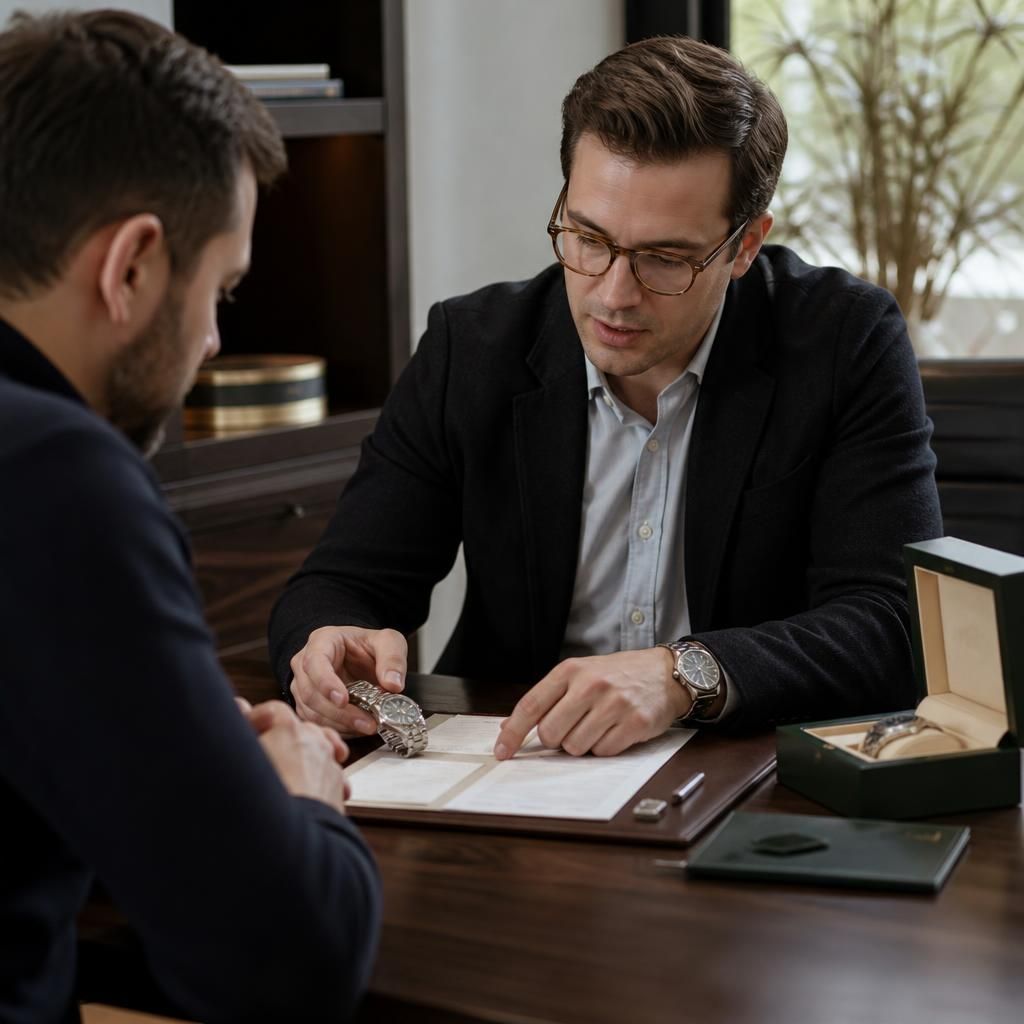
What essential documents should be reviewed before finalising the purchase of a luxury watch?
Before finalising a luxury watch purchase, review the original invoice or receipt, warranty card, serial and reference details, authenticity documentation, and any available service records. Confirm that the documents match the watch and seller’s description, and clarify what warranty, returns and aftercare cover.
Before finalising a luxury watch purchase, review the original invoice or receipt, warranty documentation, serial and reference details, authenticity records, service history and the seller’s written terms. Each document should identify the same watch, seller and transaction. If records are missing, inconsistent or only available as informal assurances, pause the purchase until the position has been independently clarified.
Original invoice or receipt
The invoice or receipt establishes what is being sold, by whom and at what price. Check that it includes:
For a private sale, request a written sale agreement that records the same information and confirms that the seller has the right to sell the watch. A vague receipt marked simply “luxury watch” provides little protection if a dispute arises.
Warranty card and manufacturer’s warranty details
Review the warranty card, digital warranty record or other proof of warranty cover. Confirm that the details correspond with the watch and establish:
A warranty card is not, by itself, conclusive proof of authenticity. It should be considered alongside the watch, its serial and reference details, purchase documentation and service records. Do not rely on a blank, altered or poorly completed card without checking its validity with an appropriate authorised service centre or experienced horologist.
Serial number and reference number records
Compare the serial number and reference number shown on the paperwork with the markings on the watch. Depending on the model, these may be found between the lugs, on the case, on the movement or in the manufacturer’s records. The numbers should be legible and should not appear polished away, re-engraved, altered or inconsistent with the case and movement.
Check that the reference describes the correct case material, dial, bezel, bracelet and movement. A genuine watch can still contain incorrect or replaced parts, so matching the serial number alone is not enough. If the paperwork uses a different reference, ask for a clear explanation and supporting evidence before proceeding.
Authenticity documentation
Where available, review any written authentication report, purchase assessment or inspection record. It should identify the specific watch rather than provide a generic statement, and should explain what was examined. Useful records may refer to the case, movement, dial, hands, bracelet, clasp and serial or reference markings.
Consider who issued the document, when it was prepared and whether the person or business has suitable expertise and professional accountability. An online listing, stock photograph or seller’s verbal assurance is not an authenticity document. If the watch is valuable or its history is uncertain, arrange an independent inspection before funds become irrevocably committed.
Service and repair history
Ask for invoices, service receipts, workshop reports and parts records covering previous maintenance. These documents can show:
Distinguish between a full service, a basic inspection, regulation, battery replacement, polishing and cosmetic cleaning. They are not equivalent. For a mechanical watch, a recent service record is useful, but it does not guarantee future performance. If no history is available, factor the possibility of servicing into your decision and ask whether the watch will be inspected before sale.
Proof of provenance and ownership
For a pre-owned watch, review any earlier purchase invoice, previous service documentation, insurance valuation or other ownership record. A continuous history is not always available, but unexplained gaps should be discussed. Ask the seller to confirm in writing that the watch is not stolen, subject to finance, leased, consigned without authority or involved in a dispute.
Where appropriate, a reputable seller should be willing to carry out relevant checks and provide suitable identification of the watch. Do not accept altered documents, unexplained duplicate papers or pressure to avoid written records. Provenance is particularly important where the watch is rare, unusually valuable or being sold significantly below its expected market level.
Condition report and accessories list
Ensure the written description accurately records the watch’s condition and every item included in the sale. This may include the presentation box, outer box, warranty card, instruction booklet, swing tags, spare links, tools and service documentation.
The condition report should disclose scratches, dents, movement issues, bracelet stretch, replaced components, refinishing, moisture exposure and any known damage. For a watch described as complete or supplied with its original accessories, check that the list is specific rather than relying on a general phrase such as “full set”. Photograph or record the documents and accessories at the point of handover if the purchase proceeds.
Return, delivery and payment terms
Read the seller’s terms before making payment, including the returns procedure, inspection period, refund method, delivery insurance and responsibility for loss or damage in transit. Confirm whether a return is available if an independent inspection identifies undisclosed issues or the watch does not match its description.
For distance purchases, retain the listing, messages, invoice and terms as evidence of the agreed description. Use a payment method that provides an appropriate record and avoid arrangements that remove normal buyer protection. The account receiving payment should correspond with the named seller or business unless a legitimate explanation is documented.
Valuation and insurance documents
A valuation is not normally proof of authenticity or ownership, and it may reflect replacement value rather than the amount paid or likely resale value. Nevertheless, a recent valuation from a suitably qualified professional can help with insurance and may identify the watch’s specifications. Check its date, purpose, identification details and whether it is based on a physical examination.
After purchase, keep the invoice, photographs, serial and reference details, warranty information and service records securely. Your insurer may require specific evidence of ownership, value and security arrangements, so check those requirements rather than assuming the purchase receipt alone is sufficient.
Final document check
Do not complete the transaction merely because the watch is accompanied by a box and warranty card. A reliable purchase file should provide a coherent record of the watch’s identity, ownership, condition, servicing and the terms agreed with the seller. If the documents cannot be reconciled, seek professional advice and delay payment until the concern has been resolved.
The essential document check is to reconcile the watch with its invoice, warranty record, serial and reference details, and service history. Every record should describe the same watch, including its model, materials and any significant replacement parts.
Do not treat a box or warranty card as conclusive proof of authenticity. Compare the paperwork with the physical watch and ask for written explanations of missing, altered or inconsistent information. If the watch’s identity, ownership or condition remains uncertain, arrange an independent inspection before making payment or completing the purchase.
- the seller’s full legal name, trading address and contact details;
- the date of purchase;
- a clear description of the watch, including its make, model or reference and serial number where appropriate;
- the agreed price, currency and any taxes or charges;
- the condition, such as new, pre-owned, unworn or refurbished; and
- the agreed payment, delivery, return and warranty terms.
- when the warranty started and when it expires;
- whether the warranty is transferable to a subsequent owner;
- which repairs, components and faults are covered;
- which exclusions apply, including accidental damage, water damage, unauthorised opening or normal wear; and
- whether servicing must be carried out through an authorised channel to preserve the cover.
- when the movement was last serviced;
- which work was completed;
- whether parts were replaced;
- whether water-resistance testing was performed;
- who carried out the work; and
- what warranty was provided for the repair.
- Match the make, model or reference, serial number, materials and included accessories across every document.
- Compare the paperwork with the physical watch and note any replaced or non-original parts.
- Check that the seller’s identity and authority to sell are clear.
- Verify warranty, service and return terms in writing.
- Ask for explanations and supporting evidence for any missing, altered or inconsistent records.
- Obtain an independent inspection before completing the purchase if authenticity, condition or provenance remains uncertain.
Need Help Reviewing Your Watch Documents?
If you would like help checking a luxury watch’s invoice, warranty records, provenance or service history, Steven Charles Quance can review the available documentation with you. Arrange a consultation before completing the purchase if any details do not match or remain unclear.
Speak to your personal jeweller
Every commission begins with a conversation. Arrange an appointment in the Birmingham Jewellery Quarter or talk it through by phone.