
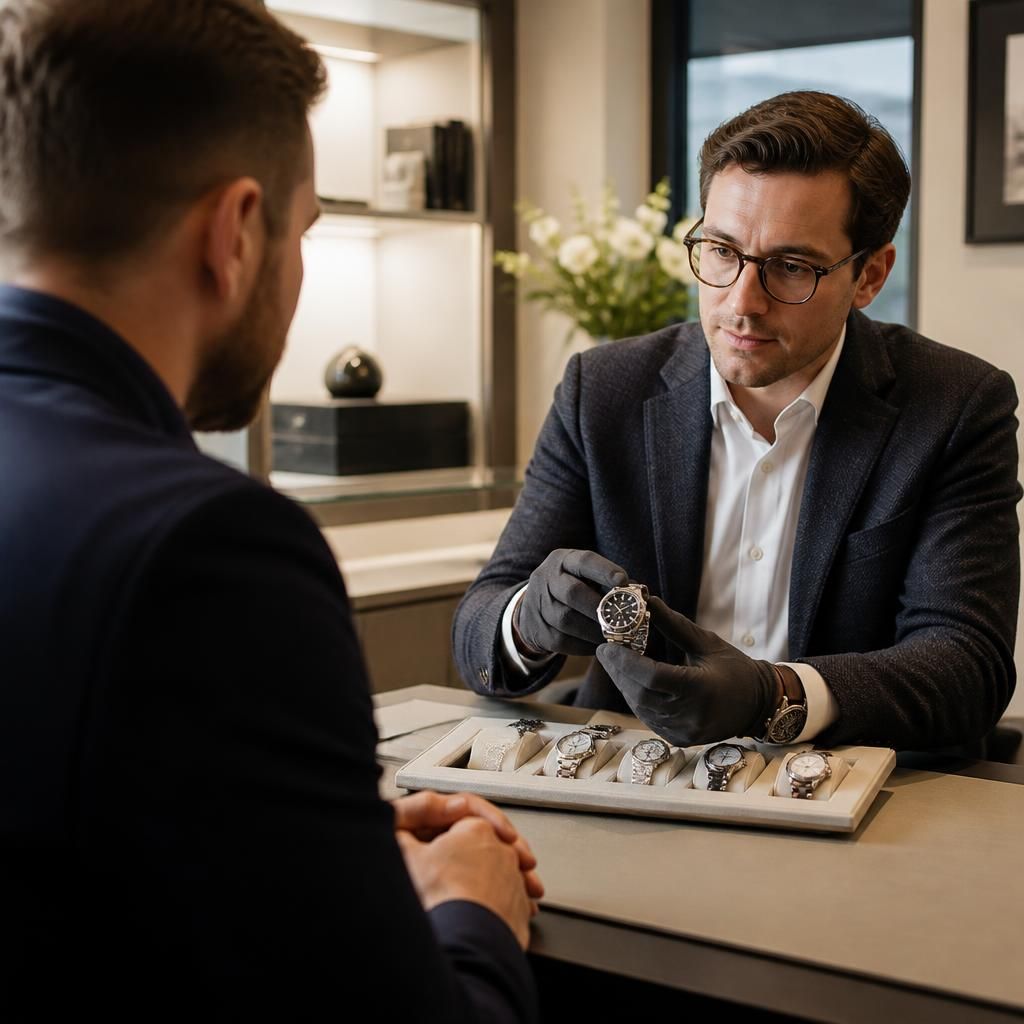
What are the best practices for buying a luxury watch in person?
The best practice when buying a luxury watch in person is to use a reputable jeweller, inspect the watch carefully, and verify its authenticity, condition, provenance and documentation before paying. Ask for a clear explanation of the warranty, servicing history and return terms, and take independent time to assess whether the watch meets your requirements.
Choose an established jeweller
Buy from a professional business with a verifiable premises, clear contact details and a documented process for authentication and aftercare. A reputable jeweller should be willing to discuss the watch openly, explain its condition and provide appropriate paperwork. They should also issue a proper receipt showing the seller’s details, the watch reference, serial information where appropriate, the price paid and any warranty provided.
Personal recommendations can be useful, but they should not replace your own checks. Look for evidence of specialist knowledge, transparent terms and a willingness to answer detailed questions without applying pressure to complete the purchase immediately. At Steven Charles Quance, an in-person consultation can be used to discuss the watch’s specifications, condition, ownership history and suitability before you make a decision.
Define what you are buying
Before viewing a watch, establish the details of the exact model, including its reference, case material, movement type, dial configuration, bracelet or strap and approximate production period. Similar-looking models can differ considerably in value and specification. Check whether the watch is being sold as new, unworn, pre-owned or restored, as these terms affect how its condition and history should be assessed.
Consider how you intend to wear it. Water resistance, case size, bracelet adjustment, complications and service requirements may matter more in daily use than appearance alone. If the watch is a gift, confirm that the recipient’s preferences and wrist size can be accommodated, while retaining the packaging and documentation until the purchase has been fully accepted.
Inspect the watch in good conditions
Ask to examine the watch under clear, adequate lighting and, where possible, with a loupe or other suitable inspection equipment. A careful inspection should include:
Wear from previous use is not automatically a defect, particularly with a pre-owned watch. The important point is that the condition should be accurately described, consistent with the asking price and acceptable to you. Ask whether any parts have been replaced, whether the case has been polished and whether the watch has been refinished or restored.
Confirm authenticity and provenance
Authentication should involve more than matching a serial number to a card. A knowledgeable jeweller will assess the watch as a whole, including its movement, finishing, markings, construction, dial, hands, bracelet and reference-specific details. Serial and reference numbers should be consistent with the watch and its paperwork, but do not treat paperwork alone as proof of authenticity because documents can be separated from a watch or misrepresented.
Ask what is known about the watch’s provenance and whether the jeweller has completed appropriate checks before offering it for sale. Where the history is incomplete, this should be stated clearly rather than presented as certainty. For a particularly valuable or unusual piece, you may wish to request an independent assessment before finalising the transaction. Confirm in advance who would pay for that assessment and whether the watch can be returned if it does not meet the agreed description.
Review the documents carefully
Relevant documents may include the original guarantee or warranty card, service records, instruction manuals, purchase paperwork, valuation information and records of replaced components. Check that the details correspond with the watch being inspected and ask the jeweller to explain any gaps or inconsistencies.
A service record can help establish when work was carried out and what was included, but it does not remove the need to assess the watch’s present condition. If the watch has recently been serviced, ask who performed the work, whether the movement was tested and whether any service guarantee applies. Do not assume that a manufacturer’s warranty remains valid, is transferable or covers every fault.
Test the functions without forcing them
Ask the jeweller to demonstrate the watch’s functions safely. Depending on the model, this may include winding, setting the time and date, operating chronograph functions, adjusting the clasp and checking the power reserve. Do not operate a crown, date mechanism or complication outside the manufacturer’s recommended conditions, as incorrect adjustment can damage the movement.
For a mechanical watch, winding should feel consistent rather than gritty or unusually resistant. The hands should move appropriately when the time is set, and the date should change as expected for the model. These checks are useful indicators, but they are not a substitute for a professional movement inspection or timing test where one is appropriate.
Clarify condition, servicing and water resistance
Ask when the watch was last serviced and whether the jeweller recommends servicing now or at a later stage. Service intervals vary according to the movement, use, age and manufacturer guidance, so avoid relying on a fixed timetable without considering the specific watch.
Water resistance should be treated as a technical specification that depends on the condition of seals, the crown, the crystal and the case. It is not permanent and may be affected by servicing or impact. Ask whether a water-resistance test has been completed recently and follow the manufacturer’s guidance for use. A watch described as water resistant should not automatically be treated as suitable for swimming or diving.
Understand the price and all terms of sale
Ask for a written breakdown of the price and establish whether it includes any adjustment, authentication, service, replacement parts, delivery or aftercare. A price that appears attractive may reflect missing accessories, significant wear, an overdue service or a limited warranty.
Before paying, confirm the return or cancellation policy, the length and scope of any warranty, exclusions, repair arrangements and the process for raising a fault. Make sure these terms are written down rather than relying only on a verbal explanation. If the watch is being altered to fit your wrist, ask whether links or other removed components will be returned to you.
Use a secure payment and collection process
Pay through the jeweller’s approved business payment method and ensure the name on the payment request matches the business you are dealing with. Be cautious of requests to transfer funds to an unrelated individual, use an unusual payment method or pay a deposit without written terms. Obtain a receipt before leaving with the watch.
Check the watch, accessories and documents against the receipt at collection. If the watch is being delivered after an in-person purchase, agree the delivery, insurance and responsibility arrangements in writing. Keep copies of the receipt, warranty and any condition report in a secure location, as they may be needed for servicing, insurance or a future valuation.
Allow time for a considered decision
A luxury watch should not be purchased solely because of scarcity claims, a short deadline or pressure from a seller. Take time to compare the watch with the written description, consider whether the condition is right for you and ask any outstanding questions before committing. If anything material cannot be verified, pause the transaction until it has been clarified.
When buying from a private seller or meeting outside established premises, take additional precautions. Meet in a secure professional setting, avoid carrying unnecessary personal information or large amounts of cash, and do not proceed if the seller refuses reasonable inspection or documentation. A private transaction may offer fewer protections and less reliable aftercare than a purchase from an established jeweller.
Arrange appropriate aftercare
Once the purchase is complete, have the bracelet fitted correctly and keep the watch, paperwork and spare links together. Ask about servicing, cleaning, polishing, water-resistance testing and repairs, particularly if the watch will be worn regularly. Obtain a valuation for insurance purposes where appropriate, and update it if the watch’s value or specification changes.
These checks help you make a confident, informed purchase without treating authenticity, condition or documentation as separate issues. The strongest in-person buying process is transparent from inspection through to payment and continues with clear warranty and aftercare support.
Before buying a luxury watch in person, verify that the watch, reference details, serial information and accompanying documents all correspond. Paperwork can support a purchase, but it should not be treated as proof of authenticity on its own.
Ask the jeweller to explain how the watch has been authenticated and whether its movement, case, dial, hands, bracelet and engravings are consistent with the stated model. Review any warranty card, service history, purchase paperwork and records of replaced components, paying attention to unexplained gaps or discrepancies.
Also confirm the watch’s condition, service requirements, warranty terms and return arrangements in writing before paying. If an important detail cannot be verified, pause the transaction and request an independent assessment where appropriate.
- The case, lugs and bezel for dents, deep scratches, uneven polishing or signs of alteration.
- The crystal for chips, cracks, excessive scratches or poor alignment.
- The dial, hands and indexes for moisture damage, discolouration, dust or inconsistent finishing.
- The crown, pushers and winding action for smooth, appropriate operation.
- The bracelet, clasp and links for excessive stretch, wear, replacement parts or secure closure.
- The case back and engravings for marks that appear inconsistent with the model or its documentation.
Arrange Your Luxury Watch Consultation
Arrange your luxury watch consultation with Steven Charles Quance to review a suitable timepiece, its condition, documentation and ownership requirements in person. Our expert guidance can help you assess the watch carefully before making an informed decision.
Speak to your personal jeweller
Every commission begins with a conversation. Arrange an appointment in the Birmingham Jewellery Quarter or talk it through by phone.