
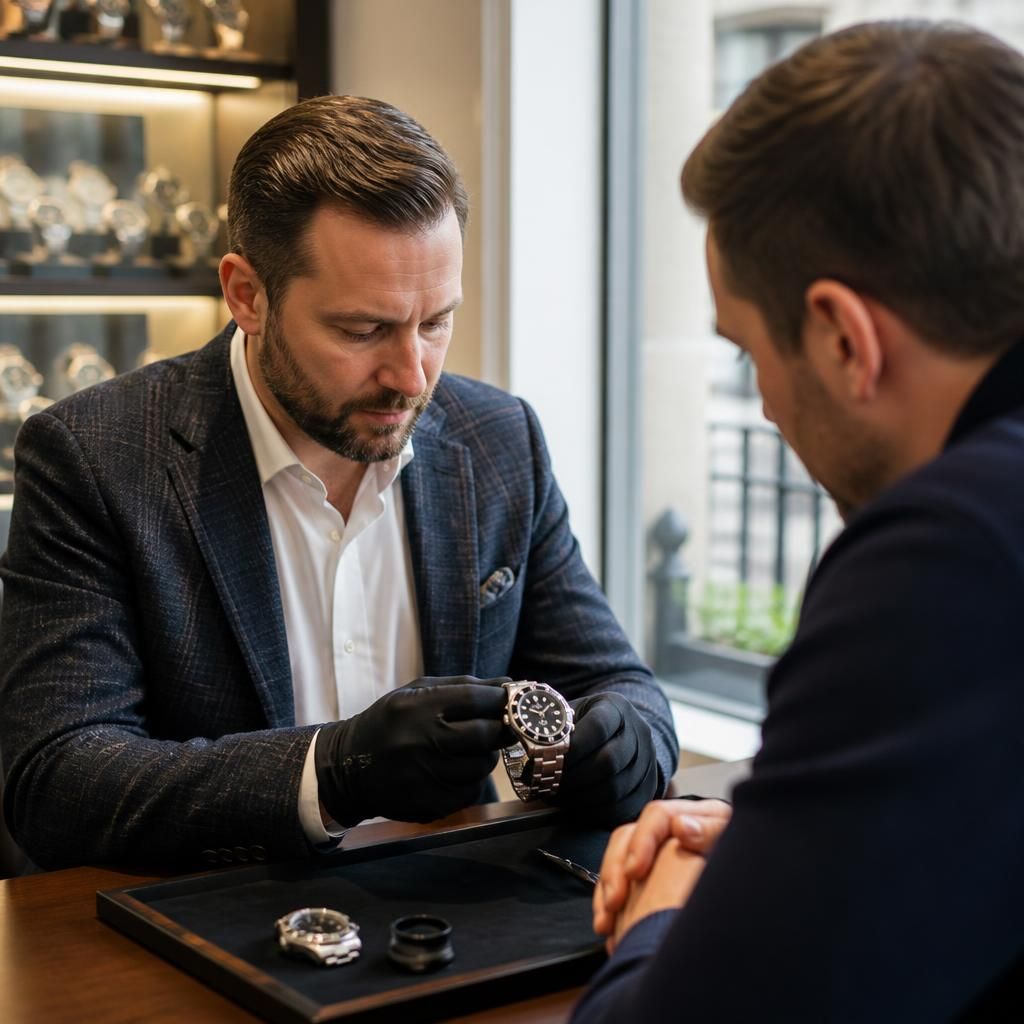
What should I look for when buying a used Rolex watch in Birmingham?
When buying a used Rolex watch in Birmingham, check its authenticity, condition, service history, provenance, original paperwork and whether the reference and serial details correspond. Buy from a reputable specialist who can explain the watch’s history, provide a clear valuation and offer appropriate aftercare.
When buying a used Rolex watch in Birmingham, assess five things together: authenticity, condition, provenance, service history and the quality of the seller’s documentation and aftercare. A genuine watch with a clear history and carefully assessed condition is generally a safer purchase than an apparently attractive example with missing records or unexplained modifications.
Check the seller and the buying process
Start with the business selling the watch. A specialist jeweller should be willing to explain how the watch has been inspected, what is known about its history and whether any parts have been replaced or restored. You should receive a written description that accurately identifies the model, reference, materials, approximate age where known and condition.
Be cautious if you are pressured to make a quick decision, asked to pay without suitable documentation or discouraged from asking questions. The watch should be examined in a professional setting, with the opportunity to compare its details against the accompanying records and the seller’s description.
Verify the identity and authenticity of the watch
Check that the reference and serial details on the watch correspond with the paperwork, where paperwork is available. These details should be inspected by an experienced professional rather than treated as proof on their own, because counterfeit watches can carry copied or altered markings and genuine components can sometimes be combined with non-original parts.
Authentication should consider the watch as a whole, including:
Small differences in typography, alignment, finishing or component fit can be significant. A reputable specialist will explain the checks carried out and identify any non-original, replacement or aftermarket components rather than presenting the watch as entirely original without qualification.
Evaluate the condition carefully
Condition affects both appearance and value, but an unworn-looking watch is not automatically the best choice. Look for dents, deep scratches, corrosion, stretched bracelet links, damage to the clasp and signs of moisture entering the case. Fine surface marks may be consistent with careful wear, while heavy polishing can alter the original case shape and soften its edges.
Ask whether the case has been polished, refinished or restored, and whether the bezel, dial, hands, crystal or bracelet has been changed. Replacement parts are not necessarily a fault, particularly where they improve reliability, but they should be disclosed and reflected in the description and valuation. A watch with original, well-preserved components may appeal to a collector, whereas a serviced watch with correctly replaced parts may be more suitable for regular wear.
The movement should run consistently, the winding and setting functions should operate correctly, and the date or other complications should change as expected. A specialist assessment can identify issues that are not apparent during a brief visual inspection. Water resistance should never be assumed simply because the model was designed for it; seals age, and resistance should be tested when relevant.
Ask for service history
Service records help show how the watch has been maintained and whether recent work may be required. Ask when it was last serviced, what work was completed, whether the movement was inspected and whether seals, crystal, crown or other components were replaced. If no service history is available, factor the possibility of a future service into your decision and ask whether the watch has been checked before sale.
A service receipt is useful, but it should be considered alongside the watch’s current performance and condition. A recently serviced watch is not necessarily superior if the work was poorly documented or involved undisclosed modifications. Conversely, an older service record does not mean the watch is unsuitable if it has been properly inspected and is functioning as it should.
Review the paperwork and provenance
Original warranty papers, purchase records, manuals, presentation boxes and service documents can support the watch’s history, although their absence does not by itself prove that a watch is not genuine. More important is that the documentation is consistent with the watch and that the seller is clear about anything missing.
Ask whether the seller has carried out appropriate checks on ownership and provenance. A clear chain of ownership is preferable, particularly for a high-value purchase. Avoid a watch whose history is vague, whose identifying details have been removed or altered, or whose documentation appears inconsistent. Keep the invoice and written description, including any statement about originality, condition, servicing and included accessories.
Compare the price with the watch’s specification
Used Rolex prices vary according to model, material, dial and bezel configuration, age, condition, originality, service history, completeness and current demand. Compare like-for-like examples rather than relying on the model name alone. A lower price may reflect missing paperwork, heavy polishing, replacement parts, cosmetic damage or servicing that is due.
The total cost should include any immediate servicing, insurance, valuation, bracelet adjustment or remedial work that may be needed. Ask for a clear explanation of what is included in the quoted price and whether the watch is covered by the seller’s guarantee or aftercare arrangements.
Consider fit, use and aftercare
The watch should suit how you intend to wear it. Check the case size, bracelet condition, clasp security and whether the bracelet can be adjusted comfortably. If you plan to wear it around water, confirm its current water-resistance position and follow the recommended testing and servicing guidance.
Before completing the purchase, clarify the aftercare available in Birmingham, including bracelet adjustments, servicing advice, repairs, valuation documentation and help with future maintenance. Keep the watch, paperwork and receipts together, and have the condition recorded if you are arranging insurance.
A practical pre-purchase checklist
For a used Rolex purchase, the strongest indicators are consistency and transparency: the physical watch, its documentation, its service history, its price and the seller’s explanation should all make sense together. If any part of the assessment is unclear, ask for it to be resolved in writing before committing to the purchase.
When buying a used Rolex watch in Birmingham, the most important check is whether the watch’s physical details, paperwork and service history are consistent with one another. A reference number or warranty card alone does not establish authenticity, as individual components and documents can be altered or mismatched.
Ask for the watch to be examined by an experienced specialist who can assess the case, dial, hands, movement, bracelet, clasp and engravings. The inspection should identify any replaced, restored or aftermarket parts, explain whether the case has been polished, and confirm that the model and materials match the description. You should also receive a written record of the watch’s condition, known history and any guarantee or aftercare included with the purchase.
- the case shape, proportions, finishing and engravings;
- the dial layout, printing, hands, date display and luminous details;
- the crown, bezel, crystal, bracelet and clasp;
- the movement and its construction, where inspection is appropriate; and
- whether the components are correct for the stated model and period.
- Confirm the model, reference, materials and identifying details.
- Have the watch authenticated by a suitably experienced specialist.
- Inspect the case, dial, movement, bracelet, clasp and crystal.
- Ask which components are original and whether the watch has been polished.
- Review service records, ownership information and available accessories.
- Check that the watch’s details match the paperwork and written description.
- Understand the price, guarantee, valuation and aftercare arrangements.
- Obtain a detailed receipt before taking ownership.
Arrange a Used Rolex Consultation in Birmingham
Arrange a used Rolex consultation in Birmingham to discuss authenticity, condition, paperwork, service history and suitability before you buy. We can provide expert guidance and explain the aftercare available for your chosen timepiece.
Speak to your personal jeweller
Every commission begins with a conversation. Arrange an appointment in the Birmingham Jewellery Quarter or talk it through by phone.