
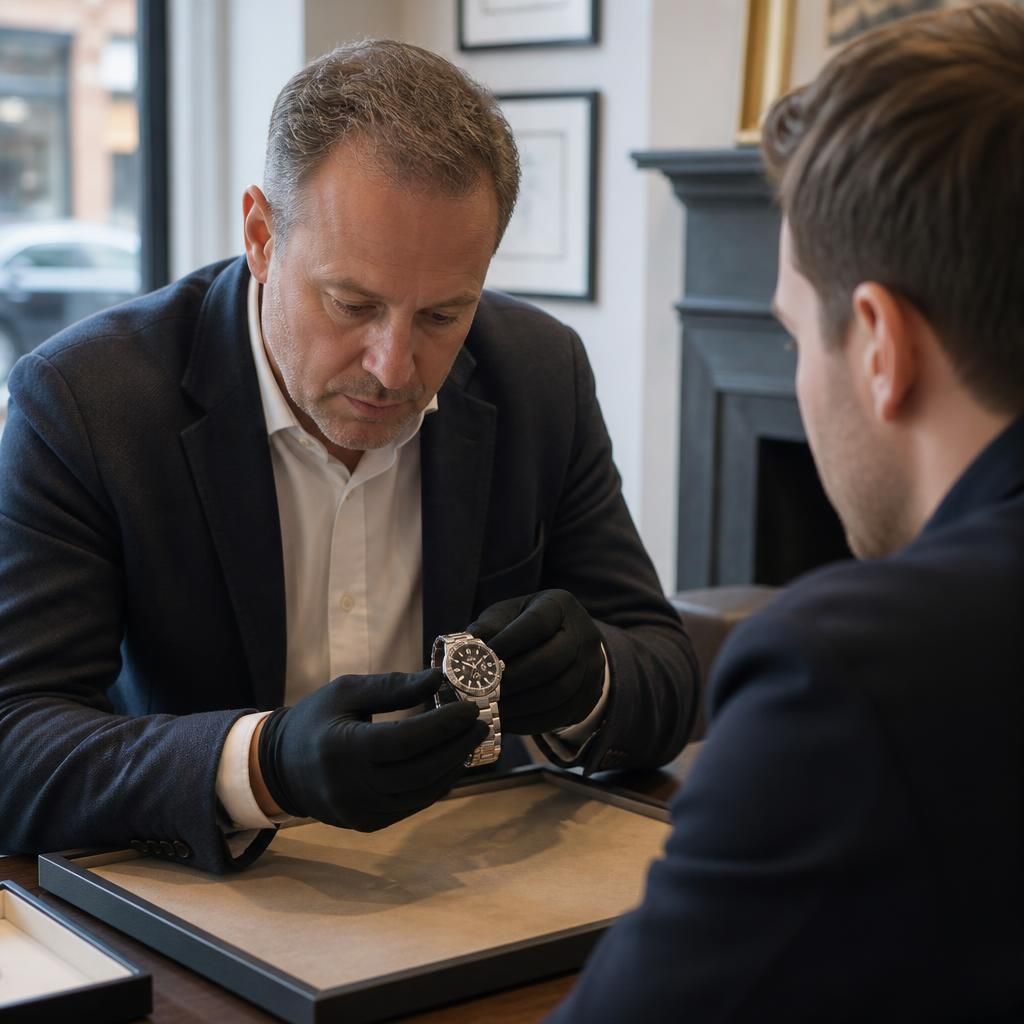
How can I verify the authenticity of a pre-owned Rolex before purchasing it in Birmingham?
To verify a pre-owned Rolex before buying in Birmingham, check its provenance, reference and serial numbers, hallmarks, paperwork and condition, then have the watch examined by an experienced Rolex specialist. A professional inspection can confirm that the case, dial, movement and bracelet are consistent with the stated model and help identify replaced, counterfeit or heavily modified components.
The most reliable way to verify a pre-owned Rolex before buying it in Birmingham is to assess its provenance and documentation, check the reference and serial numbers, and have the watch examined by an experienced Rolex specialist. A proper inspection should confirm that the case, dial, hands, movement, bracelet and clasp are genuine and consistent with the stated model, while identifying counterfeit, replaced or heavily modified components.
Begin by asking for a clear description of the watch’s history. Useful evidence can include the original purchase receipt, service invoices, warranty card, previous valuation, ownership records and details of where the watch was acquired. Documentation should support the watch’s identity, but paperwork is not conclusive proof of authenticity because cards, boxes and certificates can also be altered or incorrectly paired with a watch.
Check the reference and serial numbers carefully. The reference identifies the model and configuration, while the serial number helps establish whether the case is consistent with the watch’s claimed age and production period. Depending on the model and its age, these markings may be found between the lugs, on the rehaut or in another manufacturer-marked location. They should be professionally checked rather than relied upon in isolation. A genuine serial number does not prove that every component is original, as counterfeit watches can carry copied numbers and genuine cases can be fitted with incorrect parts.
The dial and hands deserve particular attention. Printing should be sharp, correctly positioned and appropriate to the model and production period. Hour markers, fonts, date windows, cyclops magnification, lume and coronet details should all be consistent. Differences can be legitimate on vintage or transitional models, so an unusual detail is not automatically evidence of a counterfeit. However, mismatched hands, an incorrect logo, poor lettering or a dial that appears newer than the rest of the watch may indicate a replacement or aftermarket part.
The movement is one of the most important checks. A qualified watchmaker can open the case safely and examine whether the calibre, finishing, engravings, construction and regulating components are appropriate for the reference. This inspection may also reveal water damage, excessive wear, non-genuine parts or a movement that does not belong in the stated model. The case should be opened using the correct equipment, as careless handling can damage the case back, seals or threads.
Examine the bracelet, end links and clasp as well as the case and dial. Rolex markings, clasp codes and bracelet references should be compatible with the model and period, although bracelets may have been replaced during servicing or changed by a previous owner. A genuine Rolex with a non-original bracelet is not necessarily counterfeit, but its originality and value should be described accurately before purchase.
Do not treat condition as proof of authenticity. A polished case, replacement crystal, service dial, newer bracelet or refinished hands may affect originality without meaning that the entire watch is fake. The important distinction is between a genuine watch with documented replacement parts and a watch assembled from counterfeit or incompatible components. Ask for any known changes to be recorded in writing.
There are several warning signs that justify pausing the purchase:
When buying in Birmingham, arrange an in-person examination with a reputable specialist before committing to the purchase, particularly for a valuable vintage or rare model. The inspection should include the external components, movement, timekeeping performance, winding and setting functions, bracelet security, water-resistance condition where appropriate, and any signs of previous opening or polishing. Ask for the findings and any limitations of the inspection to be explained clearly.
It is also sensible to obtain a written purchase description that records the model, reference, serial number, stated condition, included accessories, known replacement parts and any warranty or aftercare offered. Keep copies of the receipt, valuation and inspection information. These records can assist with insurance, future servicing or resale.
A specialist jeweller can help distinguish authenticity from originality and can explain whether any non-original parts affect the watch’s serviceability or value. No single feature, database search or visual comparison is sufficient on its own. Provenance, matching specifications, movement inspection and transparent documentation provide the strongest basis for buying a pre-owned Rolex with confidence.
Authenticating a pre-owned Rolex requires more than checking its box, papers or serial number. These details can be helpful, but they may be incomplete, incorrectly matched or altered. The strongest verification combines provenance, reference and serial-number checks with a physical examination of the case, dial, bracelet and movement.
A qualified Rolex specialist can confirm whether the movement and external components are appropriate for the stated model and production period. The inspection may also identify replacement, aftermarket or incompatible parts, which can affect originality and value even when the watch itself is genuine. Ask for the findings to be recorded clearly before completing your purchase.
- Compare the reference number with the case shape, bezel, metal, dial layout, bracelet and clasp.
- Check that the serial number is cleanly and consistently engraved and has not been altered, removed or poorly reproduced.
- Confirm that the numbers on the watch correspond with the supplied paperwork where applicable.
- For precious-metal models, inspect the relevant metal marks and hallmarks, taking account of the watch’s age and country of manufacture.
- The seller will not provide photographs of the serial and reference markings or allow an independent inspection.
- The price is difficult to reconcile with the model, condition and available market evidence.
- The paperwork contains inconsistent dates, descriptions, serial numbers or model references.
- The dial, bracelet, clasp or movement does not match the stated reference.
- Engravings look uneven, shallow, incorrectly positioned or recently altered.
- The seller applies pressure to complete the transaction before checks are made.
- The watch is described as “all original” despite visible replacement or aftermarket components.
Arrange a Pre-Owned Rolex Authenticity Check in Birmingham
Arrange a pre-owned Rolex authenticity check in Birmingham with Steven Charles Quance before completing your purchase. We can assess the watch’s provenance, reference and serial numbers, condition and movement, and explain any replacement or aftermarket components.
Speak to your personal jeweller
Every commission begins with a conversation. Arrange an appointment in the Birmingham Jewellery Quarter or talk it through by phone.