
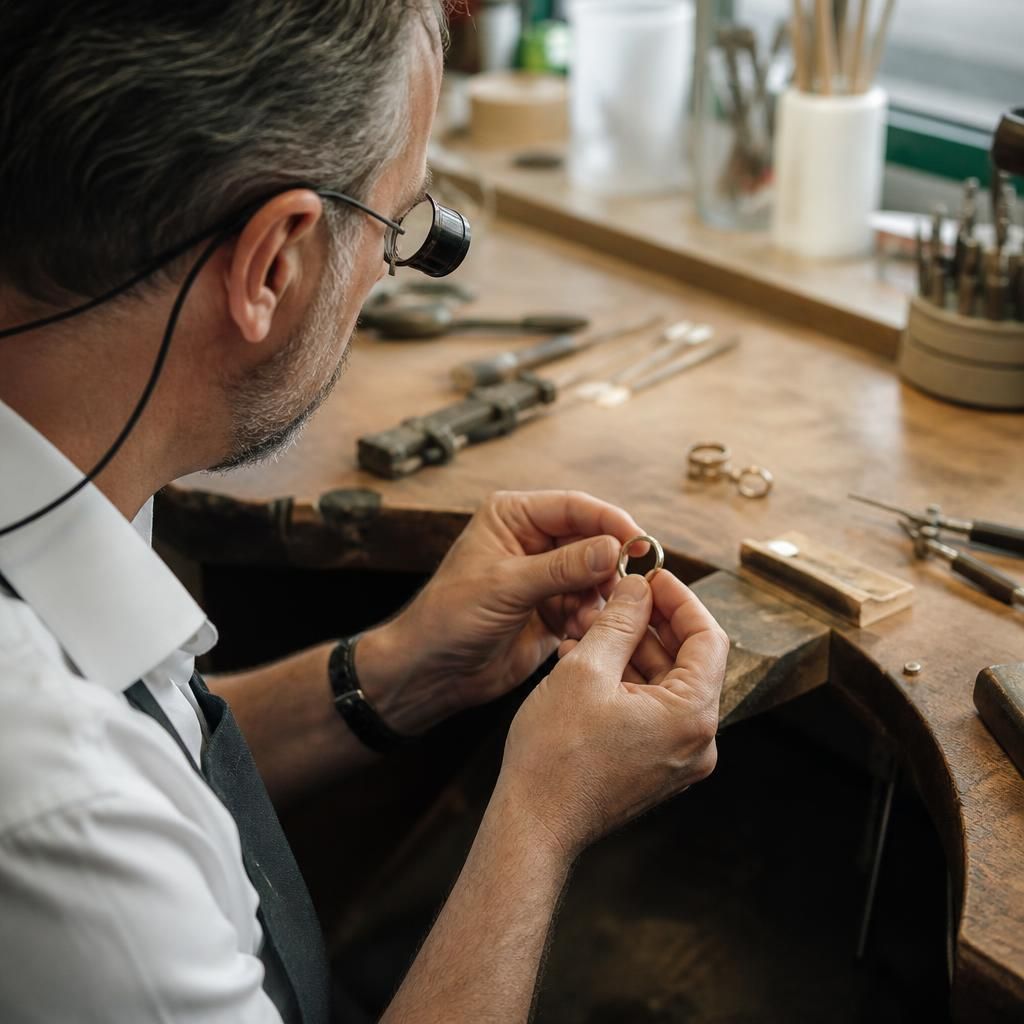
What is the process of resizing a wedding ring?
Resizing a wedding ring involves measuring the required size, carefully cutting and adjusting the band, then joining, shaping, polishing and checking the finished ring. The exact method depends on the metal, construction, stones and design, so your jeweller should assess the ring before confirming the most suitable approach.
Resizing a wedding ring is a specialist bench-jewellery process in which the ring is assessed, measured, altered and refinished so that it fits securely without compromising its structure or appearance. The jeweller first confirms how much adjustment is needed and examines the metal, setting, engraving and overall construction before choosing the appropriate technique.
1. Assessment and consultation
The process begins with an inspection of the ring and a discussion about how it currently fits. Finger size can vary with temperature, time of day and other factors, so the required size should be confirmed carefully rather than based solely on a previous measurement. Your jeweller will consider whether the ring is loose, tight or causing pressure, and whether it needs to fit alongside another ring.
The ring is also checked for wear, thinning, damage, loose stones and previous resizing work. This assessment is important because an existing weakness may need attention before or during the adjustment. The metal type, ring profile, hallmarking, setting style and any engraving are recorded so that the finished piece can be handled appropriately.
2. Selecting the resizing method
Most plain metal bands can be resized by removing a small section to make the ring smaller or adding a matching piece of metal to make it larger. The exact method depends on the amount of adjustment required and the design of the ring.
Some rings can be altered using internal sizing solutions, such as a discreet insert or beads, where only a minor change is needed or where cutting the band would be unsuitable. These options may also be considered for rings with complex settings or designs that make conventional alteration more difficult.
Not every ring can be resized safely. Full eternity designs, heavily stone-set bands, rings made from particularly hard or brittle materials, and some tension-set designs may have significant limitations. A professional assessment should take place before any work is agreed, especially where the ring contains gemstones or has sentimental, antique or unusual construction.
3. Measuring and preparing the ring
Once the required size and method have been agreed, the jeweller marks the area of the shank where the adjustment will be made. The position is selected carefully, usually away from prominent stones, settings and important design details. Any gemstones are checked and protected before work begins, and the ring is cleaned so that its condition can be assessed accurately.
For a ring that needs to be made smaller, a measured section of metal is removed. For a ring that needs to be made larger, the band is opened and a carefully matched piece of metal may be inserted. The replacement metal should be compatible with the original in type, colour and composition as far as possible. Differences may be more noticeable in mixed-metal or heavily finished designs.
4. Joining and shaping the band
The cut or inserted section is joined using a suitable jewellery soldering or laser-welding technique, selected according to the metal and the ring’s construction. The join must be secure and controlled so that heat does not damage gemstones, settings, engraving or surface treatments.
After joining, the band is shaped back into a true, even circle or the intended profile of the ring. The jeweller checks that the shoulders are aligned, that the setting sits correctly and that the ring is not twisted. This stage is particularly important for rings with a shaped exterior, a fitted wedding band or an engagement-ring pairing, as a small change in form can affect how the rings sit together.
5. Filing, polishing and restoring the finish
The join is filed and blended so that it follows the surrounding metal without leaving a sharp edge or visible step. The ring is then polished to remove tool marks and restore a consistent surface. A high-polish, satin, brushed or textured finish requires different finishing treatment, and a patterned or engraved design may need careful restoration after the band has been altered.
Where the ring is rhodium-plated or has another surface coating, the finish may need to be renewed after the resizing work. This is assessed as part of the service rather than assumed, because refinishing requirements vary according to the metal and the existing condition of the ring.
6. Final inspection and fitting check
Before the ring is returned, it is inspected for structural integrity, alignment, surface quality and the security of any stones. The inside and outside of the band are checked for smoothness, and the ring is measured again to confirm that the intended size has been achieved.
A final fitting check helps confirm that the ring passes over the knuckle appropriately and sits securely without excessive movement or pressure. If the ring is being worn with another band, both should be checked together where possible. A fit that is comfortable in one season may feel different in warmer or colder conditions, so practical advice about wear and future monitoring is also useful.
What can affect the process?
Resizing is not simply a matter of stretching or compressing the metal. Poorly controlled work can leave a weak join, an uneven profile, damaged stones or an inconsistent finish. For that reason, the ring should be assessed by an experienced jeweller before a price and timescale are confirmed. If conventional resizing is unsuitable, the jeweller should explain the limitations and discuss alternatives rather than proceeding with unnecessary risk.
After collection, avoid exposing the ring to knocks, chemicals or heavy work until you are satisfied that it fits correctly and any stones remain secure. A ring that becomes tight, rotates excessively, develops a sharp edge or shows movement around a setting should be returned for inspection. Regular cleaning and periodic checks are especially sensible for wedding rings worn every day, as normal wear can gradually thin the shank or loosen settings.
Resizing a wedding ring is a controlled jewellery repair in which the band is adjusted, rejoined and refinished to achieve a secure, comfortable fit. Before work begins, the jeweller assesses the ring’s metal, construction, stones, engraving and previous repairs, then confirms the required size and the safest method.
A plain precious-metal band may be made smaller by removing a section or made larger by adding a matching piece of metal. Rings with continuous stones, intricate detailing or unusual materials may require a different solution, such as discreet internal sizing, or may not be suitable for conventional resizing. The ring is shaped and polished after alteration, then checked for alignment, finish and stone security.
- Ring design: Plain bands are generally more straightforward than rings with continuous stones, detailed shoulders, engraving or an irregular profile.
- Material: Gold, platinum and other precious metals may require different heat control, joining methods and finishing techniques. Some modern materials cannot be resized using conventional methods.
- Amount of adjustment: A minor change may require limited intervention, while a more substantial alteration can affect the ring’s shape, setting and decoration.
- Stone setting: Heat and movement can place stress on gemstones and settings, so stones must be assessed before work and checked afterwards.
- Previous repairs: Earlier resizing, thinning or damage can affect the strength of the band and may change the recommended approach.
- Surface treatment: Plating, brushing, texturing and engraving may need to be restored after the band is altered.
Book Your Wedding Ring Resizing Consultation
If your wedding ring no longer fits comfortably, book a resizing consultation so we can assess its construction and recommend the safest adjustment.
Speak to your personal jeweller
Every commission begins with a conversation. Arrange an appointment in the Birmingham Jewellery Quarter or talk it through by phone.