
What are the specific techniques used in wedding ring resizing that ensure the integrity of the jewellery is maintained?
Expert wedding ring resizing preserves the jewellery’s integrity through careful measurement, controlled cutting or stretching, precise metal matching, secure soldering and thorough finishing. The setting, stones, hallmark and original design are inspected throughout so the ring remains structurally sound, accurately shaped and visually consistent.
Wedding ring resizing preserves the integrity of the jewellery by combining accurate measurement, controlled metal removal or addition, careful protection of stones and settings, secure joining, and precise finishing. The technique selected depends on the ring’s metal, band profile, setting style, hallmark, surface finish and the amount of adjustment required.
Initial inspection and measurement
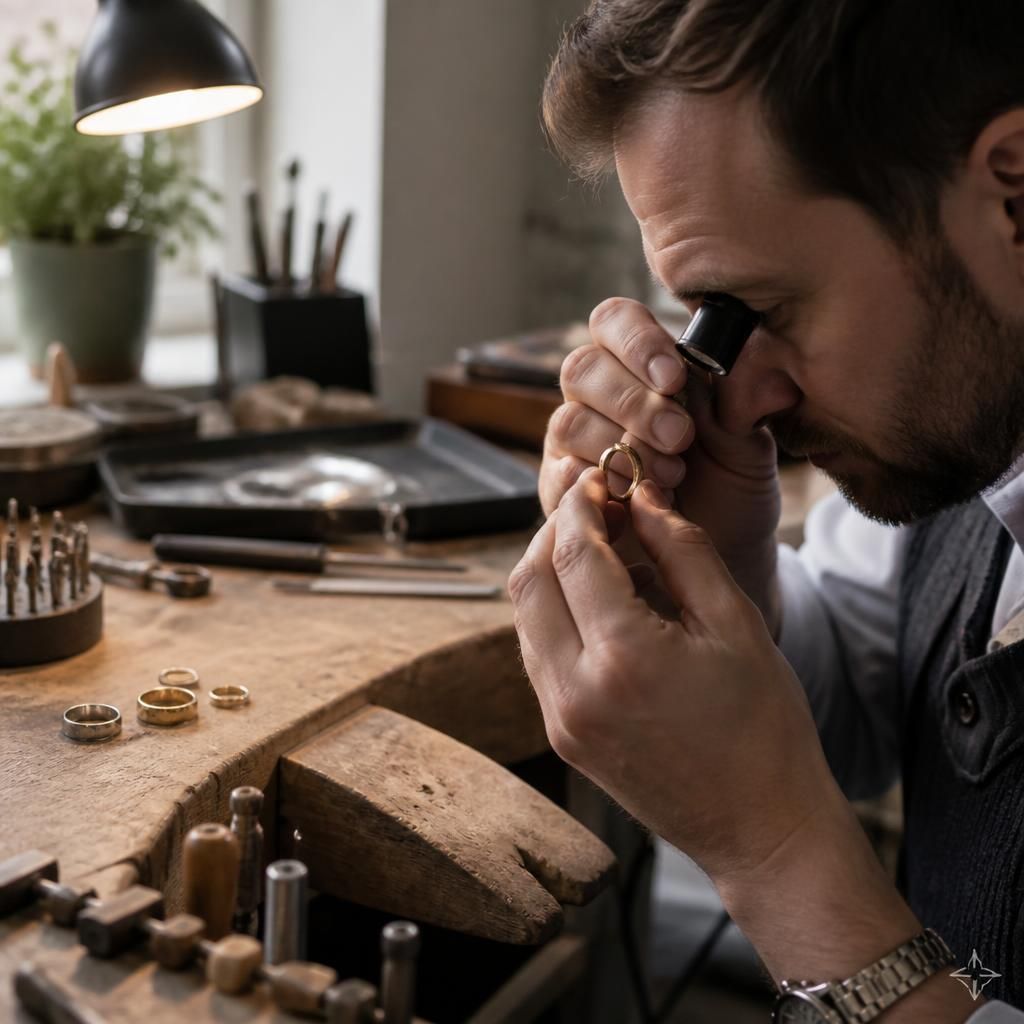
Before any work begins, the ring is examined under magnification. This identifies existing wear, thinning, previous joins, loose stones, worn claws, hairline cracks and areas of distortion that could affect the resizing. The ring is also measured against the wearer’s requirements and compared with the shape of the finger, rather than relying on a measurement alone. This helps determine whether the ring needs a permanent size change or a smaller adjustment, such as a sizing aid or discreet internal insert.
The jeweller records important details, including the position of the hallmark, engraving, shoulder design and any decorative pattern. These features influence where the ring can safely be opened and ensure that the finished piece remains as close as possible to its original appearance.
Controlled cutting and metal removal
When a ring needs to be made smaller, a narrow section of metal is carefully removed from the least visible and structurally suitable part of the shank. The cut is made with precision so that the two ends meet cleanly without placing stress on the shoulders, setting or stones. The ring is then brought back into a true circular or intentionally shaped form before the joint is secured.
Removing too much metal or cutting through a decorated area can weaken the band or interrupt its design. For this reason, the jeweller considers the ring’s profile and load-bearing areas before deciding where the cut should be made. Rings with engraving, channel settings or continuous patterns may require additional planning so the design remains aligned after resizing.
Adding a matching section of metal
For an increase in size, the shank is usually opened and a carefully selected piece of metal is inserted. The replacement section should match the original metal as closely as possible in fineness, colour, hardness and profile. Matching the cross-section is particularly important: a flat band, court-shaped band and D-shaped band each require a differently shaped insert to retain the original comfort and strength.
The added section is fitted tightly before joining. A poorly matched or loosely fitted insert can leave a visible seam, create a weak point or produce an uneven interior. Where the ring has a distinctive finish or aged appearance, the surface treatment is also considered so that the new section does not look noticeably different from the rest of the band.
Stretching and compression, where appropriate
Some plain, sufficiently substantial bands can be adjusted using controlled stretching or compression. This may be suitable for a modest change where the ring has no stones, delicate detailing or structural weakness. The process must be carefully controlled because excessive force can thin the shank, distort its profile or place pressure on settings.
Stretching is not a universal solution. It is generally unsuitable for many patterned, stone-set, hollow, heavily engraved or already worn rings. An expert will assess the construction first rather than using stretching simply because it appears quicker.
Secure joining with suitable heat control
After the ring has been cut or opened, the joint may be secured by soldering or, where appropriate, laser welding. The choice depends on the metal, construction and position of the join. The aim is to create a strong, neat connection while using heat in a controlled way.
Heat management is essential. Excessive or poorly directed heat can discolour some alloys, damage finishes, loosen stones or affect delicate settings. Stones that are sensitive to heat are removed where necessary, protected with suitable techniques, or assessed to establish whether the proposed method is safe. Laser welding can be useful for precise work close to detailed areas, but it is not automatically appropriate for every ring or metal.
Protecting stones and settings
Resizing can alter the tension in a ring, so stones and their settings are checked before, during and after the work. Particular care is required with claw, rub-over, channel and pavé settings, as movement in the shank can affect how securely stones are held. The ring is supported to prevent unnecessary pressure on the setting, and stones are not exposed to avoidable force or heat.
Once the resizing is complete, each stone is checked for movement and the claws or surrounding metal are examined for signs of weakness. If the inspection identifies pre-existing damage, it should be addressed rather than concealed by the resizing process.
Maintaining the ring’s shape and finish
The resized ring is brought back to its correct profile using controlled forming tools. This is important for comfort, even wear and proper alignment with a companion ring. The inside and outside edges are then carefully blended so the join is not sharp, raised or uneven.
Finishing may include filing, smoothing, polishing, satin finishing, frosting or reapplying a specific textured surface. The jeweller avoids removing unnecessary metal during this stage. On a ring with a matt or brushed finish, polishing the entire band can alter its character, so the original finish should be recreated as accurately as possible.
Final quality checks
A complete inspection confirms that the ring is correctly sized, round or correctly shaped, structurally sound and comfortable on the finger. The joint is checked for gaps or weakness, the band is examined for thinning or distortion, and the hallmark and engraving are reviewed. Stones are tested for security, and the surface is cleaned so that any remaining marks or residue can be identified before the ring is returned.
These techniques work together rather than as isolated steps. A successful resize is not simply a change to the internal measurement; it retains the band’s strength, setting security, proportions, finish and original design. If a ring is unusually delicate, heavily worn, significantly patterned or set with heat-sensitive stones, the safest option may be a more conservative adjustment, a partial reconstruction or advice that resizing is unsuitable in its present condition.
Wedding ring resizing maintains the jewellery’s integrity by altering the shank in a controlled way, rather than forcing the ring into a new shape. For an increase in size, the jeweller opens the band and fits a matching section of metal, selected to correspond with the original alloy, colour, thickness and profile.
The insert is shaped to meet the existing band closely before it is soldered or laser welded, depending on the ring’s construction and stone setting. The join is then blended and refinished so it remains smooth, strong and visually consistent. Throughout the process, the ring is checked for distortion and the setting is protected from unnecessary heat or pressure.
Arrange an Expert Wedding Ring Resizing Consultation
Arrange an expert wedding ring resizing consultation with Steven Charles Quance to assess the ring’s construction, stones, metal and required adjustment. We will explain the safest technique for preserving its strength, shape and original finish.