
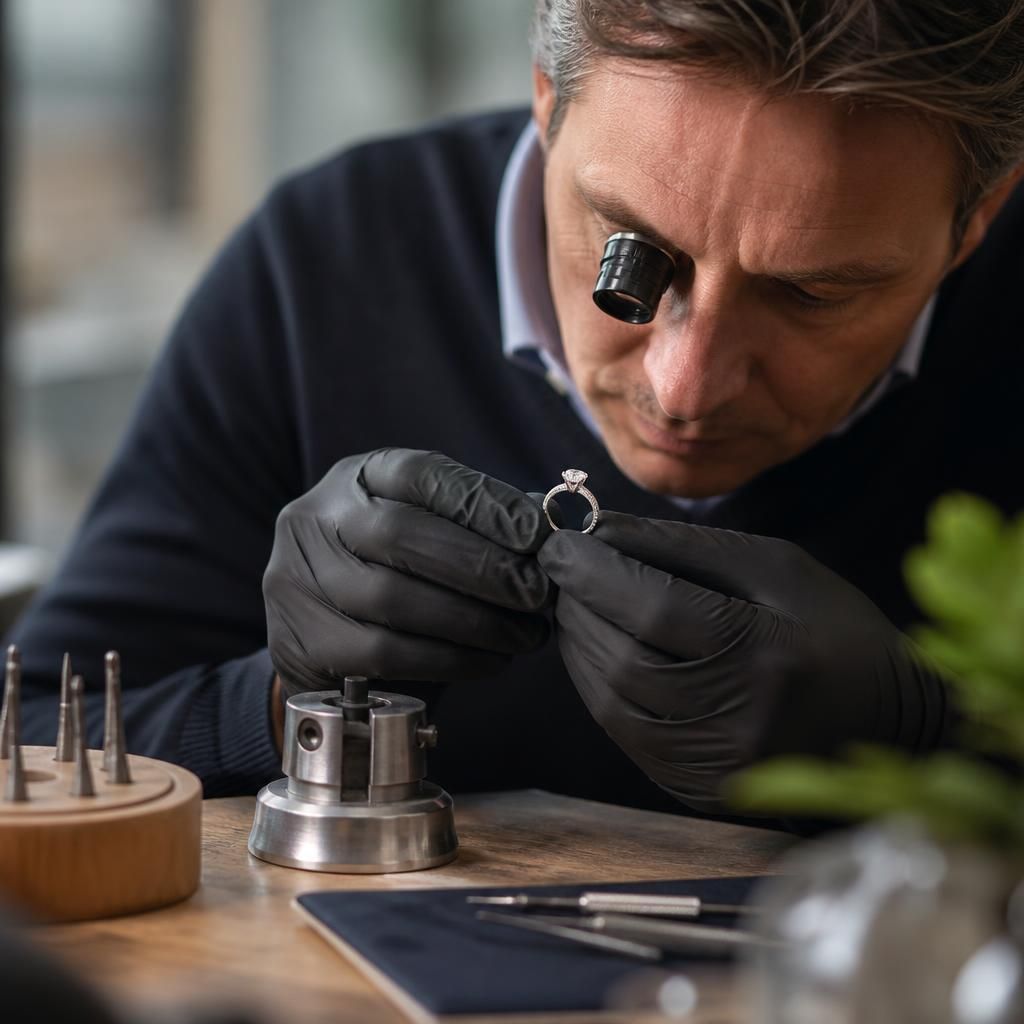
What specific steps are involved in the engagement ring resizing process at your service, and how do they ensure the quality and integrity of my ring?
Our engagement ring resizing process begins with a careful assessment of the ring, gemstones, settings and metal, followed by precise measurement and selection of the safest resizing method. After the adjustment, we restore the band, check the settings and finish, then inspect and polish the ring to ensure its strength, appearance and stone security are preserved.
Our engagement ring resizing process is a carefully controlled sequence of assessment, measurement, adjustment, finishing and inspection. We examine the ring as a complete piece rather than changing the band in isolation, so the metal, gemstones, settings, hallmarking and original design are considered before any work begins.
This process protects the ring’s quality by treating resizing as both a fit adjustment and a piece of jewellery restoration. The safest result is not always the quickest or most straightforward method: a bespoke design, an intricate setting, delicate metal, gemstones along the band or a previous alteration may require additional preparation and a more cautious recommendation.
Resizing cannot always correct every fit issue. A ring may be unsuitable for conventional alteration if the band is heavily patterned, contains stones around much of its circumference, uses incompatible mixed metals or has insufficient sound metal to work with. In those cases, we explain the limitations and discuss alternatives, which may include an internal sizing solution, a more involved remodelling approach or leaving the ring unchanged to preserve its structure.
Because resizing can expose worn settings or affect an existing finish, the assessment is an essential part of the service. It allows us to balance comfort with the ring’s long-term durability and to ensure that any recommendation is appropriate for the particular piece, not simply based on its stated size or appearance.
The initial inspection is the foundation of safe engagement ring resizing. Before the band is altered, we assess its metal, construction, gemstone settings and existing condition to determine whether resizing is suitable and which method will protect the ring most effectively.
We look for thinning metal, worn claws, loose stones, previous resizing joins, cracks and damage that could weaken the ring during adjustment. The required fit is also considered alongside the band’s width, profile and the way it is worn with other rings. This helps distinguish a genuine sizing requirement from temporary changes caused by temperature or finger swelling.
Any concerns are explained before work begins. Where a conventional adjustment could compromise an intricate design, stone setting or mixed-metal construction, we can discuss a more conservative alternative. This careful assessment ensures that resizing addresses comfort without overlooking the ring’s long-term strength, alignment or gemstone security.
- Initial assessment and discussion. We inspect the ring and discuss how it currently fits, when the fit feels uncomfortable and whether the size has changed gradually or suddenly. A ring that feels tight may need resizing, but swelling, temperature and changes in finger shape can also affect fit. We also consider whether the ring is worn alongside a wedding band or another ring.
- Inspection of the ring’s condition. The band, shoulders, claws, bezel or other setting, gemstone edges and any decorative details are checked for signs of wear or weakness. We look for thinning metal, worn claws, loose stones, previous resizing marks, cracks and damage that could affect the safest approach. If a setting needs attention, this is discussed before resizing proceeds.
- Accurate measurement. We assess the required fit using the ring and your finger, taking the ring’s width, profile and style into account. A wide band, a shaped inner surface or a setting that sits high on the finger can feel different from a narrow, plain band at the same nominal size. The aim is a secure, comfortable fit rather than relying on a measurement alone.
- Secure joining and shaping. The adjusted section is joined using a suitable jewellery-making technique for the ring’s metal and construction. The band is then brought back to a smooth, even shape, with the setting kept correctly aligned. A well-executed join should be structurally sound and visually discreet, while still allowing the ring to be inspected and maintained in the future.
- Restoration of the surface and details. Any join is blended into the surrounding metal, and the ring is checked for marks or changes caused during the work. Engraving, milgrain, texture, finishes and decorative edges are preserved or restored where possible. If the ring has a particular finish, such as a polished and matt combination, the surface is refinished to match its original appearance.
- Final sizing and quality inspection. The finished ring is checked against the intended size and profile, then inspected for a smooth interior, an even exterior and a comfortable edge. We assess the strength of the resized area, the alignment of the setting and the overall condition of the ring before it is returned to you.
- Cleaning, polishing and handover. The ring is cleaned and polished according to its metal and finish. On collection, we explain what work was carried out and draw attention to any care or monitoring recommendations. It is sensible to contact us if the ring feels loose, tight, catches on clothing or develops any movement after resizing, rather than continuing to wear it without assessment.
Arrange an engagement ring resizing consultation
Arrange an engagement ring resizing consultation so we can assess the ring’s condition, confirm the required fit and recommend the safest method for preserving its design and gemstone security.