
What specific qualifications and industry credentials should you look for in a jewellery repair service to ensure reliability and expertise?
Look for a jewellery repair service with trained bench jewellers, relevant practical experience, and recognised industry credentials such as National Association of Jewellers membership or Gem-A qualifications where gemmology is involved. Reliability is also supported by transparent written quotations, appropriate insurance, secure handling procedures, and clear aftercare or workmanship guarantees.
A reliable jewellery repair service should combine practical bench-jewellery training, relevant experience with the type of item being repaired, recognised professional or gemmological credentials, and robust procedures for quotations, security, insurance and aftercare. No single qualification proves that every repair will be suitable, so credentials should be considered alongside the jeweller’s workmanship, assessment process and willingness to explain the proposed work.
Look for relevant bench-jewellery training. The person carrying out the work should have demonstrable training in jewellery manufacture and repair, including soldering, setting, polishing, metal testing and the safe handling of gemstones. Qualifications may include recognised jewellery or goldsmithing certificates, apprenticeships, City & Guilds awards or other formal practical training. Ask whether the repair is completed by an experienced bench jeweller in-house or passed to an outside workshop, particularly where the item is valuable, antique or structurally delicate.
Practical experience matters because jewellery repairs are not interchangeable. Rebuilding a worn ring shoulder, replacing a chain clasp, tightening a stone, repairing a platinum setting and restoring a vintage piece each require different techniques. A jeweller should be able to explain how the metal, construction, hallmark, setting style and condition of your item affect the proposed repair. Experience with similar work is often more useful than a general claim to being qualified.
Consider recognised professional membership. Membership of the National Association of Jewellers can provide an indication that a business operates within an established professional framework and takes standards, training and consumer practice seriously. Membership alone is not a guarantee of workmanship, but it is a useful credential when combined with a clear repair policy, transparent pricing and appropriate insurance. You can ask which professional body the business belongs to and what standards or code of conduct apply to that membership.
Check gemmological expertise where stones are involved. If a repair includes diamonds, coloured gemstones, pearls or an unusual antique stone, look for appropriate gemmological knowledge. Gem-A qualifications are a recognised example of formal gemmological training. This knowledge helps with identifying treatments, assessing durability and recognising stones that may be vulnerable to heat, chemicals, pressure or sudden temperature changes during repair.
Not every gemstone should be treated in the same way. Some stones can be affected by heat used during soldering, while others may have inclusions, coatings, fractures or treatments that require additional precautions. A competent jeweller should inspect the stone before work, record its condition, identify obvious risks and tell you if a particular repair method could affect it. Where identification or treatment status cannot be confirmed visually, the jeweller should explain whether specialist testing is advisable.
Ask about specialist experience for watches and branded or antique pieces. Jewellery repair credentials do not automatically demonstrate competence in watch servicing. A luxury watch may require a trained watchmaker, suitable equipment, water-resistance testing and access to appropriate replacement parts. For a branded, signed or antique item, ask whether the workshop has experience with that construction and whether the proposed work will preserve original components and design features. Extensive polishing, replacement parts or alterations can affect originality and value, so these points should be agreed before work begins.
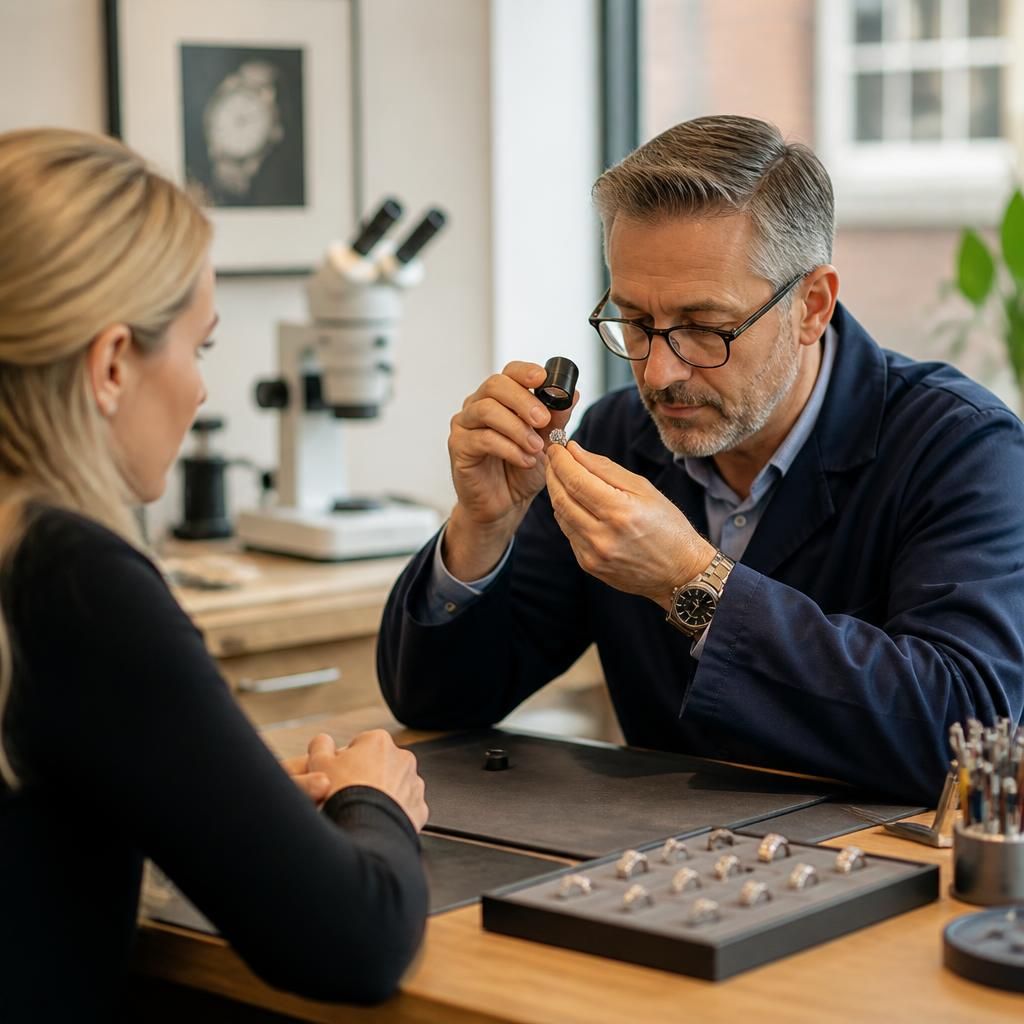
Look for evidence of assessment and documentation. A professional repair service should examine the item before accepting it and record relevant details such as the metal, hallmarks, gemstones, measurements, existing damage and any notable marks. For higher-value pieces, photographs or a written condition report provide a useful record. The repair document should state what work has been requested, what has been observed and whether any additional work may be necessary.
A written quotation should distinguish between the recommended repair and optional improvements. It should explain whether the price includes parts, labour, gemstone replacement, polishing, cleaning, hallmarking or any specialist testing. If hidden damage is discovered after dismantling, the jeweller should contact you for approval rather than proceeding with unexpected work. A clear quotation is not a qualification, but it is an important sign of professional practice.
Check security, insurance and responsibility for your item. Ask how jewellery is logged, stored and protected while it is on the premises, and whether the business holds suitable insurance for customers’ property in its care. For valuable jewellery, confirm whether the declared value or an existing valuation is sufficient for the repair period. A reputable service should be able to explain its collection procedure and what happens if a piece requires work by a specialist partner.
Review workmanship guarantees and aftercare. Find out whether the repair is covered by a written workmanship guarantee, what it includes and how long it applies. The terms should make clear how issues such as a failed solder joint, loose setting or defective replacement component will be handled. A guarantee may not cover accidental damage, normal wear, previously weakened metal or stones that were already fractured, so read the exclusions rather than relying on a verbal assurance.
Useful aftercare may include a follow-up inspection, cleaning, checking of settings and advice about wear. Ring resizing, for example, can alter the shape and tension of a setting, while polishing removes a small amount of surface metal and may not be appropriate for every antique or heavily worn piece. The repairer should tell you what maintenance is advisable and when the item should be checked again.
Use these questions when comparing a repair service:
For an ordinary repair, practical competence, careful inspection and transparent procedures may be more relevant than an extensive list of certificates. For a high-value, antique, gemstone-set or luxury watch item, use a service that can demonstrate specialist training, suitable equipment, secure handling and a documented chain of responsibility. At Steven Charles Quance, you can discuss the item’s condition, the repair options and any valuation or aftercare requirements before authorising work, allowing the appropriate level of expertise to be matched to the piece.
The most relevant qualification for a jewellery repair is practical bench-jewellery training combined with experience of the item being repaired. A jeweller should be able to explain their experience with the particular metal, setting style, gemstone or construction involved, rather than relying solely on a general professional title.
For jewellery containing diamonds, coloured gemstones or pearls, ask whether the repairer has suitable gemmological knowledge, such as a recognised Gem-A qualification. This helps with identifying treatments and assessing whether a stone may be vulnerable to heat, pressure or chemicals. Antique pieces, platinum settings and luxury watches may also require specialist workshop skills and equipment.
Credentials should be considered alongside a proper inspection, a written quotation and clear insurance and aftercare arrangements. Before work begins, the repairer should record the item’s condition, explain any risks and confirm who will carry out the repair. These practical safeguards provide useful evidence that the service is reliable and appropriately qualified for your jewellery.
- Who will carry out the repair, and what practical training or experience do they have?
- Have they worked on the same metal, setting style, gemstone or watch type before?
- Does the business hold relevant professional memberships or gemmological qualifications?
- How will the item be inspected and recorded before work begins?
- What risks, treatments or pre-existing damage have been identified?
- Will you receive a written quotation before any additional work is undertaken?
- How is the item stored, insured and tracked while it is in the workshop?
- What guarantee and aftercare are provided once the repair is complete?
Discuss Your Jewellery Repair Requirements
Discuss your jewellery repair requirements with Steven Charles Quance to review your piece’s condition, suitable repair options and any aftercare or valuation needs before work begins.
Speak to your personal jeweller
Every commission begins with a conversation. Arrange an appointment in the Birmingham Jewellery Quarter or talk it through by phone.