
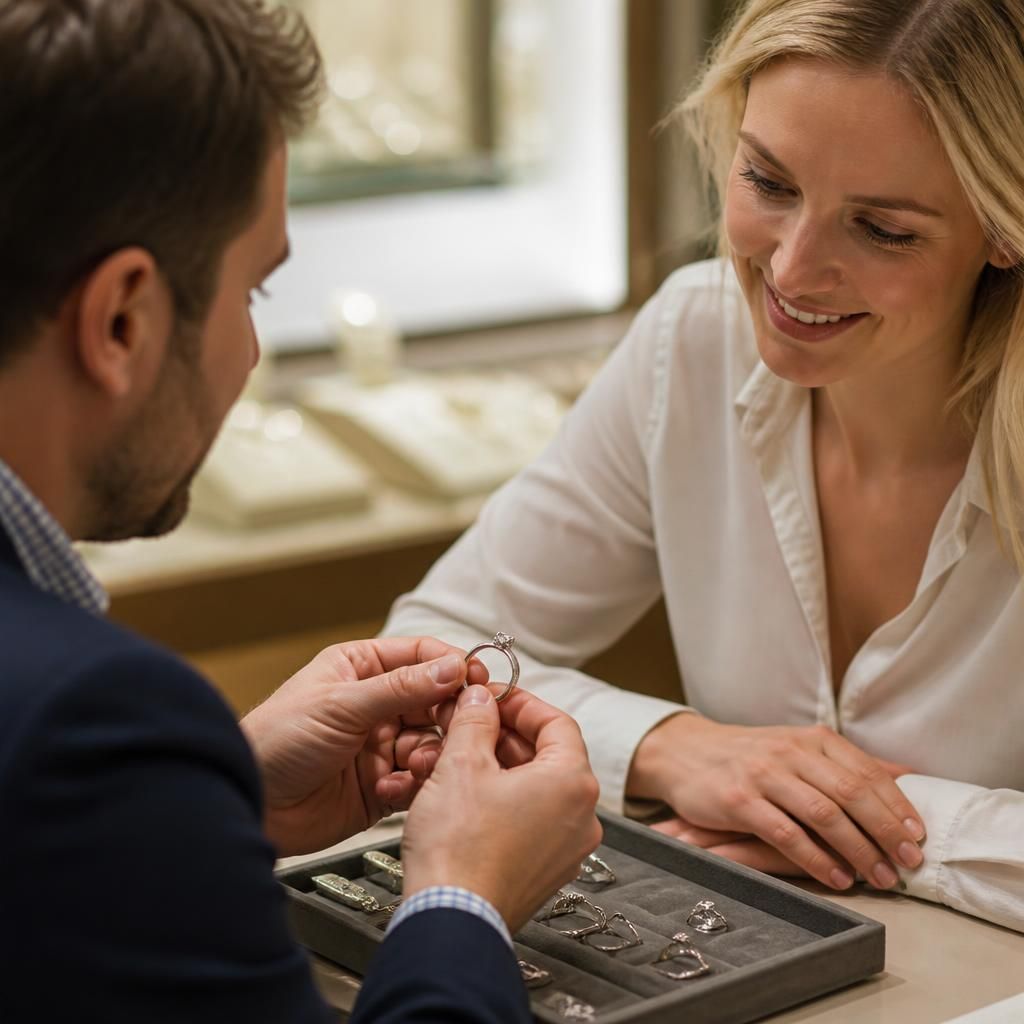
How do I ensure the quality of an engagement ring from the Jewellery Quarter?
To ensure the quality of an engagement ring from Birmingham’s Jewellery Quarter, examine the diamond or gemstone, metal hallmark, setting security and overall craftsmanship, and request independent certification where appropriate. Buy from a trusted jeweller who can explain the ring’s materials and provide clear documentation, sizing support and aftercare.
To assess the quality of an engagement ring from Birmingham’s Jewellery Quarter, examine the diamond or gemstone, confirm the precious-metal hallmark, inspect the setting and finish, and check that the jeweller provides accurate documentation and aftercare. A reputable jeweller should be able to explain how the ring was made, where its materials came from and how its condition and value can be supported after purchase.
Start with the diamond or gemstone. For a diamond, review the four Cs: cut, colour, clarity and carat weight. Cut is particularly important because it affects how effectively the diamond returns light; a well-cut stone can appear brighter than a heavier stone with weaker proportions. Colour and clarity should be assessed in relation to the setting and your budget rather than in isolation. Ask to see the diamond under neutral lighting as well as display lighting, and check whether any inclusions or treatments have been disclosed.
If the ring features a coloured gemstone, ask about its species, origin where known, treatment and durability. Some stones are more vulnerable to scratching, heat or sudden impact than diamond, sapphire or ruby. Treatments such as heating, filling or fracture enhancement can be acceptable when properly disclosed, but they may affect care requirements, durability and value.
Request a recognised grading report where appropriate. A diamond grading report should identify the stone and record its measured characteristics, proportions and grading assessments. Match the report to the stone by checking its measurements, identifying marks where present and any laser inscription. A report is not a substitute for examining the diamond in person: grading standards can vary, and the report does not assess the quality of the ring mount or the security of its setting.
Check the metal and hallmark. In the UK, a proper hallmark provides independent information about the precious-metal content and identifies the registered sponsor or maker, with an assay office mark showing where the item was tested. Look for the hallmark inside the band or in another discreet position. If the ring is too small or delicate for a conventional hallmark, ask what alternative marking or documentation applies. Do not rely solely on terms such as “gold” or “platinum”; confirm the metal, fineness and any mixed-metal construction in writing.
The hallmark should be consistent with the description on the invoice and valuation. On a pre-owned or vintage ring, worn marks may be difficult to read, so a jeweller should explain what can be established confidently and whether further testing is advisable.
Inspect the setting and stone security. The claws or bezel should hold the stone evenly, without gaps, sharp catches or visible movement. A gentle, clean-finger check should not cause the stone to rattle; do not deliberately pull or twist the setting. Examine whether claw tips are substantial and evenly finished, whether the stone sits level and whether surrounding stones are secure. On a halo or pavé design, look for consistent spacing, aligned settings and no missing or damaged accent stones.
Consider the design’s suitability for everyday wear. A high-set stone may be more exposed to knocks, while fine claws and delicate pavé work can require more frequent inspections. A wedding band may not sit flush against an engagement ring with a low or unusually shaped setting. These are not necessarily defects, but they should be discussed before purchase so that the ring suits the wearer’s work, habits and preferred level of maintenance.
Assess the craftsmanship and finish. Examine the ring from different angles for smooth edges, even symmetry, clean joins and a consistent polish. The inside of the band should be comfortable, with no rough areas or unfinished solder. On a hand-finished or bespoke ring, small variations may be part of the intended character, but they should not affect comfort, structural strength or the security of the stones.
Ask how the ring was made and which elements can be altered. For example, resizing a ring with intricate shoulders, a full eternity setting or stones around the entire circumference may be more complex than resizing a plain band. A jeweller should explain any design limitations before work begins and advise whether future resizing, remodelling or stone replacement is practical.
Verify the documentation. Keep the sales invoice, diamond or gemstone report, hallmark details, metal description and any treatment disclosure together. The paperwork should state what has been purchased rather than using broad descriptions. For a bespoke ring, retain the agreed design, specifications and any changes made during production. A valuation for insurance purposes is separate from the purchase price and should describe the ring accurately, including its materials and identifying features.
If the ring is a significant purchase, an independent valuation or second opinion can provide additional reassurance. This is especially useful for an unusual gemstone, an antique ring, a substantial diamond or a piece with uncertain history. An independent assessment should be carried out by a suitably qualified professional who is not financially involved in the sale.
Ask about origin and ethical sourcing. Quality also includes responsible practice. Ask whether the diamond or gemstone has been sourced through established, traceable supply chains and whether recycled or newly mined metal is being used. For a vintage or pre-owned ring, ask what is known about its history. Ethical claims should be specific and supported by documentation or a clear explanation of the supplier’s controls, rather than relying on general terms such as “conflict-free” without further detail.
Check the aftercare before committing. Confirm whether the ring includes inspection, cleaning, claw checks, polishing, resizing or repair support, and ask how these services affect delicate or treated stones. Establish what is covered under any guarantee and what would be considered accidental damage or normal wear. Regular professional inspections are sensible because claws can wear gradually and a secure setting at purchase can become less secure over time.
Before leaving with the ring, check that the size is comfortable, the stone matches the documentation, the hallmark and finish are as described, and you understand the care instructions. Avoid applying pressure to the setting or wearing the ring during strenuous work until its fit and security have been confirmed. If anything differs from the agreed specification, raise it promptly so it can be examined and resolved before the ring is worn regularly.
A hallmark is an important quality check for a precious-metal engagement ring from Birmingham’s Jewellery Quarter because it confirms the metal’s fineness and identifies its registered sponsor or maker. Look for the hallmark inside the band or in another discreet position, then compare it with the metal description on your invoice.
Ask the jeweller to explain each mark, particularly if the ring combines different metals or is vintage and the hallmark is worn. Do not rely solely on descriptions such as “gold” or “platinum”; the paperwork should state the metal and fineness clearly. If the ring is too small or delicate for a conventional hallmark, request an explanation of the alternative marking or supporting documentation.
Arrange an engagement ring quality consultation
Arrange an engagement ring quality consultation to review the diamond or gemstone, hallmark, setting, documentation and aftercare options with an experienced jeweller.
Speak to your personal jeweller
Every commission begins with a conversation. Arrange an appointment in the Birmingham Jewellery Quarter or talk it through by phone.