
How do I find the best jewellers in the Jewellery Quarter for bespoke engagement and wedding rings?
To find the best jewellers in the Jewellery Quarter for bespoke engagement and wedding rings, assess their design expertise, craftsmanship, diamond and gemstone guidance, ethical sourcing, written quotations and aftercare. Choose a jeweller who takes time to understand your requirements, explains each stage clearly and can create, fit, resize and maintain rings to a high standard.
The best jeweller for bespoke engagement and wedding rings is one that combines design expertise, skilled craftsmanship, transparent advice and dependable aftercare. In the Jewellery Quarter, compare jewellers by how carefully they understand your requirements, how clearly they explain materials and costs, and whether they can manage the complete process from initial consultation through to fitting, resizing and future repairs.
A strong reputation is useful, but it should be supported by evidence of the jeweller’s work and the quality of its service. Look for an established business with experience creating made-to-order rings, a clear consultation process and examples of finished pieces that demonstrate precision rather than relying solely on stock photography or broad claims about quality.
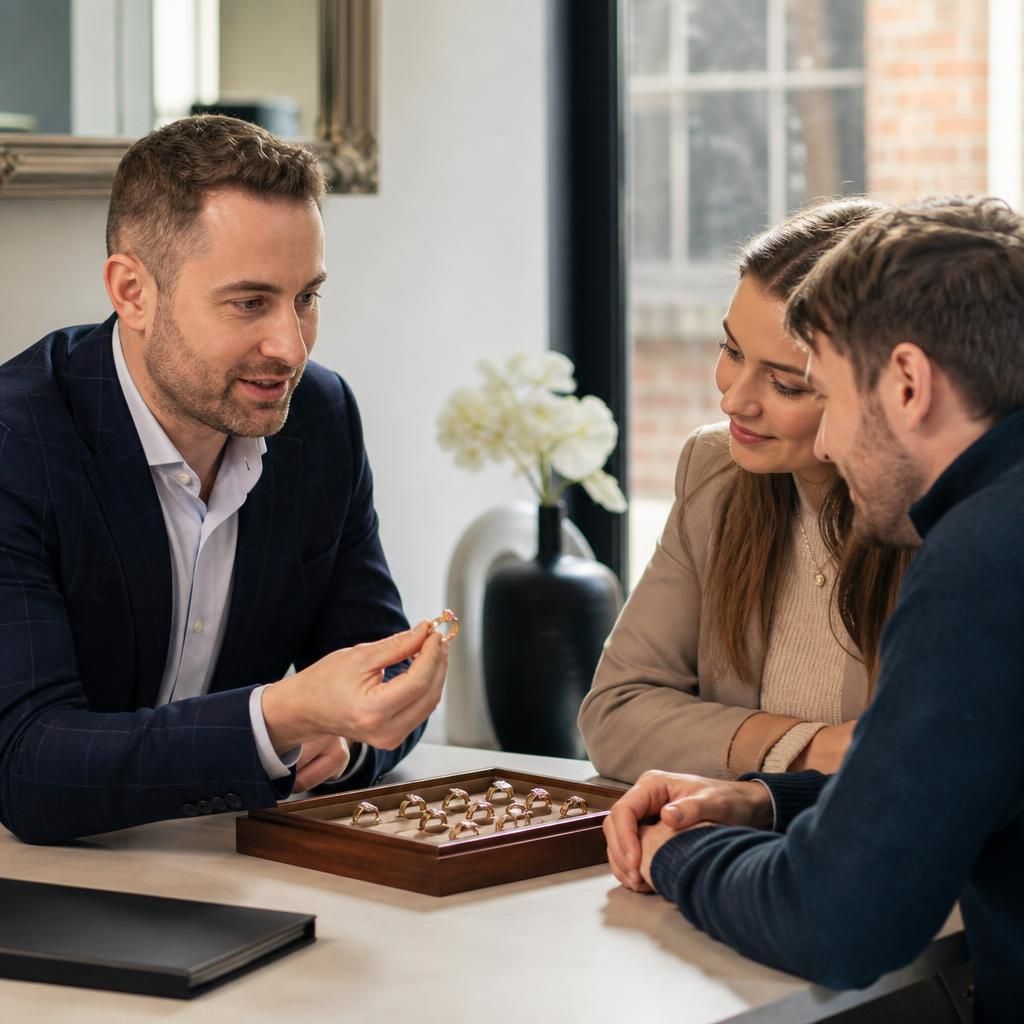
Start with the consultation. A bespoke ring should reflect the wearer’s lifestyle, preferences and practical requirements. The jeweller should ask about the preferred style, metal, stone shape, setting, budget and how the engagement ring will be worn alongside a wedding band. They should also discuss proportion, comfort, durability and any existing jewellery that may influence the design.
A useful consultation does not need to result in a decision immediately. It should give you enough information to compare suitable options and understand the implications of each choice. Be cautious if you feel pressured to select a design or stone before the jeweller has established what you actually need.
Assess the design service. Bespoke work can range from adapting an existing design to developing a completely individual ring. Ask how your ideas will be recorded and reviewed. Depending on the design, this may involve sketches, measurements, wax models or computer-aided design images. The important point is that you should have an opportunity to check the proportions, setting and overall appearance before manufacture begins.
Ask how revisions are handled and when the design becomes final. A written record of the approved design helps prevent misunderstandings about the shape, dimensions, metal, stones and finish. It is also reasonable to ask whether design changes after approval will affect the quoted price or delivery arrangements.
Examine craftsmanship and construction. A well-designed ring must also be made to withstand regular wear. Inspect the quality of the settings, claws, joins, edges and surface finish. Stones should be secure, the band should feel comfortable and the ring should be properly balanced on the finger. For a wedding band intended to sit beside an engagement ring, the jeweller should consider how the two profiles meet and whether a shaped or fitted design is needed.
Ask whether the ring will be made in the jeweller’s own workshop or produced through a specialist manufacturing partner. Neither arrangement is automatically unsuitable, but the jeweller should be able to explain who is responsible for the work and how quality is checked. A specialist’s ability to discuss construction in practical terms is often more informative than a general claim that a ring is handmade.
Understand the metal options. Gold, platinum and other precious metals differ in colour, hardness, weight, maintenance and price. The most suitable option depends on the design and how the ring will be worn, not simply on appearance. Ask about the metal’s fineness, hallmarking, durability and likely changes in finish over time. If you are matching an existing ring, the jeweller should explain how differences in alloy, colour or wear may affect the result.
For couples choosing wedding rings, consider whether both rings need to be made from the same metal and finish. A jeweller can explain how different combinations will sit together and how regular contact may affect their surfaces.
Request informed diamond and gemstone advice. The best jewellers explain a stone’s characteristics in relation to the design and your priorities. For diamonds, this includes the familiar considerations of cut, colour, clarity and carat weight, alongside the shape, proportions and setting. A stone that looks attractive in isolation may not be the right choice for a particular ring design or budget.
For coloured gemstones, ask about hardness, durability, treatment, origin information where available and the care the stone requires. Some gems are more vulnerable to scratching, impact, heat or chemicals than others. The jeweller should not present every stone as equally suitable for daily wear, particularly in an exposed engagement-ring setting.
Before committing to a significant purchase, ask what documentation accompanies the stone and whether the description on the quotation matches the item supplied. A reputable jeweller should explain any treatments, limitations or uncertainties rather than implying that every aspect of a gemstone’s history can be guaranteed.
Check ethical and provenance information. Responsible sourcing should be discussed clearly rather than treated as an unsupported promise. Ask where the metal and stones come from, what supplier documentation is available and whether recycled metals, laboratory-grown diamonds or other alternatives can be considered. The right choice depends on your priorities, but you should receive accurate information that allows you to make an informed decision.
Compare written quotations. A bespoke quotation should identify the principal materials, stone specifications, ring size, design details, finish, relevant taxes and what is included in the service. It should also explain the deposit, payment stages, estimated timescale, approval process and what happens if the finished piece requires an adjustment.
Do not compare prices without comparing specifications. A lower quotation may reflect a smaller or lower-grade stone, a lighter ring, a different metal, fewer design revisions or limited aftercare. Equally, a higher price is not by itself proof of superior workmanship. Ask the jeweller to explain the differences in plain terms.
Give aftercare proper weight. Engagement and wedding rings are worn frequently and may need cleaning, inspection, resizing, polishing or repair. Before ordering, ask whether the jeweller offers these services and whether they are carried out in-house or arranged through a specialist. Confirm how future sizing changes, worn settings, damaged claws and replacement stones are handled.
A ring should be checked if it becomes loose, catches on clothing, develops a sharp edge or shows movement in a stone. Routine professional inspection can identify wear before a stone is lost. The jeweller should also provide practical care advice, including when to remove the ring and which substances or activities may cause damage.
Confirm the fitting process. Ring size is only one part of a comfortable fit. Band width, profile, finger shape, temperature and the relationship between two rings can all affect how a piece feels. A competent jeweller will measure carefully, discuss the intended fit and explain that a final size may need reviewing if the design is particularly wide, deep or detailed.
For a surprise engagement ring, ask about discreet ways to estimate size and whether the design can be adjusted later. For a planned purchase, arranging a fitting before manufacture is usually the most reliable approach.
Look for clear communication and accountability. You should know who your main contact is, how approvals are recorded and how you will be updated during the process. The jeweller should tell you promptly if a material, stone or manufacturing issue affects the design or timescale. Keep copies of the quotation, design approval, stone documentation and any guarantee or care information.
Warning signs include reluctance to provide written specifications, vague answers about stone treatments or provenance, pressure to pay before the design is understood, and promises that seem inconsistent with the complexity of the work. A professional jeweller should welcome reasonable questions and explain limitations honestly.
When comparing Jewellery Quarter jewellers, create a short list and ask each one similar questions about consultation, design development, manufacturing, materials, stone documentation, timescale, fitting and aftercare. The best choice is usually the jeweller who gives you the clearest advice, produces work suited to your requirements and remains responsible for the ring after the sale—not simply the one offering the lowest price or the quickest completion.
The most reliable way to assess a jeweller for bespoke engagement and wedding rings is to examine the consultation and design-approval process before comparing prices. A professional jeweller should turn your ideas into a clear, workable design and explain how the ring will be made, fitted and cared for.
Ask whether you will see sketches, measurements, computer-aided design images or a wax model before manufacture begins. The approved design should record the metal, ring size, stone specifications, setting, dimensions and finish. You should also understand when changes can still be made and whether revisions will affect the quotation or timescale.
This process helps identify a jeweller who is focused on suitability rather than simply making a sale. It also reduces the risk of misunderstandings, particularly where an engagement ring must sit neatly beside a wedding band. Before placing an order, request written details of the design, payment stages, estimated completion and available aftercare, including resizing, inspections and repairs.
Discuss Your Bespoke Engagement or Wedding Ring
Discuss your bespoke engagement or wedding ring with Steven Charles Quance to review your preferred design, metal, gemstones, fit and budget. We can explain the design and approval process, provide a clear quotation and advise on ongoing aftercare.
Speak to your personal jeweller
Every commission begins with a conversation. Arrange an appointment in the Birmingham Jewellery Quarter or talk it through by phone.