
What considerations are important when evaluating the condition of a used Rolex Sea-Dweller or Deepsea?
When evaluating a used Rolex Sea-Dweller or Deepsea, assess the case, bracelet, crystal, bezel, dial and hands for wear or damage, then verify the movement’s performance, service history, authenticity and water-resistance testing. Original parts, honest condition and documented professional servicing generally matter more than superficial polishing or cosmetic presentation alone.
A used Rolex Sea-Dweller or Deepsea should be assessed as a complete instrument, not simply judged by its visible appearance. The most important considerations are the condition and originality of the case, bracelet, crystal, bezel, dial and hands; the movement’s performance; the service history; evidence of correct water-resistance testing; and whether the watch is authentic and properly matched to its documentation. A few cosmetic marks may be acceptable, whereas damaged seals, excessive polishing, bracelet wear or an undocumented movement fault can have a much greater effect on reliability and value.
Begin with the case and lugs. Examine the case sides, lugs and caseback for deep scratches, dents, gouges or signs of corrosion. The lugs should retain their original shape and remain reasonably even from side to side. Heavy polishing can soften the edges, narrow the lugs and remove the crisp transitions that are characteristic of the model. Polishing is not automatically a fault, but it should be considered alongside the amount of material removed and the quality of the work. A lightly worn watch with defined case geometry may be preferable to one that has been extensively refinished to appear new.
Check the helium escape valve and surrounding case area carefully. It should sit securely and show no obvious damage, distortion or inappropriate replacement. On a Deepsea, the case construction and pressure-resistant systems are particularly important, so any previous caseback work or specialist repair should be supported by clear service documentation. Do not assume that a visually clean case remains water-resistant without a suitable test.
Inspect the crystal, bezel and dial. The sapphire crystal should be free from cracks, chips and significant scratches, especially around its edge. Minor marks may be repairable or acceptable, but damage can compromise legibility and, in some circumstances, sealing. The ceramic bezel insert should be checked for cracks, chips, abrasion and a secure fit. The bezel should turn in the intended direction with consistent resistance, and its alignment should correspond properly with the dial markings.
The dial and hands are important both cosmetically and from an originality perspective. Look for moisture marks, spotting, discolouration, lifted or damaged markers, and lume that appears inconsistent between components. Hands and dial should be appropriate for the particular reference and period. Replacement parts may be entirely legitimate following a professional service, but undisclosed changes can affect collectability and value. Any suggestion of moisture ingress deserves particular attention because it may indicate damage beyond the dial itself.
Give the bracelet and clasp a separate assessment. Check each link for excessive looseness, stretched joints, deep dents and signs of over-polishing. Inspect the clasp for secure closure, correct alignment and worn or damaged components. A bracelet that feels loose may only need adjustment or replacement pins, but substantial stretch can require more involved work. Confirm that the bracelet is suitable for the watch and that removable links, end links and clasp markings are consistent with the model. A watch supplied on an incorrect or heavily worn bracelet may still be authentic, but its condition and value should be assessed accordingly.
Test the movement rather than relying on appearance. The movement should start reliably, wind smoothly where applicable, and run consistently in different positions. The winding action should not feel gritty or unusually stiff, and the crown should screw down cleanly without cross-threading or excessive resistance. Check that the hands set smoothly, the date changes correctly where fitted, and the power reserve is appropriate for a healthy movement. A professional inspection can assess rate, amplitude, beat error, winding efficiency and the condition of the lubricants; these findings are more useful than a brief test on the wrist.
Service history provides essential context. A dated invoice or service report from a suitably qualified watchmaker can confirm what was inspected or replaced, although paperwork should not be accepted as proof that the current condition is perfect. Ask whether the movement, crown, gaskets, crystal, bezel or bracelet components have been changed, and whether any work involved polishing. If there is no service history, budget for the possibility of a full inspection and any maintenance recommended after examination. An old service may also require reassessment if the watch has since been used extensively or exposed to moisture or impact.
Water resistance must be verified professionally. A Sea-Dweller or Deepsea is designed for demanding underwater use, but its resistance depends on the condition of the case, crystal, crown, seals and valve, as well as correct assembly. A watch that passes a basic dry test has not necessarily been cleared for its full rated depth. The test should be appropriate to the model and carried out with specialist equipment, followed by further investigation if it fails. Until a qualified professional confirms the result, avoid swimming or diving with any used example, particularly if its service history is unknown or the crown has recently been opened.
Authenticity checks should compare the watch as a whole rather than focusing on one marking. The reference, serial information, rehaut engraving where applicable, dial, hands, bezel, clasp, bracelet, case construction and movement should be mutually consistent. The quality of engraving and finishing should be examined closely, and the movement should be inspected by an experienced professional. Box, papers and a matching card can support provenance, but they do not replace examination of the watch itself. Conversely, the absence of original accessories does not by itself prove that a watch is not genuine.
When comparing two otherwise similar watches, prioritise originality, structural integrity and documented mechanical condition over an artificially bright polish or a complete-looking accessory set. A transparent description of scratches, replaced parts, previous repairs and test results is more useful than a claim that a watch is simply in excellent condition. Keep photographs and service documents with the watch’s records, particularly if you may later require insurance, valuation, servicing or resale advice.
A practical assessment should therefore confirm:
- the case retains its correct shape and has no serious dents, corrosion or damaged threads;
- the crystal, bezel, dial and hands are sound and appropriate to the model;
- the bracelet and clasp operate securely without excessive stretch;
- the movement winds, sets and runs consistently;
- the service history and any replacement parts are clearly disclosed;
- the watch has passed suitable water-resistance testing before underwater use; and
- the reference, serial details, components and documentation are consistent with an authentic example.
For a used Sea-Dweller or Deepsea, honest condition is usually more valuable than superficial perfection. A specialist examination can identify faults that are not visible externally, distinguish normal wear from structural damage and establish whether the watch is suitable for immediate wear or should first receive servicing and pressure testing.
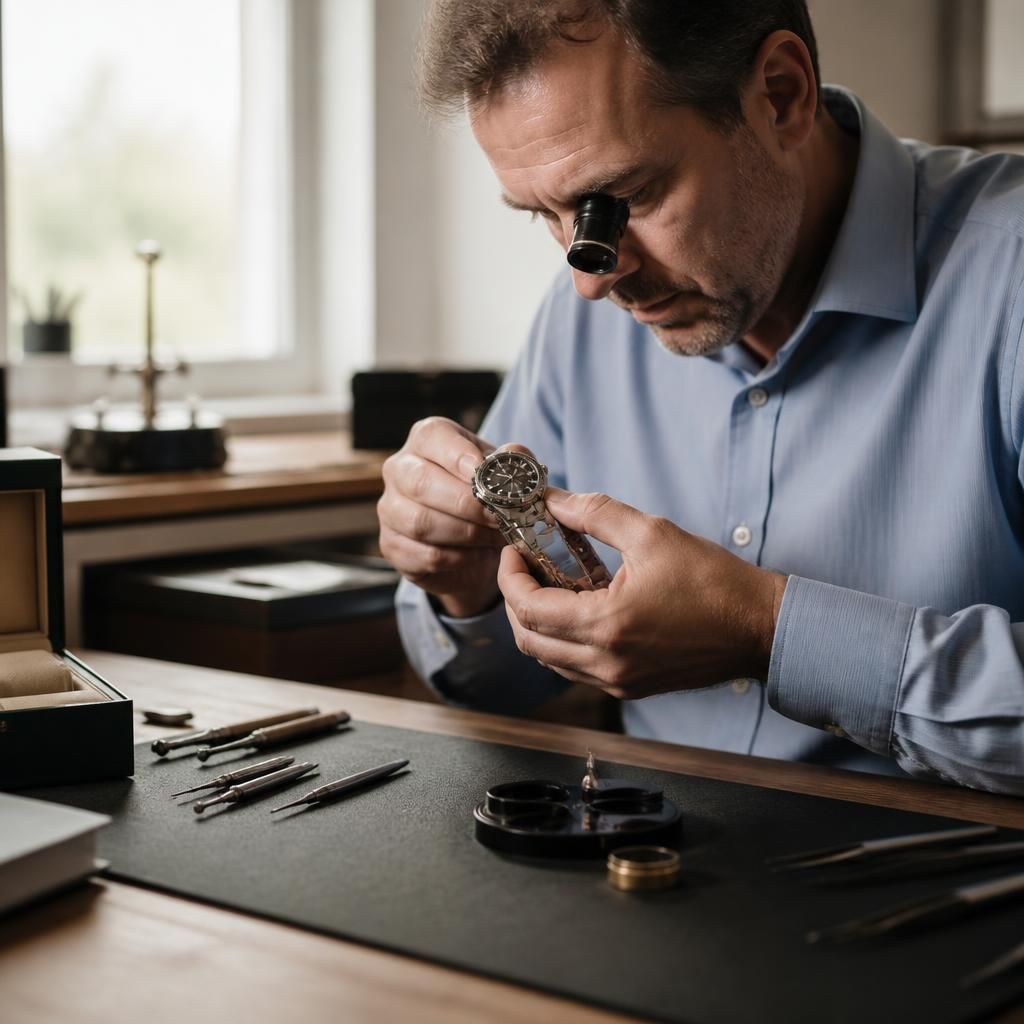
Water resistance is a critical condition check on a used Rolex Sea-Dweller or Deepsea, and it cannot be confirmed by appearance alone. Seals can age, the crown or helium escape valve may have been disturbed, and previous casework can affect the watch’s pressure resistance even when the exterior looks excellent.
Ask for evidence of a recent professional pressure test appropriate to the model. The case, crystal, crown, caseback and helium escape valve should be inspected if the watch fails or has an uncertain service history. Until the result is confirmed, do not wear the watch for swimming or diving. A watch that requires new seals or servicing should be treated as suitable for ordinary dry use only until it has been tested again.