What should I consider when determining the value of a used Rolex Daytona?
The value of a used Rolex Daytona is determined by its exact reference and materials, condition, originality, service history, provenance, completeness of the box and papers, and current market demand. A professional inspection and comparison with recent sales of equivalent watches will provide the most reliable valuation.
The value of a used Rolex Daytona depends on the precise reference, materials, originality, condition, service history, provenance, completeness and current market demand. A reliable valuation should therefore assess the individual watch rather than rely on the model name alone. Two Daytona watches that appear similar may have substantially different values because of their age, dial configuration, metal, documentation or condition.
Identify the exact reference and specification
Start by confirming the reference number, approximate production period and movement. The reference identifies the case, calibre and original configuration, while the serial number can help establish the watch’s age and support its provenance. Check whether it is a steel, gold, platinum or two-tone model, and record the bezel, bracelet, dial and hour-marker configuration.
Small specification differences can materially affect desirability. A particular dial variant, an early production detail, a discontinued configuration or a factory-set precious-stone model may attract a different market value from a more common example. The watch should be compared only with recent sales of the same reference and substantially equivalent specification.
Assess condition and originality
Condition is more than the absence of obvious scratches. A professional assessment should consider:
- the sharpness and symmetry of the case and lugs;
- whether the case has been over-polished or heavily refinished;
- the condition of the bezel, crystal, pushers, crown and chronograph functions;
- bracelet stretch, clasp wear and the availability of sufficient links;
- the dial, hands and luminous material; and
- whether components remain original to the watch and period.
Originality is particularly important when determining collectability. A replacement part may be perfectly legitimate and improve reliability, but it can affect value if it changes the watch from its original specification. Unusual dial, hand or bezel combinations should be examined carefully, as parts may have been replaced during a service or incorrectly matched at a later date.
Signs of water ingress, corrosion, damaged threads, poor previous repairs or a non-functioning chronograph can reduce value and may indicate additional servicing costs. Conversely, honest light wear, a well-preserved case and a clean, correctly operating movement generally support a stronger valuation than a watch that has been aggressively refinished.
Consider service history and mechanical performance
A Daytona’s movement, chronograph operation and water resistance should be inspected by a suitably qualified watchmaker. The valuation should take account of whether the watch starts, winds, sets and runs correctly, whether the chronograph starts and resets accurately, and whether the movement shows wear, contamination or corrosion.
Invoices, service records and a recent service report can provide useful evidence. They do not automatically make a watch more valuable, particularly if the work was incomplete or carried out using unsuitable parts, but they can reduce uncertainty and help establish its present condition. If no reliable service history is available, allow for the possibility of a full inspection and servicing when comparing the price with an equivalent watch that has documented maintenance.
Check provenance, box and papers
Provenance helps establish where the watch came from and whether its history is credible. Original warranty documentation, dated purchase records, service paperwork and a consistent serial-number trail can all support confidence in the watch. Documentation should be checked against the watch itself rather than accepted at face value.
The original presentation box, warranty card or papers, booklets, swing tags and spare links may contribute to desirability, especially for collectors. Their effect varies by reference and condition. Missing accessories do not necessarily undermine the watch’s authenticity, but an incomplete set will normally be compared differently from a complete and well-documented example.
Allow for current market demand
Market value changes with demand for particular Daytona references, materials and dial variants. Recent completed sales are more useful than advertised asking prices, which may not reflect what a buyer is actually prepared to pay. Compare watches sold within a similar period and adjust for condition, originality, documentation, service history and seller support.
Demand can also differ between a price for a private sale, a dealer purchase, an auction result and a retail offering. A dealer’s price may include authentication, inspection, warranty, overheads and aftercare, while a private-sale price may carry more risk and provide fewer protections. The purpose of the valuation should therefore be stated clearly: insurance replacement, estate planning, a possible sale, trade-in or purchase comparison may each require a different figure.
Separate market value from insurance value
An insurance valuation is usually intended to represent the cost of replacing the watch with an equivalent item through an appropriate retail channel. It may therefore differ from the amount a dealer would offer to buy the watch or the price achieved in a private sale. Make sure the valuation document explains the basis used, the watch’s identifying details and any assumptions about condition or availability.
Use an independent, professional assessment
Photographs and online listings can provide an initial indication, but they cannot reliably confirm movement condition, polishing, originality or authenticity. A proper valuation should involve examination of the watch, its serial and reference details, movement where appropriate, accessories and supporting documents. Where the value is significant, a written report should record the condition, identifying features, accompanying items and valuation date.
Before buying or selling, gather all available paperwork, count the bracelet links, note any previous repairs and avoid altering or polishing the watch solely to improve its appearance. Presenting the watch complete and unmodified gives the valuer the best opportunity to assess it accurately. At Steven Charles Quance, a consultation can help you understand which features support the value, which issues may affect it and whether further inspection or servicing is advisable before you proceed.
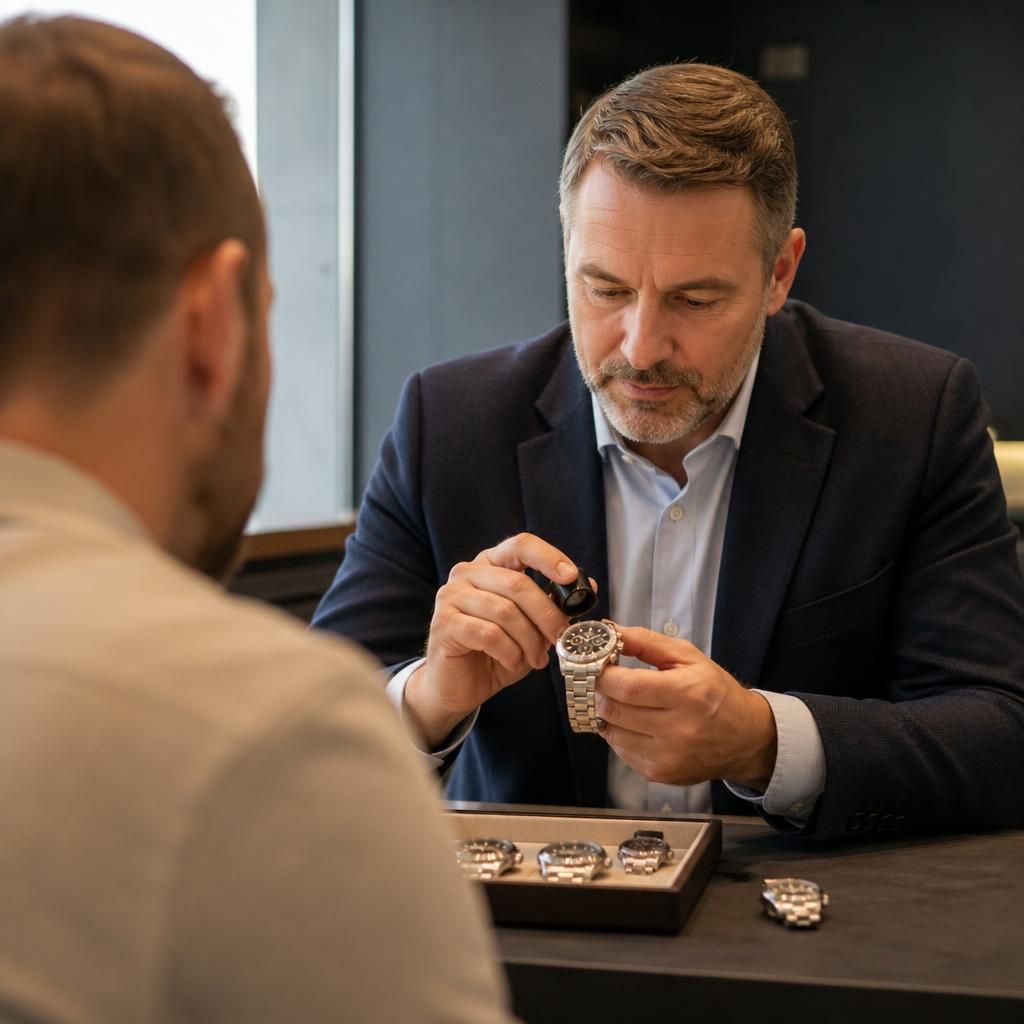
The condition and originality of a used Rolex Daytona are among the most important factors in determining its value. A professionally assessed watch with a sharp, symmetrical case, original dial and bezel, a correctly functioning chronograph, and minimal bracelet wear will usually compare more favourably with equivalent examples than a heavily polished or altered watch.
Replacement parts, corrosion, damaged threads, poor previous repairs and missing bracelet links can reduce value or increase the cost of ownership. Service records and a recent inspection help clarify the watch’s mechanical condition, but the valuation should also note whether components remain consistent with the original specification. Comparing the exact reference with recent sales of watches in genuinely similar condition provides a more reliable guide than relying on the model name alone.
Arrange an Expert Valuation of Your Used Rolex Daytona
Arrange an expert valuation of your used Rolex Daytona to assess its reference, condition, originality, provenance and current market position. Steven Charles Quance can provide clear guidance on its value and any inspection or servicing requirements before you buy or sell.