
What should I know about the authenticity and condition when buying a second-hand Rolex Submariner?
When buying a second-hand Rolex Submariner, confirm its authenticity through examination of the reference, serial details, movement and documentation, ideally with an experienced specialist. Assess the case, bracelet, bezel, crystal and dial for wear or alteration, and request service records so you understand the watch’s condition, originality and likely maintenance needs.
When buying a second-hand Rolex Submariner, authenticity and condition should be assessed together. A genuine watch can still have replacement parts, excessive polishing, water damage or an overdue service, while a well-presented example may contain non-original components. The safest approach is to have the reference, serial details, movement, construction, paperwork and physical condition examined by an experienced luxury-watch specialist before completing the purchase.
Start with the exact reference and specification. The Submariner has been produced in numerous references and configurations, with differences in case dimensions, movement, bezel, dial, bracelet, clasp and date function. Confirm that the watch’s reference corresponds with the features fitted to it. The dial, bezel insert, hands, crown, bracelet and clasp should be appropriate for that reference and production period. Small inconsistencies do not automatically prove that a watch is counterfeit, as Rolex watches may receive legitimate replacement parts during servicing, but they should be explained and reflected in the description and price.
Check the serial and reference markings. The serial number and reference details should be present in the expected locations and be consistent with the accompanying paperwork where supplied. Engraving should look precise and professionally executed rather than shallow, uneven or poorly defined. A serial number alone does not authenticate a watch: copied or altered numbers can appear on counterfeit examples, and paperwork can also be misrepresented. Treat these details as part of a wider examination rather than proof in isolation.
Examine the movement and internal construction. A genuine Submariner should contain the appropriate Rolex movement for its reference, with the correct architecture, finishing and component layout. An expert can inspect the movement without causing damage and compare it with known characteristics of the relevant calibre. This is particularly important because external appearance can be copied convincingly. Avoid buying a watch if the seller refuses reasonable inspection or cannot explain why the movement cannot be examined.
Assess the case carefully. Look for deep scratches, dents, corrosion, damaged threads and signs of moisture entry. Pay close attention to the lugs, crown guards, case back and case edges. Polishing is common on pre-owned watches, but excessive polishing can remove the original sharpness and alter the proportions of the case. Uneven surfaces, softened edges or asymmetrical lugs may indicate poor refinishing. A watch with honest wear and strong case geometry can be preferable to one that has been heavily polished to appear newer.
Inspect the bezel and crystal. The bezel should rotate correctly, with appropriate resistance and alignment, and the insert should be suitable for the watch’s reference and period. Check for chips, fading, loose components or damage around the bezel. A sapphire crystal should be free from significant scratches and cracks, while the magnification over the date, where applicable, should be clear and correctly positioned. Replacement bezels and crystals are not necessarily a fault, especially after authorised repair, but their presence should be disclosed because originality affects collectability and value.
Review the dial, hands and luminous material. The dial printing should be sharp, correctly positioned and consistent with the reference. Check the alignment of the hour markers, the condition of the hands and whether the luminous material appears consistent across the dial and hands. Relumed, refinished or replacement dials can affect originality and desirability. Signs such as uneven printing, incorrect fonts, mismatched lume colour or poorly aligned markers require specialist assessment rather than an assumption that the watch is genuine.
Examine the bracelet and clasp. Check for excessive stretch between the links, damaged screws, worn pins and a loose or poorly functioning clasp. Confirm that the bracelet and clasp codes, where present, are appropriate for the watch and period. Wear to a bracelet is normal, but replacement links or a non-original bracelet should be identified. Make sure the bracelet can be adjusted securely and that the clasp closes positively without excessive play.
Do not rely on water resistance without testing. A Submariner is designed as a professional dive watch, but age, impact, gasket deterioration and previous opening can compromise water resistance. Even a watch that looks excellent externally may require seals or crown servicing. Ask whether a pressure test has been completed recently and request the result where available. Until water resistance has been confirmed, keep the watch away from water, particularly if its service history is incomplete.
Ask for service history and understand what it proves. Service invoices, a dated service card or a documented overhaul can help establish how the watch has been maintained. Look for information about movement servicing, gasket replacement, pressure testing, polishing and parts replaced. The absence of paperwork does not prove that a watch has been neglected, but it means its maintenance history is unverified. A seller should be able to explain when the watch was last serviced, who carried out the work and whether any parts were changed.
A service is not the same as authentication. A watch may have been serviced without every component being original, and a recently serviced watch may still require attention if the work was incomplete or poorly documented. Conversely, a watch that has not been serviced for some time may be mechanically sound, but the likely cost of bringing it up to standard should be considered before agreeing a price.
Distinguish normal wear from condition concerns. Light surface marks, minor bracelet stretch and small signs of use are expected on many pre-owned Submariners. More important concerns include:
- Moisture beneath the crystal, corrosion or staining on the dial and hands;
- A crown that does not screw down correctly or feels rough when operated;
- A bezel that is loose, does not align or fails to rotate as expected;
- A bracelet or clasp that does not secure firmly;
- Noticeable loss of timekeeping performance, an inconsistent power reserve or unusual movement noise;
- Cracks, severe dents or damage to the case, crystal or lugs;
- Evidence of poor polishing, refinishing or non-original replacement parts.
These issues do not always make a watch unsuitable, but they should be disclosed, professionally assessed and allowed for in the valuation. Functional faults and water damage can be more significant than cosmetic marks because repairs may be complex and replacement parts may affect originality.
Consider the paperwork and chain of ownership. Original warranty documents, purchase records, service documentation, instruction material and presentation items can support provenance, but a complete set does not guarantee authenticity. Check that descriptions, reference details and serial information are consistent and that documents do not appear altered. If the watch is supplied without papers, focus more heavily on independent examination, seller transparency and a clear written description.
Buy only with appropriate safeguards. Before paying, obtain a written description of the reference, condition, originality, included accessories, service status and any known repairs. Confirm the returns or inspection terms and establish whether the watch will be checked by a qualified specialist. Do not rely solely on photographs, online authentication tools or a comparison with another Submariner. Photographs can conceal polishing, movement issues and moisture damage, while counterfeit watches may use genuine-looking external components.
A professional inspection should cover the movement, timekeeping, functions, case, bracelet, crystal, bezel, crown and water resistance where appropriate. It should also identify whether parts appear original, period-correct or replaced. If an inspection cannot be arranged before purchase, use a seller who provides clear provenance, accurate condition reporting and meaningful after-sales support.
In practice, the strongest purchase is not necessarily the newest-looking Submariner. It is the example whose identity, originality, mechanical condition and maintenance requirements are clearly understood, with any limitations reflected in the price. When there is uncertainty about authenticity or condition, pause the transaction and seek an independent expert assessment rather than relying on an attractive price or a convincing presentation.
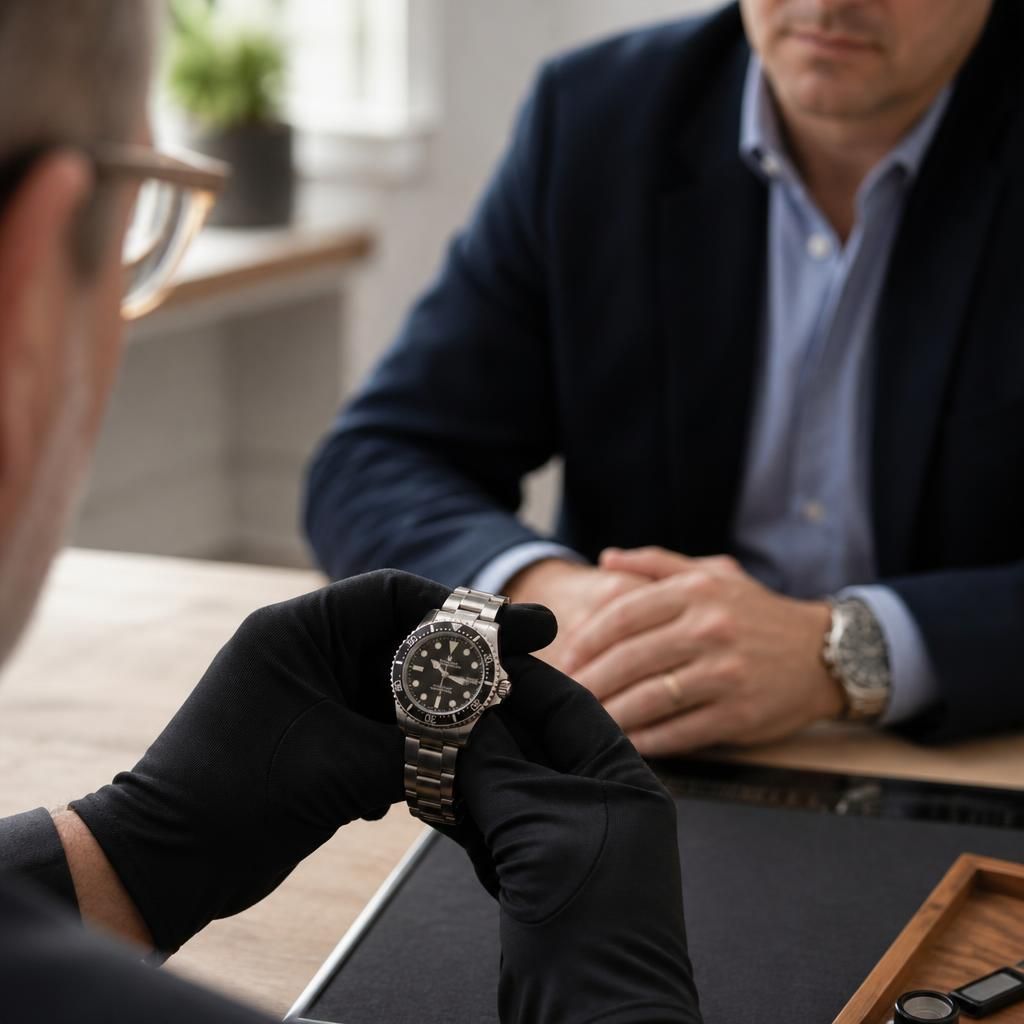
A professional inspection is the most reliable way to assess a second-hand Rolex Submariner’s authenticity and condition before purchase. An experienced watch specialist can compare the reference, serial details, movement, dial, hands, bezel, bracelet and clasp with the expected specification, while identifying replaced, refinished or non-original parts.
The inspection should also assess timekeeping, crown and bezel operation, case condition, bracelet security and water resistance where appropriate. Ask for a written summary of any servicing, polishing, moisture damage or repairs, and make sure these findings are reflected in the description and price. If the seller will not allow reasonable checks or cannot explain the watch’s history, treat that lack of transparency as a significant concern.
Arrange a Professional Rolex Submariner Assessment
Arrange a professional Rolex Submariner assessment with Steven Charles Quance to verify its authenticity, originality and mechanical condition before purchase. We can review the watch, supporting documentation and service history, then explain any findings clearly.