
What are the different models available in the used Rolex GMT Master II range?
Used Rolex GMT-Master II models include classic aluminium-bezel references such as the 16710, later ceramic-bezel versions including the 116710 and 126710, and two-tone or solid-gold options such as the 116713, 126711 and 126715. They are available with distinctive bezel colours including black, Pepsi (blue and red), Coke (black and red) and Root Beer (brown and black), with differences in movement, case material, bracelet and age affecting their character and value.
Used Rolex GMT-Master II models range from early aluminium-bezel references to modern ceramic-bezel watches in stainless steel, two-tone Rolesor, white gold and yellow gold. The main differences are the reference, bezel colour, case material, movement, bracelet and production period. These factors determine the watch’s appearance, wearing characteristics, collectability and value.
Early GMT-Master II models: reference 16760 and 16710
The reference 16760, introduced in the 1980s, was the first GMT-Master II. It is often identified by its slightly thicker case and is sometimes referred to as the “Fat Lady”. It was produced with a red-and-black, or “Coke”, 24-hour bezel. Examples are now sought after for their historical importance and transitional design.
The reference 16710 followed and remained in production for many years. It is one of the most widely recognised pre-owned GMT-Master II models and is available with interchangeable aluminium bezel inserts in several configurations:
- Black: a restrained option that suits everyday wear.
- Pepsi: a blue-and-red bezel, traditionally associated with the GMT-Master family.
- Coke: a black-and-red bezel with a stronger contrast.
The 16710 uses the Rolex calibre 3185, or calibre 3186 in some later examples. Its aluminium bezel is lighter and more susceptible to marks and fading than modern ceramic, but this ageing can be part of its appeal. The five-digit reference also has a slimmer, more traditionally proportioned case than later ceramic models. It may be found on an Oyster bracelet or a Jubilee bracelet, depending on the original configuration and subsequent ownership.
Modern stainless-steel models: references 116710 and 126710
The reference 116710 marked the move to a ceramic Cerachrom bezel and a more substantial case. The original 116710LN has a black bezel and was produced on an Oyster bracelet. A later black-and-blue version, the 116710BLNR, is commonly known as the “Batman”. Its two-tone bezel distinguishes it from the all-black model while retaining the same stainless-steel case and general GMT-Master II layout.
The 116710 uses the calibre 3186 and includes features associated with the modern range, including a Triplock winding crown, solid end links and an Oyster clasp. The ceramic bezel is highly resistant to fading and scratching, although the case, bracelet and clasp still require careful examination when assessing a pre-owned example.
The reference 126710 introduced the newer calibre 3285 and is available in two particularly recognisable bezel configurations:
- 126710BLRO: the blue-and-red “Pepsi” bezel.
- 126710BLNR: the black-and-blue “Batman” bezel.
These watches have a 40mm Oystersteel case and can be found with either a Jubilee or Oyster bracelet, depending on the version and supply history. The calibre 3285 offers Rolex’s newer movement architecture and an extended power reserve compared with the preceding generation. For a buyer comparing a 116710 with a 126710, the key distinctions are movement generation, bracelet configuration, case and clasp details, and the presence of the ceramic bezel rather than the older aluminium insert.
Two-tone Rolesor GMT-Master II models
Two-tone models combine stainless steel with 18-carat yellow gold or Everose gold. They offer the functionality of the GMT-Master II with a more noticeable precious-metal presence.
- 116713LN: a previous-generation yellow Rolesor model with a black Cerachrom bezel and calibre 3186.
- 126713GRNR: a newer yellow Rolesor model with a black-and-grey Cerachrom bezel and calibre 3285.
- 126711CHNR: an Everose Rolesor “Root Beer” model with a brown-and-black Cerachrom bezel.
The yellow Rolesor watches are generally paired with an Oyster bracelet, while the Everose Rolesor Root Beer is commonly seen on a Jubilee bracelet. The choice between yellow gold and Everose gold is primarily visual: yellow gold gives a brighter traditional contrast, whereas Everose gold has a warmer tone. On any two-tone watch, inspect the gold surfaces, bracelet stretch, clasp, bezel edges and transitions between the metals particularly carefully.
Solid-gold GMT-Master II models
Rolex has produced the GMT-Master II in solid yellow gold, white gold and Everose gold. These watches are heavier than steel or two-tone versions and have a distinctly precious-metal character.
- 116718LN: a previous-generation 18-carat yellow-gold model with a black ceramic bezel.
- 116719BLRO: a white-gold model with a blue-and-red Pepsi bezel.
- 126718GRNR: a newer yellow-gold model with a black-and-grey bezel.
- 126715CHNR: an Everose-gold Root Beer model with a brown-and-black bezel.
- 126719BLRO: a white-gold Pepsi model, available with different dial treatments across its production history.
Solid-gold examples may be supplied on an Oyster or Jubilee bracelet, depending on the reference. White-gold models can appear less obviously precious-metal at a glance, but their weight, hallmarks and case construction distinguish them from stainless steel. Verification of the metal, reference and bracelet is therefore essential when buying a pre-owned example.
Left-handed and less conventional configurations
The reference 126720VTNR is the left-handed GMT-Master II, often called the “Sprite”. It reverses the usual layout, with the winding crown and crown guards on the left side of the case and the date display positioned accordingly. Its green-and-black bezel gives it a distinctive appearance, while the reversed controls are the main functional difference. It is available with an Oyster or Jubilee bracelet depending on the specific configuration.
There are also gem-set and special-material versions within the wider GMT-Master II family. These can feature diamond-set bezels, precious-metal cases or unusual dials, but they should be assessed as specialist pieces rather than compared directly with standard steel or two-tone models. Originality is particularly important because aftermarket setting or replacement parts can affect both provenance and future serviceability.
How the bezel colours differ
The bezel is one of the quickest ways to distinguish used GMT-Master II models, but its colour should always be considered alongside the reference. “Pepsi” normally describes a blue-and-red bezel, “Coke” a black-and-red bezel, “Batman” a black-and-blue bezel, and “Root Beer” a brown-and-black bezel. The same nickname can refer to different generations, materials and movements, so it does not identify the watch by itself.
Older aluminium inserts may show natural fading, small marks or colour variation. Modern Cerachrom bezels have a sharper, more uniform appearance and are more resistant to ultraviolet light and everyday scratching. A replacement bezel or insert may be entirely legitimate, but it should be recorded and consistent with the reference and service history.
Bracelet and dial options
Bracelet choice affects the character of the watch as well as its fit. An Oyster bracelet has a sportier, more understated appearance, while a Jubilee bracelet gives a more intricate and traditionally dressy finish. The correct bracelet, end links and clasp should match the reference where possible. A watch can still be genuine if components have been changed during servicing, but replacement parts should be disclosed and considered when establishing originality.
Dial variations are most noticeable among precious-metal and later models. Black dials are common on many references, while white-gold and special editions may be available with blue, meteorite or other dial treatments. Dial condition matters: refinishing, replacement, damage to the luminous material or incorrect printing can affect authenticity and desirability.
Choosing between the main used models
- Choose a 16710 if you value a slimmer case, aluminium bezel inserts and the character of an earlier mechanical GMT-Master II.
- Choose a 116710 if you prefer a robust modern case, a ceramic bezel and the established 3186 movement.
- Choose a 126710 if you want the current-generation stainless-steel format, calibre 3285 and the choice of Oyster or Jubilee bracelet.
- Choose a two-tone model if you want a balance between practical stainless steel and the visual presence of gold.
- Choose a solid-gold model if case weight, precious-metal construction and a more formal appearance are priorities.
- Choose the 126720VTNR if you specifically need or prefer a left-handed layout and a green-and-black bezel.
When comparing a used Rolex GMT-Master II, check the reference engraved between the lugs or on the rehaut where applicable, the serial information, movement generation, bezel configuration, bracelet and clasp codes, dial, case condition and service documentation. The watch should also be assessed for polishing, bracelet stretch, water resistance, timekeeping and the originality of its components. A professional inspection is advisable when the model’s provenance or specification is unclear.
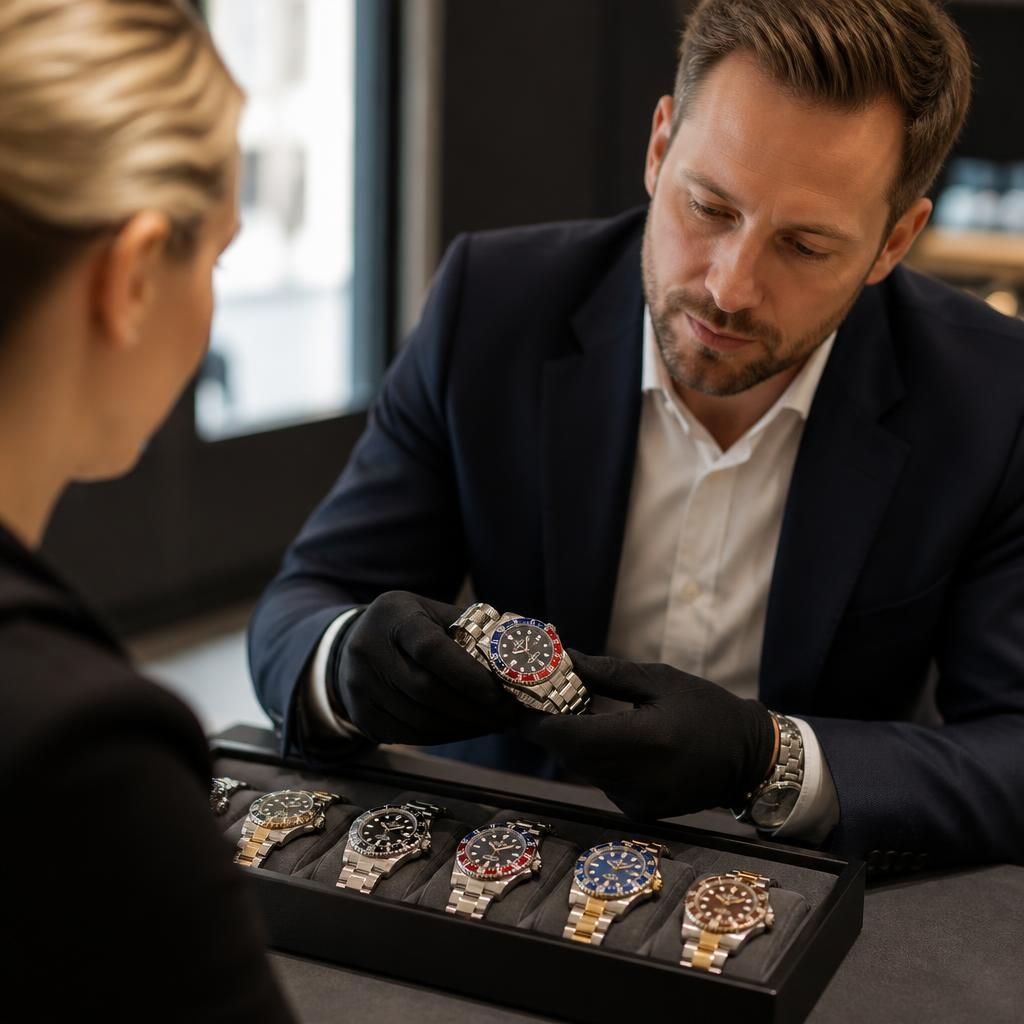
The main used Rolex GMT-Master II models are distinguished by their reference, bezel material, case metal, movement and bracelet. Earlier references such as the 16710 use an aluminium bezel insert, while later models including the 116710 and 126710 use a ceramic Cerachrom bezel. This difference affects appearance, resistance to fading and scratching, and the overall character of the watch.
Bezel nicknames are useful but do not identify a model on their own. “Pepsi” refers to a blue-and-red bezel, “Coke” to black and red, “Batman” to black and blue, and “Root Beer” to brown and black. Each colour combination may appear across different references and materials, so the reference number, movement, bracelet and case construction should be checked when comparing used examples.