What should I consider when buying a used ladies Rolex locally?
When buying a used ladies Rolex locally, check its authenticity, condition, provenance, service history and price, and confirm what documentation and aftercare are included. A trusted local jeweller should explain the watch’s reference, movement, originality and any previous work clearly before you buy.
When buying a used ladies’ Rolex locally, assess five things before agreeing to purchase: authenticity, condition, provenance, service history and total price. You should also confirm the exact reference and movement, check that the bracelet and case fit correctly, review the available paperwork, and understand the warranty and aftercare provided by the jeweller.
A local purchase gives you the opportunity to inspect the watch in person and discuss its history with someone who can examine it professionally. Use that opportunity to ask specific questions rather than relying only on the appearance of the dial or the presence of a Rolex box.
Confirm the model and reference
Identify the model, case size, metal, dial configuration, bracelet and movement. The reference number helps establish what the watch should originally have been fitted with, while the serial number may assist with identifying its production period and matching it to the accompanying records. A reputable jeweller should be able to explain these details and point out any variations from the original specification.
Check whether the watch is a Datejust, Oyster Perpetual, Lady-Date or another model, and consider whether the proportions suit your wrist. A smaller case may look understated, whereas a larger ladies’ model can have greater wrist presence. The decision should be based on comfort, legibility and personal preference rather than resale considerations alone.
Establish authenticity
Authenticity should be verified through the watch as a whole, not through one feature in isolation. The case, engravings, dial, hands, bezel, bracelet, clasp and movement should be consistent with the stated model and period. The movement should receive particular attention because it is difficult to assess reliably without appropriate expertise and equipment.
Documentation can support an authenticity assessment, but papers, boxes and receipts can be separated from a watch or reproduced. Conversely, the absence of original accessories does not automatically mean that a watch is not genuine. Ask what checks have been completed, whether the movement has been inspected, and what protection you have if a serious authenticity issue is subsequently identified.
Examine the condition carefully
Inspect the case, crystal, bezel, bracelet and clasp under good lighting. Look for scratches, dents, excessive polishing, stretched bracelet links, loose end links, damaged threads and signs of moisture. Small marks may be consistent with normal wear, but deep damage or corrosion can affect both appearance and reliability.
Over-polishing is worth discussing. A watch that has been polished heavily may have softened or altered case edges, lugs and bevels. This does not necessarily prevent it from working correctly, but it can affect originality and desirability. Ask whether any visible marks are being left as part of the watch’s history or whether restoration has been carried out.
Check the dial and hands for discolouration, refinishing, replacement parts or inconsistencies. A replacement dial may be genuine, but it should be disclosed because it can affect the watch’s originality and value. The same applies to non-original bracelets, bezels, crowns or crystals.
Ask about provenance
Provenance is the available evidence of where the watch came from and how it has been owned. Useful records may include purchase documentation, previous service invoices, valuation reports, insurance records and details of any ownership transfer. These documents do not replace professional inspection, but they can help create a coherent history.
A local jeweller should be able to explain whether the watch was sourced from a private owner, an established trade source or another channel, and what due-diligence checks were completed before it was offered for sale. Be cautious if the seller cannot provide a clear explanation of the watch’s origin, is unwilling to answer reasonable questions or applies pressure to make an immediate decision.
Review the service history
Find out when the watch was last serviced, who carried out the work and what was included. A service may involve movement cleaning and regulation, replacement of worn components, gasket replacement, water-resistance testing and refinishing. An invoice stating only that the watch was “checked” may not provide the same assurance as a detailed service record.
Ask whether the watch has been tested for timekeeping and water resistance, and whether the results can be explained. Water resistance is not permanent and can be affected by age, impact or opening the case. It should not be assumed simply because the model has an Oyster case or because the watch appears visually sound.
If there is no recent service history, include the possibility of future servicing in your budget. A watch without records is not necessarily a poor purchase, but the price should reflect the uncertainty and the jeweller should be clear about any inspection or service already undertaken.
Compare the price with the specification
Compare like for like, taking account of the model reference, metal, dial, bracelet, condition, originality, service history, accessories and warranty. Two watches that appear similar may have materially different values because one has its original parts, stronger documentation or a more comprehensive service record.
Consider the total cost rather than the ticket price alone. Possible additional costs include servicing, bracelet adjustment, replacement links, insurance valuation, repairs or restoration. A properly inspected watch with a clear warranty may represent better value than a cheaper example with uncertain condition or limited support.
Check the bracelet and fit
Try the watch on and check that the case sits comfortably, the clasp closes securely and the bracelet has enough adjustment. Examine the links for excessive looseness and confirm whether additional original links are included. Replacing missing links can be expensive, particularly when the bracelet is made from precious metal.
Check that the crown winds and sets the watch correctly, the date changes as expected where applicable, and the clasp and any other functions operate smoothly. Do not force a component that feels stiff or unusual; ask the jeweller to demonstrate it and investigate any concern before purchase.
Understand the paperwork and protection provided
Establish exactly what is included: original or replacement box, warranty card, service records, instruction material, valuation documentation and any spare links. Ask whether the serial and reference details on the paperwork correspond with the watch, where appropriate.
Read the warranty terms carefully. Confirm its duration, what parts and labour it covers, whether water-resistance issues are included or excluded, and where the watch must be returned for assessment. Also ask about the jeweller’s aftercare, including bracelet adjustment, servicing advice, repairs, valuations and help with future maintenance.
Use the inspection appointment properly
Before buying, ask to see the watch close up and allow time for questions. A professional inspection should cover the movement and external components without causing damage. If the watch is being assessed for water resistance, confirm how and when that test was performed.
Ask for any verbal claims about originality, service work or provenance to be recorded on the invoice or sales documentation. Written details reduce misunderstanding and provide a useful record for insurance and future servicing.
Finally, take time to decide. A used ladies’ Rolex is a mechanical watch with a specific history, not simply a branded accessory. The strongest purchase is one where the watch’s identity, condition, ownership history, service position, price and aftercare are all clearly explained and acceptable to you.
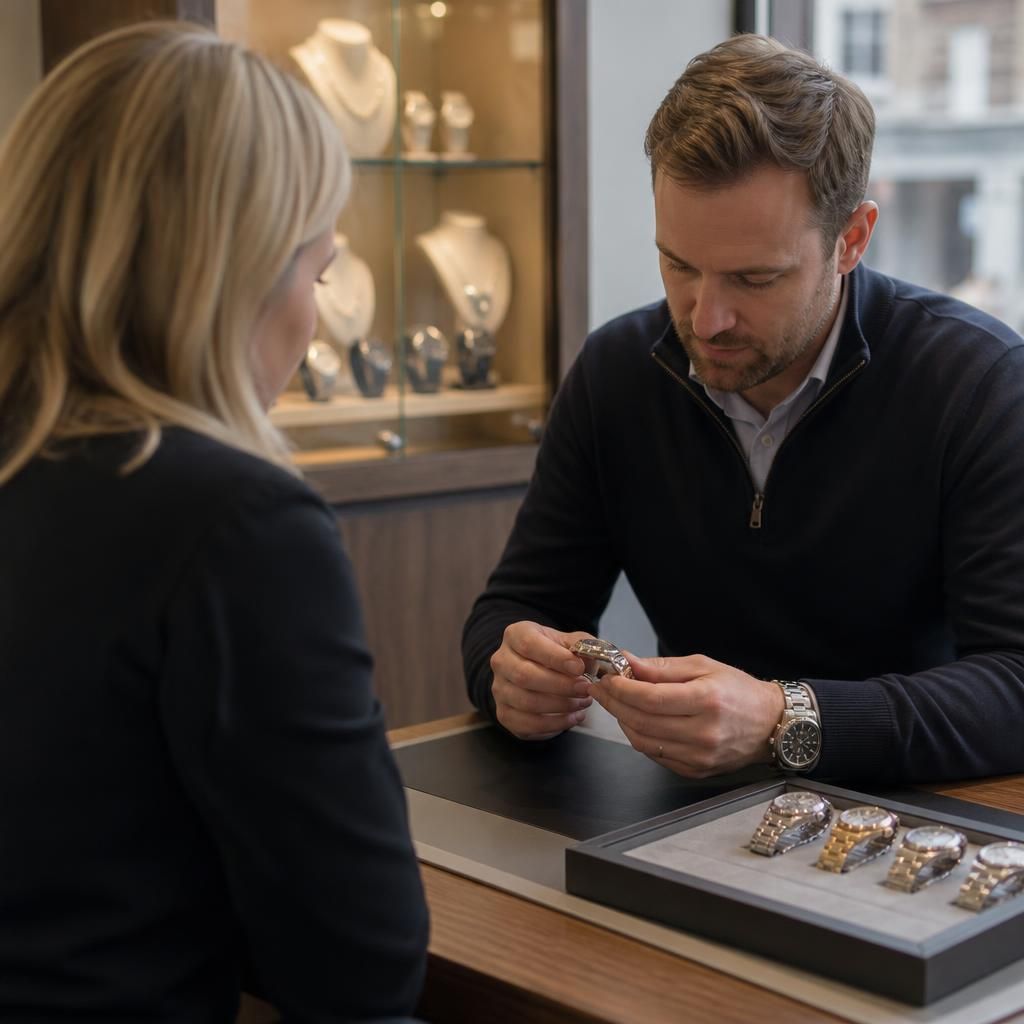
Authenticity is best assessed by examining the complete watch, not simply its box, papers or serial number. The case, dial, hands, bezel, bracelet, clasp and movement should all be consistent with the stated Rolex model and production period.
Ask for the movement to be inspected by a suitably experienced professional, and confirm whether any parts have been replaced or refinished. Original accessories can support the watch’s history, but they do not prove authenticity on their own. A reputable local jeweller should explain the checks completed and record important details, such as originality, service work and warranty protection, in the sales documentation.