What are the key factors to consider when choosing a pre-owned Rolex for women?
When choosing a pre-owned Rolex for women, assess its authenticity, condition, service history, case size, design, movement and overall value. Check that the watch comes from a trusted source and that its documentation, serial details and condition support the asking price.
Choosing a pre-owned Rolex for women involves more than selecting a desirable model or dial colour. The key considerations are authenticity, overall condition, service history, case and bracelet fit, suitability for everyday wear, completeness of the documentation, and whether the asking price reflects the watch’s age, specification and provenance.
Authenticity and provenance
Authentication should be the first priority. A genuine Rolex should have a reference number and serial details that are consistent with its case, movement and production period. These details should be examined by someone with the appropriate knowledge and equipment rather than judged from photographs alone. The dial, hands, bezel, crown, bracelet, clasp and movement should also be assessed as a complete set, since individual parts may have been replaced during the watch’s lifetime.
Ask where the watch came from and whether the seller can provide a clear ownership and purchase history. Original Rolex paperwork, a dated guarantee card, service documents, presentation box and supporting receipts can help establish provenance, although the absence of accessories does not automatically mean that a watch is not genuine. Documentation should support the watch, not replace a proper physical inspection.
Condition and originality
Pre-owned watches naturally show varying degrees of wear. Light marks from careful use may be acceptable, while deep scratches, dents, corrosion, stretched bracelet links or damage around the lugs may affect both appearance and value. Check the crystal for chips or significant scratches, the bezel for damage, and the case edges for excessive polishing. A case that has been polished heavily may lose some of its original definition and proportions.
It is also important to establish which components remain original. A replacement crystal, crown or bracelet may be entirely appropriate if fitted correctly, but an aftermarket dial, hands, bezel or bracelet can materially affect collectability and value. Some vintage or discontinued watches are valued for unusual original features, so alterations should be identified before purchase.
Service history and mechanical performance
A documented service history provides useful evidence of how the watch has been maintained. Look for invoices or service records describing the work completed, the date of the service and the organisation that carried it out. A service may include cleaning, lubrication, regulation, replacement of worn parts and tests for water resistance, but the precise scope should be confirmed rather than assumed.
During an inspection, the movement should run consistently and the hands should set correctly. The winding action should feel smooth, the date should change properly where applicable, and the clasp and crown should operate securely. Timekeeping should be checked with suitable equipment, as accuracy, amplitude and power reserve can indicate whether further attention is required. A watch that has not been recently serviced is not necessarily a poor purchase, but the likely maintenance requirement should be reflected in the price and your ownership plans.
Case size, proportions and comfort
Case diameter is only one part of fit. The lug-to-lug length, case thickness, bracelet width and shape of the case all affect how a Rolex sits on the wrist. A smaller case may offer a discreet, traditional appearance, while a larger case can provide stronger wrist presence and improved dial legibility. The best choice depends on personal preference, wrist proportions and how the watch will be worn.
Try the watch on, if possible, and check that the case does not move excessively or press into the wrist. The bracelet should sit securely without feeling tight, and the clasp should close positively. Confirm that the bracelet has sufficient adjustment for comfortable daily wear, particularly if the watch will be worn in changing temperatures. Additional or removed links should be identified, as obtaining correct replacement links can affect the overall cost.
Model, dial and design
Rolex offers a broad range of women’s watches, from understated steel designs to models featuring precious metals, gem-set details or more decorative dials. Consider whether the watch needs to suit business clothing, formal occasions, everyday wear or a combination of these. A classic dial can be versatile, while a diamond-set or unusual configuration may be more distinctive but less adaptable.
Examine the dial carefully for discolouration, moisture marks, loose markers or signs that it has been refinished. A refinished dial may look attractive, but it is different from an untouched original dial and can influence collectability. Confirm that the reference, metal, bracelet, bezel and dial configuration are correct for one another, particularly when considering an older or less common model.
Water resistance and practical use
Water resistance is not permanent. Gaskets age, crowns can wear and previous opening of the case may affect sealing. Do not rely solely on the water-resistance rating stated for the model; ask whether the watch has been pressure-tested and whether the test remains current. If the watch will be worn while washing hands, swimming or travelling, its sealing condition and service history are especially important.
Water resistance also does not protect a watch from every form of damage. Avoid operating the crown or pushers when the watch is wet, and have the seals checked as part of appropriate maintenance. A pre-owned Rolex intended for daily use should be selected and assessed with these practical demands in mind.
Box, papers and included accessories
A complete set may include the original box, guarantee card, manuals, swing tags, wallet and spare links. These items can support provenance and may make the watch more appealing to a future owner, but they do not determine condition or authenticity on their own. Conversely, a watch without its original accessories can still be a sound purchase when it has been properly authenticated and inspected.
Check that any guarantee card or certificate corresponds with the watch’s reference and serial details. Be cautious of paperwork that appears inconsistent, has unexplained alterations or is being used to make broad claims about the watch’s history.
Price and long-term value
Compare the asking price with equivalent examples, taking account of model, age, material, dial configuration, condition, originality, service history and completeness. Two watches with the same broad model name can have substantially different values because of their specification or maintenance history. A lower price may reflect missing papers, replacement parts, heavy polishing or an imminent service rather than a genuine bargain.
Consider the total cost of ownership, including servicing, bracelet adjustment, insurance, valuation and any necessary repairs. Desirability can support future resale value, but no pre-owned watch should be bought solely as an investment. Choose a piece that meets your requirements for fit, appearance and reliability first.
Inspection and aftercare
Before committing to a purchase, request a close inspection and ask for a written description of the watch’s condition, included accessories, service history and any replaced components. A reputable specialist should be willing to explain what has been checked and identify limitations rather than presenting every pre-owned watch as flawless.
Once selected, arrange appropriate insurance and retain all invoices and service records. Keep the watch clean with suitable methods, avoid exposing it to impacts or magnetic fields unnecessarily, and have it examined if it gains or loses time, stops unexpectedly or shows signs of moisture. A professional valuation can also provide useful documentation for insurance and future records.
In practice, the strongest purchase is not necessarily the newest or most complete example. It is the pre-owned Rolex whose authenticity, condition, originality, fit, maintenance requirements and price have all been properly understood before purchase.
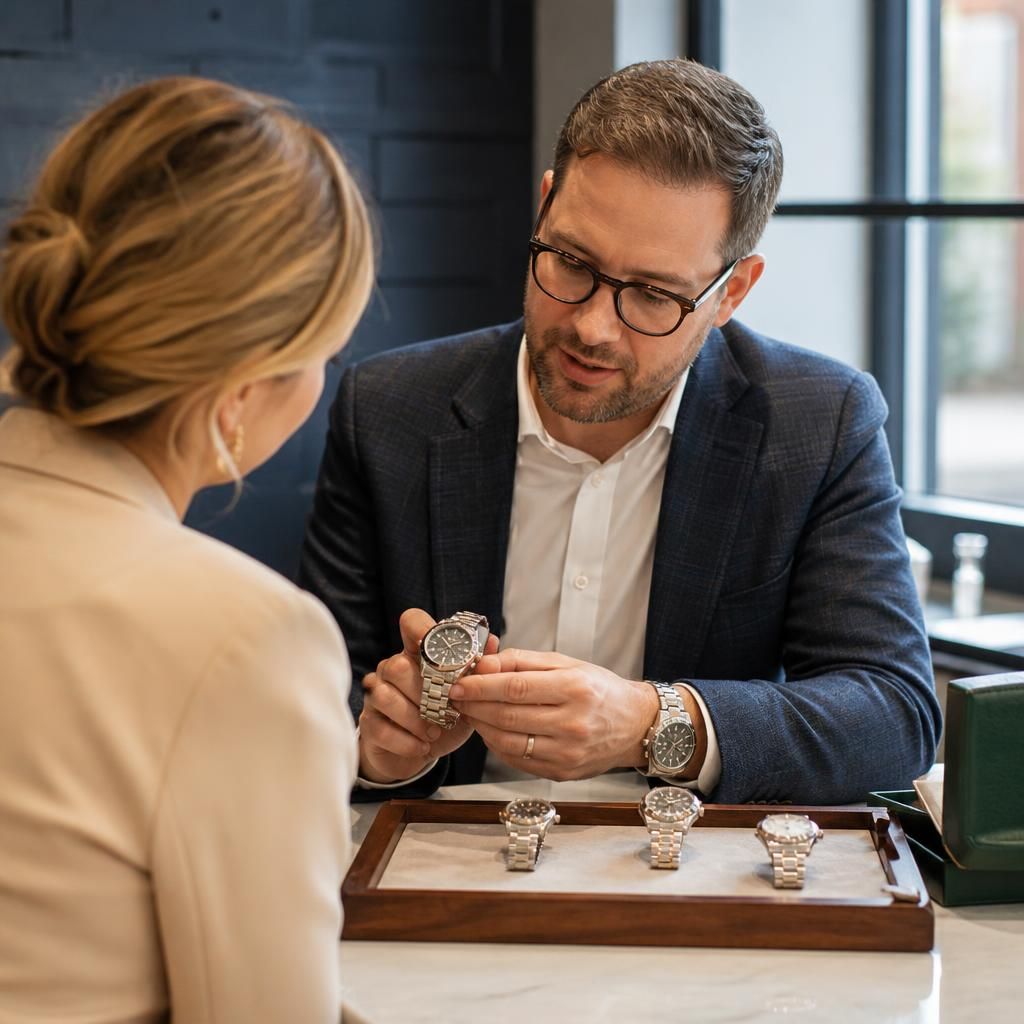
Authenticity is the first factor to establish when choosing a pre-owned Rolex for women. The watch should be examined as a complete piece, with its reference and serial details, movement, dial, hands, bezel, bracelet and clasp assessed for consistency. Matching paperwork can support provenance, but documents alone cannot confirm that every component is genuine or original to the watch.
- Ask for the reference and serial details and check that they are consistent with the model and production period.
- Establish whether any parts, such as the dial, hands, bezel, crown or bracelet, have been replaced.
- Request available guarantee cards, service records, receipts and ownership information.
- Have the watch physically inspected by an experienced specialist before purchase, particularly if its originality or history is unclear.
This inspection also helps distinguish appropriate replacement parts from aftermarket components, which can affect reliability, collectability and value. A reputable pre-owned Rolex should be accompanied by a clear explanation of what has been checked and any limitations in the available evidence.