
What qualifications and experience should a jewellery repair technician have?
A jewellery repair technician should have recognised practical training in jewellery manufacture or repair, supported by proven experience working with precious metals, gemstones, settings, soldering and polishing. They should also demonstrate careful workmanship, accurate assessment skills, appropriate insurance and a clear record of handling valuable items responsibly.
A competent jewellery repair technician should have recognised practical training in jewellery manufacture or repair, substantial bench experience, and a demonstrable ability to work safely with precious metals, gemstones, settings and delicate components. They should also assess damage accurately, explain the proposed repair clearly, document the item on receipt, and have suitable insurance and procedures for protecting valuable jewellery.
Relevant training and qualifications
Formal qualifications are useful evidence of technical knowledge, although practical ability is equally important. Suitable backgrounds may include a jewellery-making apprenticeship, a recognised vocational qualification or diploma in jewellery manufacture and repair, or assessed bench training covering fabrication, soldering, filing, polishing and finishing. A technician should understand how different metals behave under heat and pressure, and how a repair can affect a hallmark, plating, gemstone or existing setting.
Additional training may be appropriate for particular work. Stone setting, engraving, watch-related work, laser welding and working with unusual alloys all require specific skills. A technician does not necessarily need to perform every specialist process personally, but should know when a repair requires a qualified setter, watchmaker, gemmologist or specialist workshop.
Practical experience at the bench
Experience should cover more than straightforward soldering or polishing. A capable repair technician should be familiar with sizing rings, rebuilding worn claws, replacing or strengthening joints, repairing chains and clasps, re-tipping settings, replacing missing components and refinishing scratched or distorted metal. They should be able to work on both modern and older jewellery without removing original detail unnecessarily.
Experience with high-value jewellery is particularly relevant when an item contains fine gemstones, delicate pavé settings, antique construction or mixed metals. The technician should be able to identify potential risks before starting, such as loose stones, thin areas of metal, previous repairs, heat-sensitive treatments or damage that may worsen during cleaning or soldering.
Assessment and workmanship
Good repair work begins with a careful inspection rather than an immediate recommendation. The technician should examine the setting, shank, joints, stones, mounts and any previous alterations, then explain what needs attention and what may be optional. Where appropriate, they should distinguish between a temporary repair, a sound restoration and a full rebuild.
Precision is essential. Solder joints should be neat and appropriately matched to the metal, edges should be comfortable and even, settings should hold stones securely, and polishing should preserve the correct shape and hallmarks. A reputable professional will not promise that every item can be returned to its original condition without first considering its age, construction and existing wear.
Knowledge of gemstones and jewellery construction
Repair technicians should understand the properties and vulnerabilities of common gemstones, including the effects of heat, chemicals, ultrasonic cleaning and mechanical pressure. They should know when stones need to be removed before soldering or polishing, and when a safer low-heat or non-heat method is preferable.
They should also recognise that gemstones can have treatments, fractures or inclusions that are not visible to an untrained observer. If the stone’s identity, condition or treatment affects the repair, the technician should explain this and recommend appropriate specialist examination rather than proceeding on assumption.
Professional standards and responsible handling
Qualifications alone do not establish that a technician is suitable for valuable jewellery. Look for clear intake and collection procedures, a written description of the item, agreed work and pricing, secure storage, appropriate insurance and a documented record of any stones or detachable parts. Before-and-after photographs or condition notes can also help establish what was present when the item was left for repair.
The technician should be willing to explain who will carry out the work, whether any part will be subcontracted, and how unexpected findings will be handled. They should not carry out additional work without obtaining approval where the scope or cost changes materially.
How to assess a repair technician
- Ask about practical training, apprenticeships or recognised jewellery repair qualifications.
- Find out how much experience they have with the specific repair and materials involved.
- Ask whether they regularly handle gemstones, antique pieces, intricate settings or high-value jewellery, if relevant to your item.
- Request an explanation of the proposed method, likely risks and expected finish.
- Check that the business has suitable insurance and secure procedures for items in its care.
- Confirm that the work, estimated cost and collection arrangements will be recorded clearly.
- Ask what aftercare or workmanship guarantee applies and what happens if a hidden fault is discovered.
For routine work, a trained technician with sound bench experience may be appropriate. More complex repairs should be assessed by a jeweller who can call on specialist setting, gemmological, engraving or watchmaking expertise when required. The best choice is therefore not based on a qualification alone, but on the combination of relevant training, proven workmanship, careful assessment and responsible aftercare.
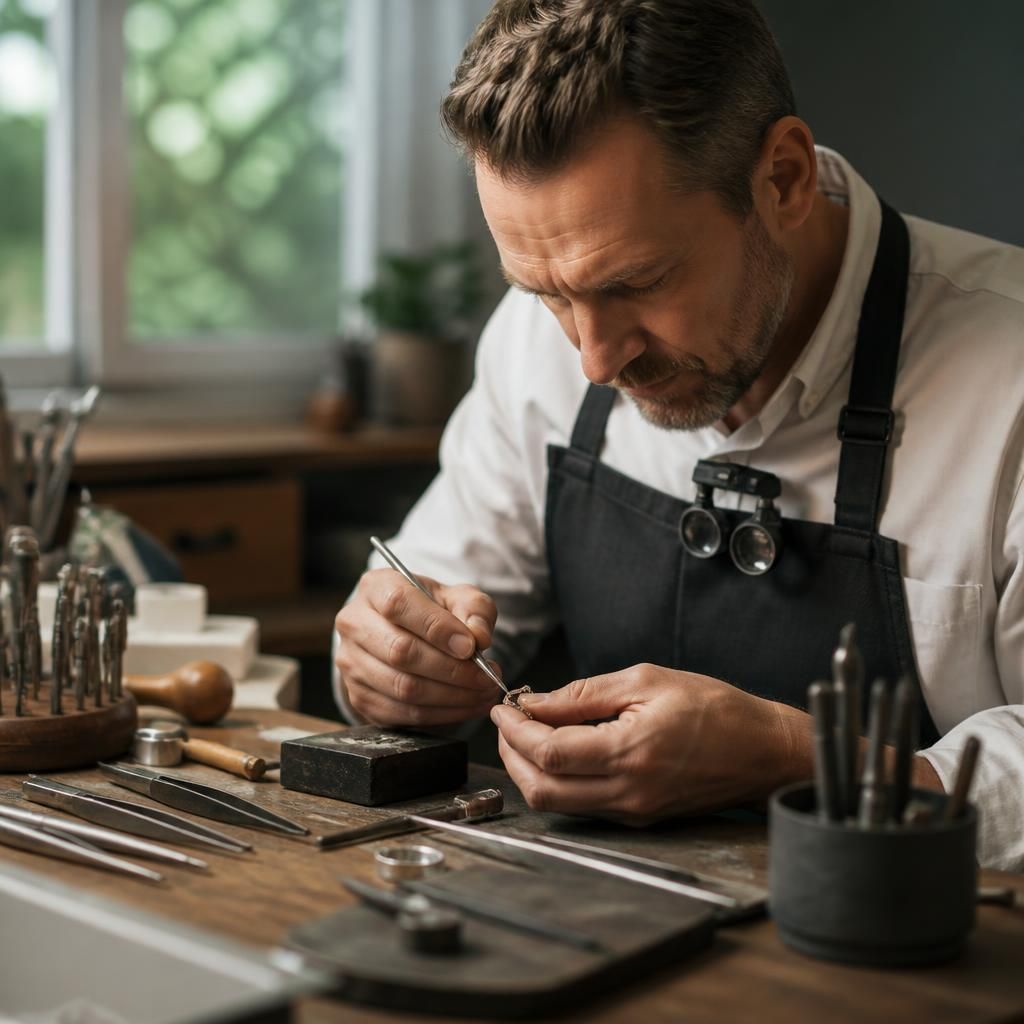
A qualified jewellery repair technician should combine recognised practical training with relevant bench experience. Training in jewellery manufacture or repair should cover precious metals, soldering, setting, filing, polishing and finishing, while experience shows whether those skills can be applied accurately to real pieces.
For valuable or intricate jewellery, check that the technician has worked with the relevant materials, gemstones and construction. They should inspect the item before starting, explain the proposed method and risks, record its condition, and use secure handling and storage procedures throughout the repair.