
What considerations should couples make when choosing wedding bands made from different metals?
When choosing wedding bands made from different metals, couples should compare durability, colour, weight, comfort, maintenance and how each metal may wear alongside the other. Consider your lifestyle, skin sensitivity, budget and whether you want the rings to coordinate closely or express individual styles.
When couples choose wedding bands made from different metals, they should compare each metal’s durability, colour, weight, comfort, maintenance, price and suitability for everyday wear. The rings do not need to be identical, but their profiles, finishes and proportions should work together, while each person’s lifestyle, skin sensitivity and personal preferences should guide the individual choice.
Start with how each ring will be worn. Consider whether the bands will be worn every day, alongside engagement rings, or mainly on formal occasions. A person who works with their hands, exercises frequently or regularly exposes their jewellery to chemicals may benefit from a hard-wearing metal and a practical finish. Someone with a less physically demanding routine may have greater flexibility when choosing a softer metal or a more detailed design.
It is also important to consider contact between the two rings. If a wedding band will sit against an engagement ring, differences in hardness can affect how the surfaces wear over time. Repeated rubbing may create marks, particularly where rings have sharp edges, raised settings or highly polished finishes. A jeweller can assess the shape and fit of the existing ring and recommend a band profile that minimises unnecessary contact.
Compare durability and everyday wear. Platinum is dense and naturally white, and it tends to develop a soft patina rather than losing metal in the same way as some harder alloys. Gold is available in different purities and colours, with the alloy affecting its strength and appearance. White gold commonly has a bright surface finish that may require periodic renewal, while yellow and rose gold retain their characteristic colour through the metal itself. Palladium and other precious-metal alloys have their own balances of weight, hardness and maintenance.
No precious metal is completely scratch-proof. Scratches and changes to the surface are normal signs of wear, but the rate and appearance of wear vary. Ask about the alloy rather than judging a metal by colour alone, as two rings that look similar may behave differently in daily use.
Consider colour coordination without demanding an exact match. White, yellow and rose gold can be combined successfully when there is a deliberate connection between the designs. This might be a shared profile, matching edge detail, the same satin or polished finish, or a consistent width. Alternatively, keeping the rings simple can allow different colours to look intentional rather than mismatched.
When one ring is intended to sit beside an engagement ring, compare the tones under natural and indoor light. A cool white metal may create a crisp contrast with yellow gold, while a warmer metal can provide continuity with an existing ring. Small details, such as a mixed-metal edge or a matching engraving style, can link different metals without making the rings identical.
Check comfort, weight and proportions. The density of a metal affects how substantial a ring feels on the finger. A wide or deep ring can feel heavier regardless of its metal, and a dense metal may feel noticeably more solid at the same dimensions. Comfort also depends on the internal shape: a court or comfort-fit profile usually has gently curved inner edges, whereas a flat profile may create a more structured feel.
Try each proposed ring at its intended width and depth rather than relying on a sample of a different size. The balance between both rings matters as well. A very narrow, delicate band paired with a substantially wider band may be right for the couple, but the proportions should be considered as part of the overall design.
Think about skin sensitivity and metal content. Reactions are usually linked to an alloy component rather than the main metal’s colour. If either person has experienced irritation from jewellery, disclose this before choosing a ring and ask about the alloy and manufacturing specifications. Avoid assuming that every white, yellow or rose gold ring has the same composition. A suitable alternative may be available, but the choice should be based on the wearer’s history and professional advice.
Allow for maintenance and future changes. Different metals may require different approaches to cleaning, polishing, refinishing and repair. Finishes such as brushed, hammered or satin surfaces can change with wear and may need restoring if the original texture is important. Plated surfaces may also need renewing in time, depending on the metal and the wearer’s use.
Ask whether each ring can be resized and how much alteration its design will permit. Plain bands are generally more straightforward to adjust than rings with continuous patterns, intricate settings or extensive engraving. Some metals and construction methods have more limited resizing options, so this should be confirmed before ordering rather than assumed.
Set a combined budget, but compare value as well as price. The cost of a wedding band reflects the metal, purity, weight, width, construction, finish and workmanship. Choosing different metals can help each person select a ring that suits their budget and priorities, but two rings of the same apparent size may differ significantly in price because of metal density or design complexity. Include future servicing, refinishing and potential adjustments in the decision.
Ethical sourcing may also be part of the comparison. Ask about the provenance of the precious metals and whether recycled or responsibly sourced options are available. This should be considered alongside durability, repairability and the expected lifespan of the finished rings.
Make the designs individual but connected. Couples do not need to select the same metal, and forcing a match can compromise comfort or personal style. A shared design feature can provide cohesion: identical engraving, complementary textures, a similar bevel, coordinated widths or profiles that align when the hands are placed together. It is also perfectly reasonable for the connection to be subtle if each person prefers a distinct ring.
Before making a final choice, wear samples for long enough to assess weight, edge comfort and the way the rings sit beside any existing jewellery. Confirm the metal composition, finish, maintenance requirements, resizing options and aftercare for both rings. A design consultation can then refine the proportions and details so that the pair works visually while remaining practical for each wearer.
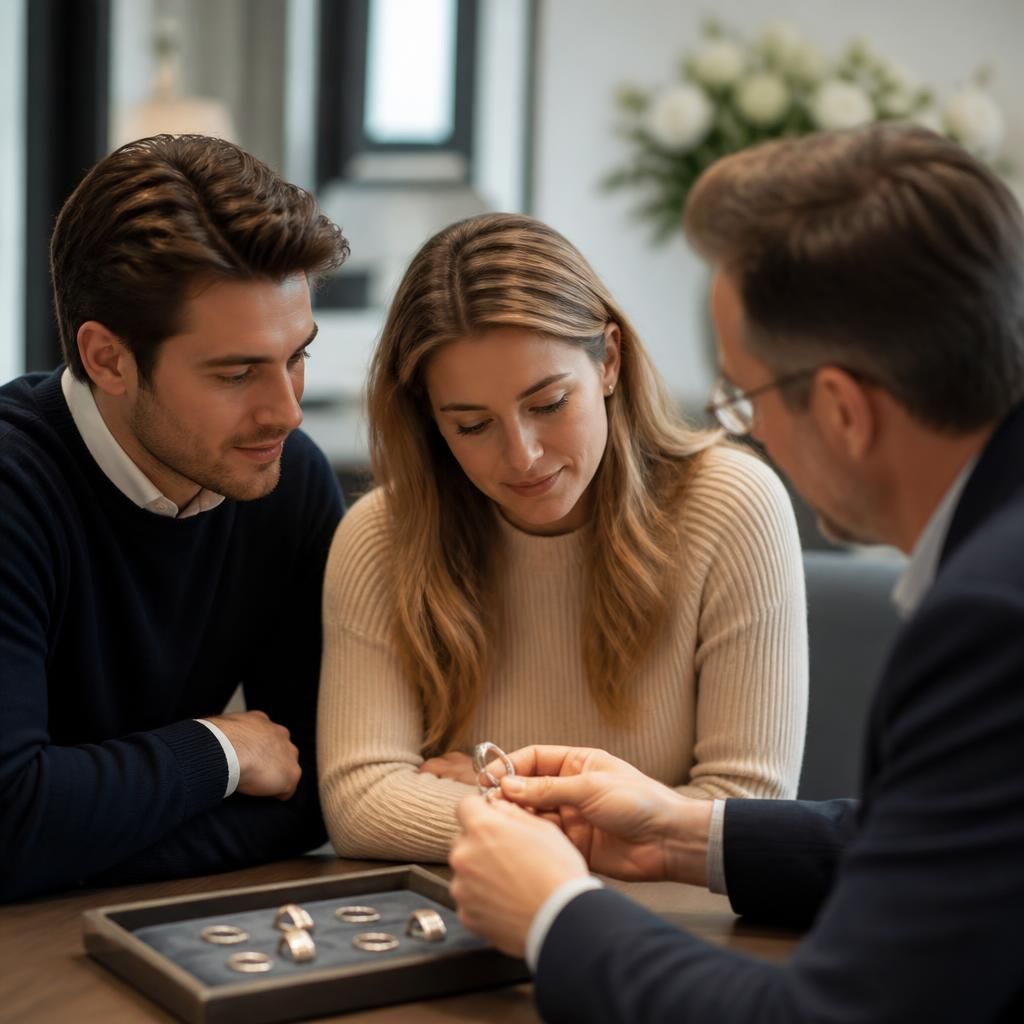
Wedding bands made from different metals should be assessed for how their surfaces will wear when worn together, particularly beside an engagement ring. Differences in hardness, finish and shape can cause rubbing, marks or changes to polished and textured surfaces over time.
Ask for both rings to be tried together before ordering. A jeweller can check whether the profiles sit comfortably, whether sharp edges make unnecessary contact and whether the finishes are suitable for everyday wear. Matching the proportions or adding a shared design detail can create a coordinated appearance without requiring the same metal.