
What should I know about warranties and servicing for luxury watches?
A luxury watch warranty usually covers manufacturing defects for a defined period, but normally excludes accidental damage, wear and tear, moisture caused by misuse, and work carried out by an unauthorised party. Servicing should follow the manufacturer’s guidance and be completed by a qualified specialist, with service records, original documentation and proof of authorised work retained to protect the watch’s condition and value.
A luxury watch warranty generally covers defects in materials or workmanship for a defined period, while servicing is scheduled maintenance intended to preserve accuracy, water resistance and reliable operation. Warranties do not normally cover accidental damage, ordinary wear, cosmetic deterioration, magnetism, misuse, or work carried out by an unauthorised person. Always check the specific warranty terms for the watch, keep its supporting documents and use a suitably qualified specialist for inspection and servicing.
What a luxury watch warranty usually covers
A manufacturer’s warranty is intended to address a fault attributable to the watch’s construction or manufacture. Depending on the terms, this may include a movement that stops or runs outside the manufacturer’s stated tolerance, a defective component or a fault with the case or winding mechanism. The warranty normally applies only while it remains valid and may require the watch to be presented with its warranty card, certificate, receipt or other proof of purchase.
The warranty is separate from a service guarantee. If a watch has been serviced, the service provider may offer a limited guarantee for the work completed or parts fitted. That guarantee does not necessarily restore or extend the original manufacturer’s warranty. Ask for the terms in writing, including its duration, exclusions and the procedure for making a claim.
Common exclusions and limitations
- Scratches, dents, scuffs and other cosmetic damage caused by normal wear or an accident.
- Damage to the crystal, bracelet, clasp or crown resulting from impact, snagging or misuse.
- Water damage where the crown was not fully secured, the watch was used beyond its stated water resistance, or seals had deteriorated.
- Damage caused by incorrect opening, attempted repair, modification or servicing by an unauthorised party.
- Normal deterioration of seals, gaskets, lubricants, finishes and other consumable or wear-related parts.
- Loss, theft or damage that should instead be addressed through appropriate insurance.
Water resistance is not a permanent condition. It depends on seals that age and may be affected by heat, chemicals, impact and repeated exposure to water. A watch described as water resistant is not automatically suitable for swimming or diving. Follow the manufacturer’s stated rating and care instructions, and never operate the crown or pushers while the watch is wet unless the manufacturer specifically permits it.
Manufacturer warranty, seller warranty and legal rights
A watch may have a current manufacturer warranty, a warranty provided by the seller, or both. With a pre-owned watch, confirm whether any remaining manufacturer warranty is valid, whether it transfers to a subsequent owner and which documents are required. A seller’s warranty may cover different faults and may have different exclusions, so it should not be treated as equivalent to the manufacturer’s warranty without checking the terms.
In the UK, a warranty does not remove your statutory rights when buying from a business. The watch should be as described, of satisfactory quality and fit for its intended purpose. These rights and the available remedy can depend on the circumstances of the purchase, the age of the watch and the nature of the fault. Keep the purchase documentation and speak to the seller promptly if a problem appears.
When should a luxury watch be serviced?
Service timing depends on the movement, age, use, storage conditions and the manufacturer’s recommendations. A watch may need attention sooner if it is losing or gaining noticeably, stopping, making an unusual sound, becoming difficult to wind, showing condensation beneath the crystal or displaying reduced power reserve. A service may also be sensible after significant impact, exposure to water or a prolonged period without use.
Do not rely solely on a calendar interval. A watch that appears to be running normally can still have dried or contaminated lubricants, worn components or ageing seals. Conversely, opening a watch unnecessarily can introduce avoidable risks. A qualified specialist can assess its condition and recommend inspection, testing or a full service based on evidence rather than assumption.
What is included in a professional service?
The exact work varies by watch and service level, but a complete mechanical service commonly involves:
- Recording the watch’s condition, reference details and any requested work.
- Disassembling and inspecting the movement and identifying worn or damaged components.
- Cleaning the movement and replacing parts that cannot reliably be reused.
- Reassembling and lubricating the movement in accordance with the relevant technical requirements.
- Adjusting the movement and checking rate, amplitude, power reserve and functions.
- Inspecting the case, crown, pushers, crystal, bracelet and clasp.
- Replacing appropriate seals and checking water resistance where the watch is designed for it.
- Carrying out final testing before returning the watch.
Polishing is not automatically part of a service and should be discussed before work begins. Careful refinishing can improve worn surfaces, but excessive polishing may soften sharp edges, alter factory finishing or reduce originality. For an important or collectible watch, retaining the original case profile may be preferable to removing every mark.
Choosing a servicing provider
Use a provider with appropriate experience of the watch’s movement and construction. Ask whether the work will be carried out in-house or sent elsewhere, which parts may be replaced, whether original or compatible parts will be used, how water resistance will be tested and what guarantee is provided after servicing. A clear written estimate should distinguish essential repairs from optional cosmetic work.
For a watch still covered by a manufacturer’s warranty, check the warranty conditions before authorising independent work. An unauthorised intervention may affect the manufacturer’s ability to support a later claim, particularly if the work or parts contributed to the fault. Where warranty protection, originality or future resale matters, use the service route specified by the manufacturer or an appropriately authorised specialist.
Records and documents to retain
Keep the warranty card or certificate, original receipt, service invoices, estimates, repair notes and any pressure-test or timing results. Record the watch reference and serial details securely, and retain photographs that show its condition before significant work. These records help establish ownership and service history, support an insurance claim and give a future buyer confidence in the watch’s maintenance.
For a pre-owned purchase, compare the watch with its documents before finalising the transaction. A service receipt should identify the watch clearly and describe the work completed; a generic statement that a watch has been “serviced” is less useful. If the history is incomplete, arrange an independent inspection rather than assuming that an attractive appearance or apparently smooth operation proves recent servicing.
Practical care between services
- Keep the crown fully pushed in or screwed down where the design requires it.
- Avoid strong magnets, sudden impacts, extreme heat and prolonged contact with chemicals, cosmetics or salt water.
- Rinse and dry a water-resistant watch according to the manufacturer’s instructions after exposure to suitable clean water, but do not do this if the case or crystal may be damaged.
- Have the watch checked after a serious impact or any suspected moisture ingress.
- Do not open the case, adjust the movement or attempt to remove links without the correct tools and expertise.
- Store the watch securely, away from damp and excessive temperature changes, and insure it appropriately if its value warrants cover.
Before handing over a valuable timepiece, agree the condition, requested work, estimated cost, expected timescale and responsibility for any additional repair. If a fault is found during inspection, the provider should obtain your approval before carrying out non-essential work. This creates a clear record and helps protect both the watch and your expectations.
In practical terms, the safest approach is to read the warranty before relying on it, obtain a condition assessment when the watch’s history is uncertain, service it through a properly qualified route and retain every relevant record. If you are unsure whether a fault is covered or whether a watch is due for service, a professional inspection can distinguish a warranty issue from routine maintenance or accidental damage.
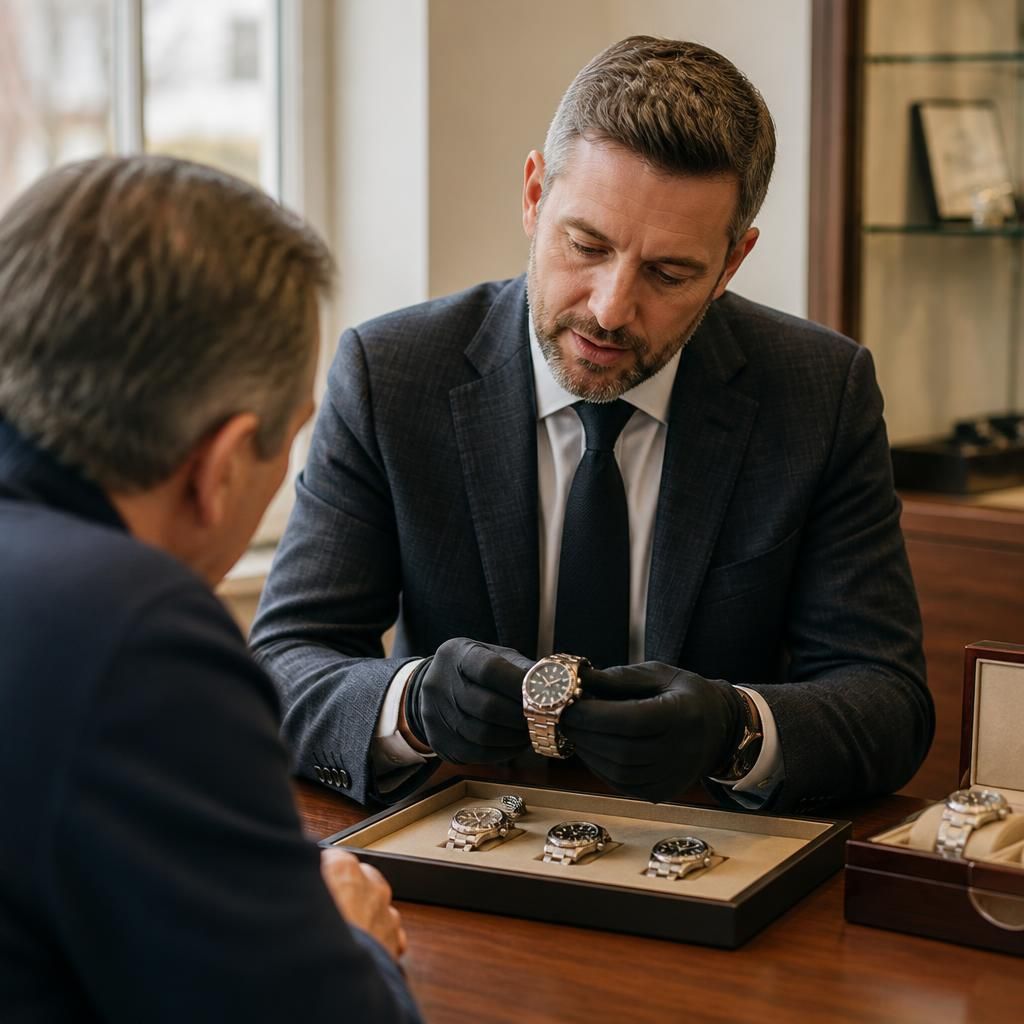
A luxury watch warranty covers eligible manufacturing faults; it is not a substitute for routine servicing or protection against accidental damage. Before making a claim, check the warranty terms, confirm that the warranty remains valid and retain the card, receipt and service records.
Water resistance is a common area of misunderstanding. Seals deteriorate with age and can be affected by impact, heat and chemicals, so a water-resistant watch should be tested periodically and never used beyond its stated rating. Keep the crown secured, avoid operating it when wet and arrange an inspection promptly if condensation appears beneath the crystal.