What types of designs can be achieved with laser engraving on jewellery?
Laser engraving on jewellery can create precise text, dates, handwriting, fingerprints, symbols, monograms, photographs and intricate decorative motifs. The design can be applied to rings, pendants, bracelets, bangles and other suitable pieces, subject to the available engraving area, material and surface shape.
Laser engraving on jewellery can produce highly precise designs ranging from names, dates and meaningful messages to handwriting, fingerprints, symbols, photographs and detailed decorative patterns. The result depends on the jewellery’s material, finish, available engraving area and the shape of the surface, so each design is assessed individually before engraving.
Text and personal messages
Text is one of the most versatile laser engraving options. Suitable wording may include a name, initials, a date, a place, a short quotation or a private message. Laser engraving allows lettering to be reproduced with clean edges and consistent depth, including small or unusual typefaces where the surface and design size permit.
For rings, the inside of the band is often used for discreet messages, dates or initials. Pendants, bracelets and bangles can provide more visible space for names, phrases or commemorative details. The length of the wording must be balanced against legibility: text that is too small or tightly spaced may not remain clear over time.
Handwriting and signatures
A handwritten note, signature or short personal phrase can be converted into an engraving design. This is particularly suitable for commemorative jewellery, wedding rings and gifts. The original writing should be supplied as a clear, high-quality image or scan, with sufficient contrast between the writing and the background. Natural variations in handwriting can be retained, although very fine strokes may need to be simplified to engrave clearly.
Fingerprints and other personal marks
Fingerprint designs can be engraved to create a highly individual pattern. The image is prepared digitally and adjusted to suit the intended area, while preserving the main ridges and distinctive form. Similar treatment can be used for children’s drawings, a personal sketch, a soundwave-style graphic or another meaningful mark, provided the original artwork has enough clarity for accurate conversion.
Dates, coordinates and symbolic details
Important dates can be combined with symbols, initials or a short inscription. Geographical coordinates, star signs, infinity symbols, hearts, religious symbols and other simple motifs can also be incorporated into a design. These elements may be engraved alone or arranged as part of a more considered composition, such as a central motif surrounded by lettering.
Monograms, crests and logos
Monograms can be created using interlocking initials, decorative lettering or a more understated arrangement. Personal crests, family emblems and suitable line-art logos may also be engraved, subject to copyright ownership and the detail contained in the artwork. Fine areas, enclosed spaces and very small elements may need to be adapted so the design remains identifiable on the finished jewellery.
Photographs and portrait designs
Laser technology can reproduce selected photographs and portrait-style images on suitable jewellery. These are generally converted into a tonal or line-based design rather than engraved as a conventional full-colour photograph. Images with a clear subject, strong contrast and an uncluttered background usually translate more effectively. The available surface area is important, as facial features and other fine details can become difficult to distinguish when reduced.
Decorative and patterned designs
Laser engraving is not limited to personal wording. It can create geometric patterns, botanical motifs, stars, constellations, waves, filigree-style lines and other decorative artwork. Repeated borders and symmetrical designs can be planned digitally to follow the shape of a bangle, pendant or ring. Curved surfaces require particular care to maintain consistent alignment and visual balance.
Layered and combined designs
Several design elements can often be combined. For example, a pendant may feature a central symbol with a date around it, or a ring may carry a fingerprint alongside initials. A design can also combine different lettering styles or use a contrast between polished and satin-finished areas. The composition needs to be proportionate to the jewellery so that the engraving remains readable rather than appearing crowded.
What determines the final design?
- Material: Gold, platinum, silver and other jewellery materials respond differently to laser engraving. Coatings, plating and surface treatments may affect the available finish.
- Surface shape: Flat, gently curved and highly curved surfaces each place different limits on size, alignment and consistency.
- Available space: A wider pendant or bangle can accommodate more detail than a narrow ring or small charm.
- Design clarity: Fine lines, delicate lettering and intricate images may need to be simplified for a clean, durable result.
- Finish and depth: The desired contrast and appearance depend on the jewellery’s existing finish and the engraving method used.
- Condition of the jewellery: Existing scratches, wear, previous engraving or structural features may influence where a new design can be placed.
Before work begins, the proposed artwork should be checked against the piece itself. This allows the lettering, image or motif to be scaled appropriately and identifies any areas where detail may be lost. A digital preview or layout can help confirm the position and proportions, although the finished appearance can vary slightly according to the material and surface finish.
Laser engraving is precise, but it cannot make every design suitable for every item of jewellery. Very long messages, extremely fine artwork, deep curvature, fragile components and heavily textured surfaces may require an alternative layout or a simpler design. If the jewellery is plated or coated, engraving may expose the underlying material and create a contrasting appearance that should be considered in advance.
For a bespoke piece, the most effective design is one that combines personal meaning with practical legibility. Steven Charles Quance can assess the jewellery, discuss the intended artwork and advise on the most suitable placement, scale and finish before engraving takes place.
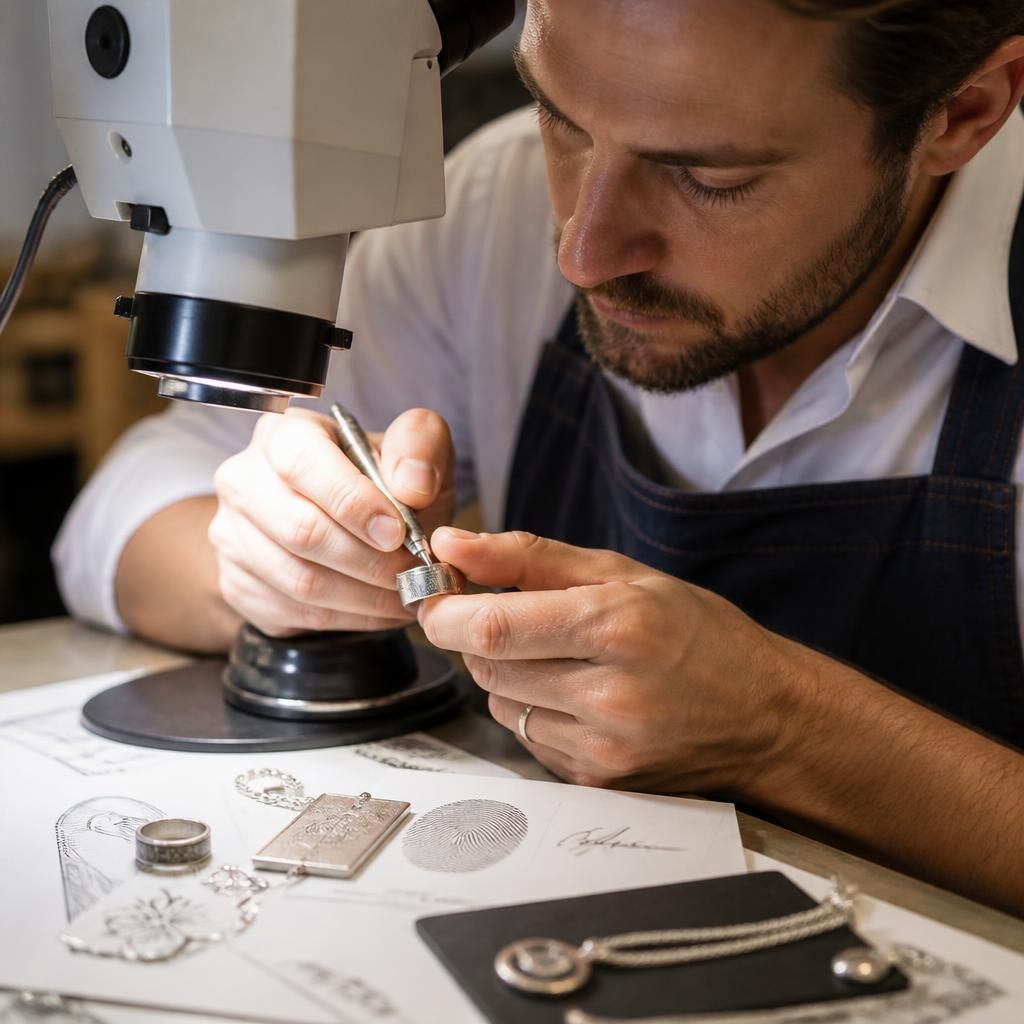
Laser engraving on jewellery can reproduce personal details such as handwriting, signatures and fingerprints, provided the original design is clear enough to convert accurately. These designs are prepared digitally and scaled to suit the jewellery’s available surface.
A clear scan or high-resolution photograph normally gives the best result. Very fine handwriting strokes or fingerprint lines may need slight simplification so they remain visible after engraving, particularly on a narrow ring or small pendant. Before work begins, the design can be checked against the item to confirm its size, position and legibility.