What should I know about the authenticity of pre-loved jewellery?
The authenticity of pre-loved jewellery is assessed by checking its hallmarks, materials, construction, gemstones and available provenance. A reputable jeweller should explain what has been verified, identify any alterations or replacements, and provide an independent valuation or documentation where appropriate.
Authenticity in pre-loved jewellery is established by examining its hallmarks, metal content, workmanship, gemstones, construction and available provenance. A reputable jeweller should explain which elements have been physically tested, identify any later alterations or replacement stones, and distinguish between an authentic piece and one that has simply been restored, remodelled or repaired.
Start with the hallmark and maker’s marks. In the UK, a legal hallmark can confirm that an item has been independently tested and that its precious-metal fineness meets the stated standard. Look for a sponsor or maker’s mark, a fineness mark and an assay office mark. A date letter may also be present on older items, although it is not compulsory on every piece and should not be treated as proof of authenticity on its own. Birmingham-associated pieces may carry the anchor assay office mark, but the absence of a Birmingham mark does not automatically mean that an item is not genuine.
Hallmarks can be very small, worn or difficult to read, particularly on rings and bracelets. They may also be found in less visible positions, such as inside a shank, on a clasp tongue or on a pendant fitting. Do not rely on a printed description or a photograph alone. The marks should be examined with suitable magnification and compared with the item’s age, style and construction.
Understand what the fineness mark tells you. A gold fineness mark indicates the proportion of pure gold in the alloy, while sterling silver is commonly marked with its recognised fineness. Platinum and palladium have their own hallmark standards. The mark confirms the tested metal standard at the time of hallmarking; it does not prove that every component of a multi-part item is made from the same metal. For example, a ring may include a precious-metal setting with a base-metal spring, plated detail or a later replacement component.
Testing is important where marks are absent, unclear or inconsistent. A jeweller may combine visual inspection with appropriate metal-testing methods and, where necessary, refer an item for further assessment. Surface testing has limitations: plating, solder, wear and different alloys can affect results. A professional assessment should therefore consider the whole piece rather than treating a single test as conclusive.
Inspect the workmanship and construction. Genuine quality jewellery usually shows evidence of deliberate manufacture, such as consistent settings, secure claws, properly formed hinges, even soldering and a coherent finish. These features do not prove age or value by themselves, but inconsistencies can indicate alterations, assembled parts or a modern reproduction. Check whether the style, hallmark and manufacturing techniques appear compatible. Wear should also be plausible for the item’s claimed age, although a well-preserved piece may have been worn very little.
Gemstones need separate consideration. Their authenticity involves identifying whether they are natural, laboratory-grown, synthetic or imitation, and whether they have been treated. These terms are not interchangeable. A laboratory-grown stone may have substantially similar chemical and physical properties to a natural stone but does not have the same geological origin. Glass, cubic zirconia and other simulants are different again. A jeweller should describe the stone accurately and disclose known treatments or replacements.
For significant gemstones, request a suitable gemmological report where one exists or where the value and rarity justify independent documentation. A report may identify the species, variety, measurements, treatments and, in some cases, origin indications. It is not necessarily a valuation, and a valuation is not necessarily a gemmological identification report. These documents serve different purposes.
Check the provenance, but treat it as supporting evidence. Provenance can include a previous valuation, purchase receipt, service record, presentation box, insurance documentation or a clear ownership history. It may help establish how an item has been represented and cared for, but paperwork can be incomplete, inaccurate or associated with a different piece. Match any description, measurements, photographs, hallmarks and identifying features to the jewellery itself.
For pre-loved luxury watches, authenticity checks should include the case, dial, movement, serial or reference markings, bracelet, clasp and service history. Replacement parts are not automatically evidence of a counterfeit; they may have been fitted during legitimate servicing. However, the watch should be described honestly as original, serviced, refurbished or containing replacement components where relevant. Specialist examination is advisable when a watch has a substantial value or an unusual history.
Ask what is included in the description. Before buying, confirm:
- the metal type and fineness, and whether all visible precious-metal components have been checked;
- the identity, size and condition of any gemstones;
- whether stones are natural, laboratory-grown, synthetic or imitation;
- any known treatments, repairs, resizing, remodelling or replaced parts;
- whether the item has a UK hallmark or another recognised assay mark;
- what paperwork, valuation or independent report accompanies it; and
- what returns, guarantees and aftercare arrangements apply.
Be cautious of jewellery described only as “gold-coloured”, “gold tone”, “gold plated” or “gold-filled” when you are looking for solid gold. These descriptions refer to different materials and should not be confused with a solid precious-metal fineness. Similarly, a stamped mark is not conclusive proof: counterfeit items can carry copied or misleading marks, while genuine older pieces may have worn, repaired or incomplete hallmarks.
Price is another useful cross-check, but it is not an authenticity test. A low price may reflect condition, a modest metal weight, treated or replacement stones, an unrecognised maker, incomplete documentation or the need for repair. Conversely, a high price should be supported by the item’s materials, craftsmanship, provenance and condition. Ask for a clear explanation of what determines the price rather than relying on a claim about rarity or age.
Authenticity should also be considered alongside condition. A genuine antique or designer piece may have worn settings, thinning at the back of a ring, stretched links or previous repairs. These issues do not necessarily reduce its authenticity, but they can affect safety, longevity and value. Before purchase, have vulnerable areas checked and establish whether any work is recommended, included or likely to alter the item’s original character.
The safest approach is to buy from a jeweller who is willing to inspect the piece properly, explain the evidence in plain language and record material facts in writing. If the hallmark is unclear, the gemstone is unusual, the provenance is incomplete or the value is significant, request further testing or an independent opinion before committing to the purchase. This gives you a more reliable basis for judging whether the jewellery is authentic, accurately described and suitable for its intended use.
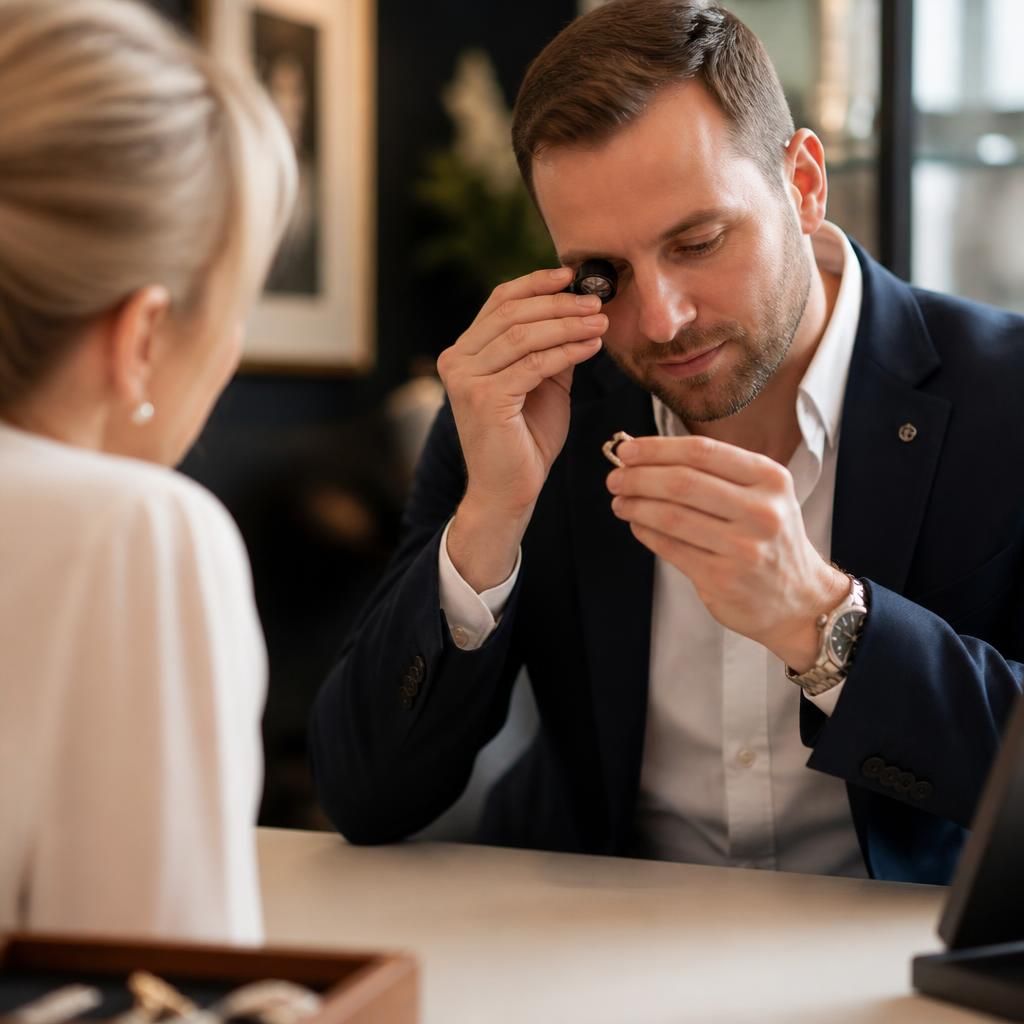
A hallmark is an important indication of a pre-loved jewellery item’s precious-metal standard, but it is not proof of the entire piece’s authenticity. It should be assessed alongside the maker’s mark, construction, gemstone details, condition and any available provenance.
When checking a hallmark, confirm that the fineness mark and assay office mark are clear and consistent with the jewellery’s age and design. A worn or incomplete mark may require professional examination, while a copied stamp can be misleading. Ask us to check whether stones, settings or other components have been replaced, repaired or remodelled, and ensure the findings are recorded accurately before you buy.