What are the benefits of choosing laser engraving for personalising jewellery?
Laser engraving provides highly precise, durable personalisation, allowing names, dates, messages and intricate designs to be applied neatly to suitable jewellery surfaces. It creates a clean, consistent finish with more scope for fine detail than many traditional engraving methods, making each piece distinctly personal.
Laser engraving personalises jewellery by using a precisely controlled beam of light to mark, remove or alter a very small area of the surface. Its main benefits are accuracy, consistency and the ability to reproduce fine details, allowing names, dates, handwriting, symbols, fingerprints and intricate patterns to be added neatly to suitable jewellery.
Precise and highly detailed results
A laser can be focused on a very small area, which makes it suitable for delicate lettering and detailed artwork. This is particularly useful when the available engraving space is limited, such as on the inside of a ring, the back of a pendant or a slim bracelet plate. Fine lines, small motifs and carefully prepared handwritten messages can often be reproduced more accurately than with a broader traditional engraving tool.
The final appearance depends on the jewellery’s material, surface finish, available space and the design supplied. Very small lettering may not remain easy to read over time, so the design should always be assessed at the intended size before engraving.
Consistent, controlled personalisation
Laser engraving is digitally controlled, helping to produce even lettering and repeatable detail across the chosen surface. This is valuable for matching engravings on wedding rings, creating complementary messages on paired pieces or applying a carefully balanced design to a bespoke item. The process also allows the position, scale and orientation of the engraving to be planned before work begins.
Because the laser is guided by a prepared design, it can be used for more than standard names or dates. Depending on the jewellery and equipment available, suitable designs may include initials, meaningful words, signatures, simple illustrations, geometric patterns, symbols and reproduced handwriting.
More flexibility for bespoke designs
Traditional engraving is often associated with cut lettering and hand-finished lines. Laser engraving can create a different range of effects, including sharp outlines, fine surface marks and varied levels of contrast. It may also be used alongside other techniques where a design requires both cut detail and surface marking.
This flexibility makes laser engraving useful for personalising engagement rings, wedding bands, pendants, medallions, cufflinks, bracelets, watch components and other jewellery items, provided that the surface is suitable and there is enough room for the design.
Contactless application
Laser engraving is a contactless process: the engraving tool does not need to press against the jewellery in the same way as a traditional cutting tool. This can help reduce the risk of unwanted tool marks or distortion during the marking stage. It does not, however, remove the need for careful preparation. The item must still be secured correctly, and stones, settings, coatings and delicate components must be considered before the work is approved.
Durable when matched to the right material and finish
A correctly applied engraving can provide lasting personalisation because it changes the jewellery’s surface rather than adding a separate printed layer. How well it remains visible depends on the depth and type of mark, the jewellery material, the surface finish and how the piece is worn. Frequent friction, polishing, refinishing or resizing can soften or remove an engraving, particularly when it is positioned on an exposed area.
For this reason, an engraving should be planned with future aftercare in mind. If a ring may need resizing, the intended position should be discussed beforehand. Engraving on the inside of a band may be protected from some everyday contact, while an engraving on the outside can be more visible but more exposed to wear.
Suitable for meaningful, individual messages
Laser engraving gives you the option to personalise a piece with information that is significant to you rather than choosing a standard decoration. A date, private message, initials or a section of handwriting can make the item more distinctive while keeping the overall design understated. It is also useful for commemorative jewellery and gifts where a small, discreet detail is more appropriate than a prominent design.
Before proceeding, the wording should be checked carefully, including spelling, punctuation and character spacing. The layout can then be reviewed to make sure it fits the jewellery and remains legible. Once a design has been engraved, corrections may require repolishing or replacing the affected component, so approval at this stage is important.
What to consider before choosing laser engraving
- Material: precious metals, plated surfaces, coated finishes and alternative materials can respond differently to the laser.
- Surface shape: flat areas are generally easier to engrave consistently than highly curved, uneven or narrow surfaces.
- Available space: longer messages need more room, and reducing the text too far can affect readability.
- Finish: polished, brushed, matt and darkened surfaces may produce different levels of contrast.
- Wear and aftercare: exposed engraving may change with use, cleaning, polishing, repairs or resizing.
- Stones and settings: the construction of the item must be assessed to avoid affecting gemstones or delicate components.
Laser engraving is therefore a strong choice when you want accurate, fine and carefully planned personalisation, especially for bespoke jewellery or designs that would be difficult to reproduce by hand. It is not automatically the right option for every item. Reviewing the material, surface, message, design size and likely future aftercare with an experienced jeweller ensures that the chosen engraving method is appropriate and that the finished result remains clear and practical to wear.
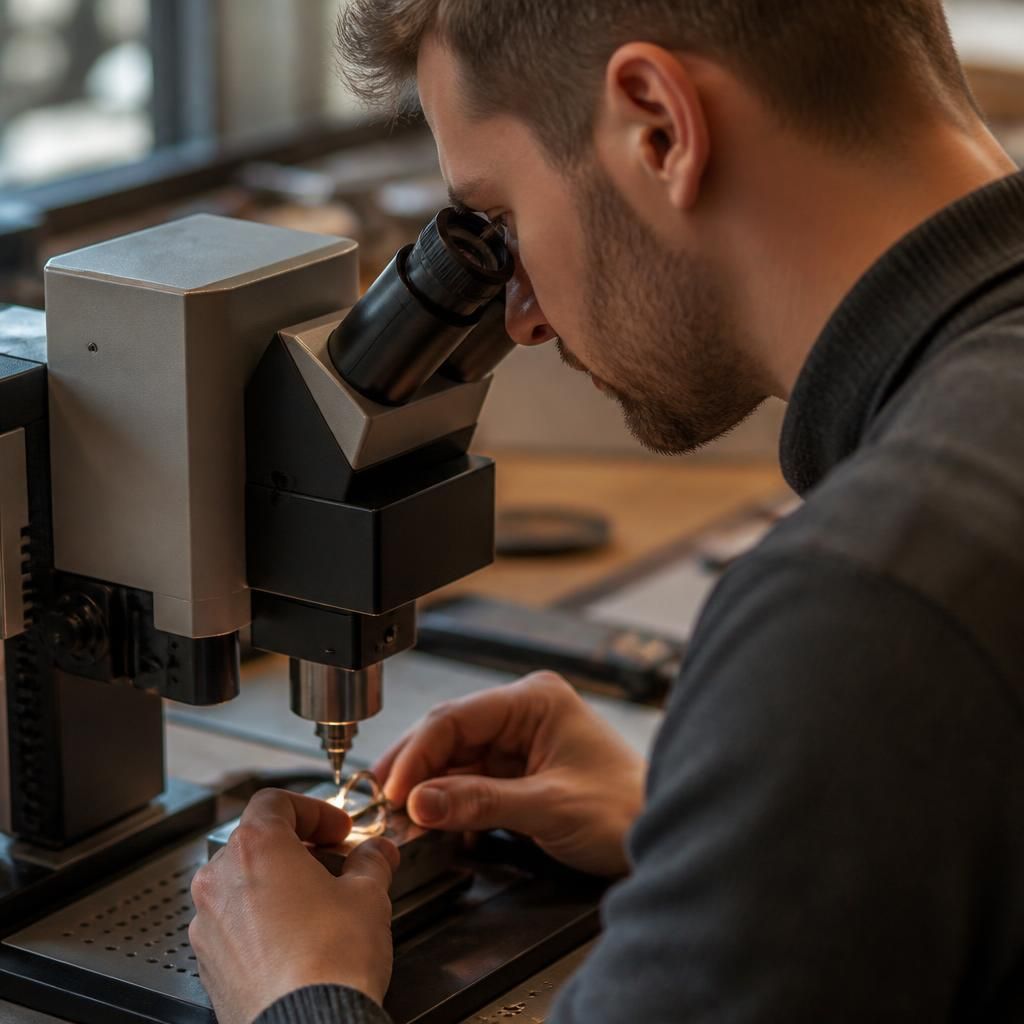
Laser engraving creates personalisation by marking the jewellery’s surface with a precisely controlled beam, rather than applying a printed or separate decorative layer. This gives names, dates, handwriting and symbols a clean, permanent finish when the material, depth and surface are suitable.
Its durability still depends on how the piece is worn and maintained. Engraving on the inside of a ring may receive less direct abrasion, while an exposed bracelet, pendant or ring surface can gradually show wear through friction, polishing, refinishing or future repairs. We therefore assess the jewellery, available space and intended design before engraving, helping ensure the detail remains legible and appropriate for the piece.