What precautions should I take to ensure a Rolex is authentic before purchasing?
To check a Rolex is authentic before purchasing, buy from a reputable jeweller, verify the reference and serial details against the watch and accompanying documentation, and have the movement, case and parts examined by an experienced Rolex specialist. Confirm the seller’s provenance, condition, service history, return terms and warranty, and avoid any watch with altered markings, inconsistent paperwork or pressure to complete the purchase without independent checks.
The safest way to establish that a Rolex is authentic is to combine checks of the watch, its documentation and its provenance with an examination by an experienced Rolex specialist before the purchase becomes final. No single feature proves authenticity: genuine-looking boxes, papers, serial numbers and even individual components can be copied, altered or fitted to a watch assembled from mismatched parts.
Buy from a reputable source
Start by assessing the seller rather than relying only on the advertised model. A professional jeweller should be able to explain where the watch came from, provide clear photographs and descriptions, answer specific questions about its history, and offer written terms covering condition, returns and warranty support. Check that the business has a verifiable premises, established contact details and a clear process for resolving problems after the sale.
Exercise particular caution with private sellers who refuse an in-person inspection, offer an unusually low price, create urgency or insist on payment methods that provide little protection. A convincing listing and positive-looking online profile are not substitutes for examining the watch and confirming the seller’s identity and rights to sell it.
Match the reference and serial details
Compare the reference number, serial number and model description across the watch, paperwork, receipt and any service records. The details should be consistent with the model’s case, dial, bracelet and approximate production period. Ask the seller to explain any discrepancy rather than assuming it is an innocent clerical error.
Serial and reference markings should be professionally formed, correctly positioned and free from signs of grinding, re-engraving or damage around the relevant areas. However, a matching serial number does not prove that the watch is genuine. Numbers can be copied from authentic watches, and documentation can be paired with a different watch. Avoid publishing or sharing full serial details unnecessarily, as this information can be misused.
Inspect the external components
Examine the case, crown, bezel, crystal, dial, hands, bracelet and clasp for consistency with the stated reference. Look for:
- Sharp, even case finishing that matches the model, with appropriate polished and brushed surfaces.
- Clean, precise dial printing, correctly shaped markers and hands, and details that are proportionate to the model.
- A date display and magnification effect that are consistent with the watch, without relying on magnification alone as proof.
- A bracelet and clasp with the correct construction, markings and fit for the reference.
- Correct engravings and hallmarks where applicable, without blurred, uneven or freshly altered markings.
- No unexplained gaps, loose components, poor alignment, excessive refinishing or parts that appear inconsistent with one another.
Be aware that an authentic Rolex may have been polished, repaired or fitted with replacement parts during its lifetime. Such work does not automatically make it counterfeit, but it can affect originality, value and future servicing. The seller should identify non-original or later replacement components clearly.
The small coronet visible on some crystals is not, by itself, an authentication test. Its visibility varies with lighting, cleaning and condition, and counterfeit examples may imitate it. Likewise, weight, sound, sweeping seconds-hand movement and general appearance can help identify concerns but cannot replace a professional inspection.
Have the movement examined
A qualified specialist should inspect the movement, not merely the exterior. The movement should be appropriate for the stated model and reference, with correct architecture, finishing, markings and component layout. An examination can also reveal a counterfeit movement, an incorrect movement, extensive wear, water damage or a mixture of genuine and non-genuine parts.
Opening a watch should be carried out by someone equipped to protect the case and maintain water resistance. Do not ask an inexperienced person to remove the case back simply to provide reassurance. Depending on the watch’s condition and the proposed transaction, the specialist may also recommend timing, pressure or water-resistance tests, although these tests assess operation and sealing rather than proving authenticity on their own.
Review the papers, service history and provenance
Check that the warranty card, receipts, service documents and valuation records relate to the actual watch. Look for consistent model descriptions, dates and serial information, but remember that paperwork can be fabricated or transferred. A box, swing tag, polishing cloth or card is supporting evidence only and does not authenticate the watch.
Ask when and where the watch was purchased, whether it has been serviced, whether any parts have been replaced and whether it has been repaired after impact or water exposure. A responsible seller should be open about missing papers, aftermarket components, refinishing and uncertain history. Where appropriate, request evidence that the watch is not subject to an ownership dispute or reported as stolen. If the provenance cannot be reasonably explained, do not proceed simply because the watch appears genuine.
Use an independent authentication condition
For a valuable purchase, make the sale conditional on an independent inspection by a suitably experienced watch professional. The inspection should be carried out before payment is irrevocable, or within a clearly written return period that allows the watch to be examined properly. Confirm in advance what happens if the watch is found to be counterfeit, materially different from the description or fitted with undisclosed non-original parts.
Do not rely solely on an expert selected by the seller if the transaction is high value and the seller will not permit independent checks. A reputable jeweller should be willing to explain the basis of its assessment and provide written details of the watch’s reference, condition, originality and any limitations of the inspection.
Protect the transaction
Before completing the purchase, obtain a detailed invoice identifying the seller, watch, reference and serial details, sale price, condition, included items, warranty and return terms. Pay through a method that provides an appropriate audit trail and protection, and make sure the recipient’s name matches the contracting seller. Avoid cash handovers or transfers to unrelated third parties where there is no clear reason and no practical recourse.
When meeting in person, arrange the inspection and exchange at a professional premises rather than an isolated location. Do not allow pressure to skip checks because another buyer is supposedly waiting. If buying remotely, confirm the seller’s identity, use secure delivery with suitable insurance and do not accept stock photographs in place of images of the actual watch.
Warning signs that should stop the purchase
- The price is substantially below comparable examples without a credible explanation.
- The seller will not provide the reference, serial details or clear images of the actual watch.
- Markings look altered, documentation contains inconsistencies or the watch has an unexplained mixture of parts.
- The seller describes the watch as “almost genuine”, “replica”, “customised” or “just needing authentication” while presenting it as an original Rolex.
- You are discouraged from opening the watch or seeking an independent opinion.
- The return policy is unclear, conditional on the seller’s approval or unavailable once payment has been made.
If any of these concerns arise, pause the purchase. A genuine watch can still be a poor purchase if it has undisclosed aftermarket parts, an uncertain history, significant movement damage or no meaningful aftercare. The most dependable decision combines authentication with a proper assessment of condition, originality, service needs and the seller’s contractual obligations.
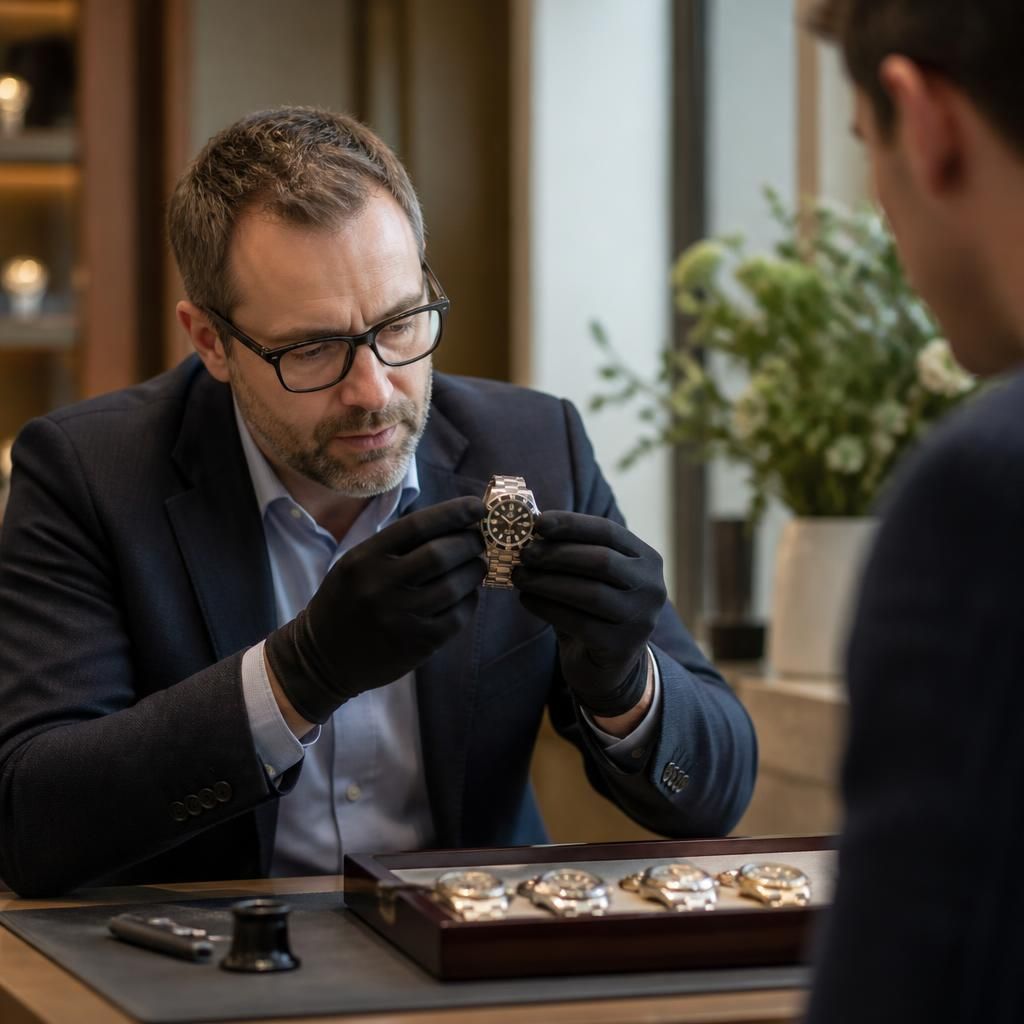
The most reliable way to confirm a Rolex is authentic is to combine checks of the watch, its paperwork and its provenance with an examination by an experienced Rolex specialist. External details such as the coronet on the crystal, a sweeping seconds hand or a matching serial number can support an assessment, but none proves authenticity on its own.
A specialist should compare the reference, case, dial, bracelet and movement, checking for incorrect components, altered markings, refinishing or a mixture of genuine and non-genuine parts. Ask for this inspection before payment becomes irrevocable, or make the purchase subject to a clearly written return period that allows independent examination.
Also confirm that the invoice identifies the actual watch and sets out its condition, originality, warranty and return terms. If the seller discourages an independent check, provides inconsistent documentation or pressures you to complete the purchase, pause the transaction.