
Are there risks associated with buying luxury watches online?
Yes. Buying a luxury watch online can involve counterfeit or stolen goods, inaccurate descriptions, hidden damage, fraudulent payment requests and limited warranty or returns protection, particularly when the seller’s identity and provenance are unclear.
Reduce the risk by checking the seller’s credentials, reviewing detailed photographs and documentation, confirming authenticity and service history, using a secure payment method, and ensuring the purchase includes clear written terms and appropriate aftercare.
Buying a luxury watch online carries genuine risks because you cannot examine the watch, verify the seller or handle the paperwork in person before committing to the purchase. The main concerns are counterfeit watches, stolen goods, undisclosed damage, altered or incomplete components, misleading photographs, payment fraud and weak returns or warranty protection. These risks can be reduced by dealing with an established seller, checking provenance and condition carefully, using a secure payment method and confirming the terms of the sale in writing.
Counterfeit or misrepresented watches
Counterfeit watches can look convincing in photographs, particularly when images are low-resolution, heavily edited or taken from a manufacturer’s website. Some listings use genuine photographs while supplying a different watch, or combine authentic exterior parts with non-original internal components. A watch may also be described as fully original when it contains replacement parts, an aftermarket dial, bezel, bracelet or hands.
Request clear, current photographs of the actual watch rather than catalogue images. These should show the dial, case, case sides, crown, clasp, bracelet, case back and movement where appropriate. Ask for a photograph showing the watch alongside a note bearing the seller’s name and the current date. This does not prove authenticity by itself, but it helps establish that the seller has the item in their possession.
Authenticity should be assessed through the watch as a whole. Serial and reference markings, dial printing, finishing, movement details, bracelet construction and correspondence between the watch and its documents should be consistent. A serial number alone is not sufficient evidence, as numbers can be copied, altered or paired with unrelated paperwork. For a high-value purchase, independent examination by a suitably qualified watch specialist before the end of the return period provides additional protection.
Stolen or unlawfully obtained goods
A watch may be genuine but still present a legal and financial risk if it has been stolen or its ownership is disputed. If the watch is later identified as stolen, the buyer may lose possession and could face difficulty recovering the money, especially where the seller is anonymous or located outside the UK.
Ask for a clear ownership history and retain copies of invoices, receipts, valuation documents and all correspondence. Check that the serial number has not been removed or defaced and that it matches the seller’s records. A reputable seller should be able to explain the watch’s provenance and should not object to reasonable questions about title, previous ownership or servicing. Be cautious if the seller is unwilling to provide identification, offers an implausibly low price or pressures you to complete the transaction immediately.
Undisclosed condition issues
Online photographs rarely show every mark, scratch or functional problem. A watch may have a worn bracelet, over-polished case, damaged threads, moisture ingress, inconsistent timekeeping or a movement requiring service. Water resistance can also be affected by age, seals, previous opening or incorrect reassembly. Even a watch described as being in excellent condition may have visible wear when inspected under suitable lighting.
Request a written condition report that distinguishes between normal signs of use and defects. Ask whether the watch has been polished, restored, modified or serviced, and whether any components have been replaced. For mechanical watches, clarify whether the seller has checked winding, power reserve, timekeeping, date changes, chronograph functions and other complications. Do not assume that a recent service means the watch is in perfect condition; ask who carried out the work, what was replaced and whether service documentation is available.
Incomplete or inaccurate documentation
Warranty cards, certificates, service records, manuals and presentation boxes can support a watch’s history, but they do not independently prove authenticity. Documents may be missing, incorrectly matched, altered or supplied from another watch. Conversely, the absence of original packaging does not automatically mean that a watch is counterfeit.
Check that the reference and serial details on the documents correspond with the watch where those details are intended to appear. Confirm the original date of sale, the seller or authorised retailer named on the paperwork, the remaining warranty terms and any exclusions. If the watch has been serviced, ask for an itemised service record rather than relying on a verbal statement. Keep the original listing and photographs, as these form part of the evidence of what was represented at the time of purchase.
Payment and impersonation scams
Fraudsters may copy a legitimate business identity, create a professional-looking website or take over a social media account. Common warning signs include requests to pay a private individual, instructions to send money to a different account at short notice, pressure to use a bank transfer, or payment requests through methods that provide little buyer protection. A seller may also claim that a deposit is needed immediately to reserve the watch.
Confirm the legal name and physical address of the business independently, and ensure that the payment details match the verified business identity. Contact the seller using a trusted telephone number rather than replying only to an unexpected message. Never bypass an agreed payment process because of a last-minute change. A secure card payment or established escrow arrangement may offer stronger protection than an irreversible transfer, although the specific terms and exclusions should be checked before payment.
Do not send copies of identity documents, card details or security codes unless there is a legitimate, clearly explained reason and the information is being handled through a secure process. Avoid completing a luxury-watch purchase over public Wi-Fi or through an unfamiliar payment page. Keep confirmation emails, receipts and transaction records until the return and warranty periods have ended.
False listings and misleading prices
Listings may contain stock photographs, incorrect reference numbers, vague descriptions or prices that exclude delivery, insurance, taxes or import charges. A low price is not proof of a bargain; it may indicate missing parts, serious damage, a fake watch, a stolen item or an attempt to obtain a deposit without supplying anything.
Compare the description with the actual specification of the model, including its size, material, movement, bracelet and included accessories. Ask for a complete purchase price in writing, including delivery and any applicable charges. Be particularly cautious when a seller refuses to provide a firm price, changes the description during negotiations or claims that a deal is available only for an immediate payment.
Delivery, loss and damage in transit
Luxury watches can be lost, damaged or substituted during delivery. Standard postage may not provide adequate insurance, and a signature on delivery does not necessarily confirm that the contents are correct or undamaged. International purchases can also involve customs delays, import charges and less straightforward returns.
Confirm which party is responsible for the watch until it is delivered, how it will be insured, which courier will be used and what evidence is required for a claim. On delivery, inspect the exterior of the package before signing where possible and record any visible damage. Film or photograph the unboxing, retain the packaging and check the watch against the listing promptly. If there is a problem, notify the seller in writing without delay and follow the stated returns procedure.
Limited returns and warranty protection
Some online sellers offer short or restrictive return windows, charge restocking or return fees, or exclude problems described as wear and tear. Private sellers may offer no meaningful aftercare, while an international seller may make it costly or impractical to return the watch. A seller’s own warranty may cover only selected movement faults and may be invalidated by third-party repairs, water exposure or opening the case elsewhere.
Before paying, read the returns, cancellation, warranty and dispute terms in full. Confirm the length of the return period, when it begins, who pays return delivery, whether the watch must remain unworn and how refunds are made. Check whether the warranty is transferable and whether servicing must be completed by a particular provider. Written terms are especially important if the watch is pre-owned or has been modified.
A safer online buying process
- Verify the seller. Check the business identity, trading history, physical address, customer service details and professional standing. A polished website is not enough on its own.
- Verify the watch. Request current photographs, a detailed condition report, matching serial and reference information, and a clear explanation of the watch’s provenance.
- Verify the price. Establish the total cost, delivery arrangements, insurance and any taxes or import charges before making a commitment.
- Verify the paperwork. Review invoices, warranty information, service records and ownership documents, while remembering that paperwork must correspond with the actual watch.
- Protect the payment. Use a payment method with appropriate buyer protection and never accept unverified changes to bank details or payment instructions.
- Inspect immediately. Compare the delivered watch with the listing, test the relevant functions and arrange an independent inspection if the value or condition warrants it.
Pause the purchase if the seller avoids specific questions, will not provide photographs of the actual watch, refuses a reasonable inspection, cannot explain its ownership history or insists on an irreversible payment. For a high-value timepiece, buying from an established jeweller with transparent documentation, written terms and accessible aftercare generally provides more practical protection than relying on an anonymous online listing.
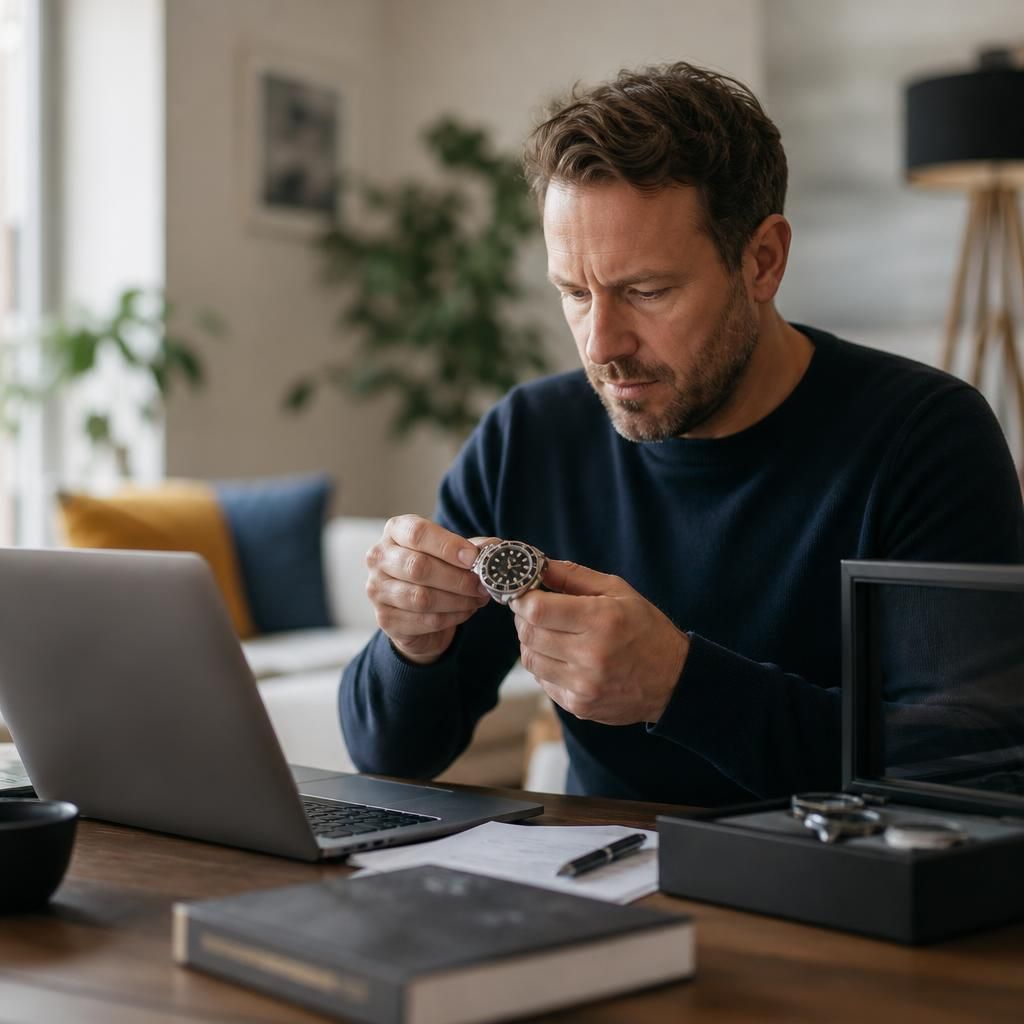
The most significant risk when buying a luxury watch online is that the item may not match the listing. Photographs can conceal replaced components, polishing, damage or a counterfeit movement, while documents may belong to another watch. Ask to see clear, current photographs of the actual timepiece, including the dial, case, engravings, clasp, bracelet and movement where appropriate.
Before paying, compare the watch’s reference and serial details with the available paperwork and request a written condition report. A reputable seller should explain the watch’s ownership history, service record and any non-original parts. For a high-value purchase, arrange an independent inspection within the returns period and use a payment method offering appropriate buyer protection.