
What maintenance and servicing should one expect with a used Rolex GMT Master II?
A used Rolex GMT-Master II should receive regular condition checks, water-resistance testing and professional servicing when its service history, timekeeping or condition indicates it is due. Maintenance may include movement inspection, lubrication, gasket replacement, cleaning, pressure testing and repairs, with the exact work depending on the watch’s age, usage and previous care.
A used Rolex GMT-Master II should be assessed on its current condition and service history, rather than its age alone. Expected maintenance includes periodic timekeeping and water-resistance checks, inspection of the case, crystal, crown and bracelet, and a complete movement service when the watch is due or shows signs of deterioration. The required work will depend on the reference, age, use, previous servicing and whether the watch has been exposed to moisture, impact or magnetic fields.
Begin with a condition assessment. Before recommending any work, a specialist should examine the watch externally and test its movement. This assessment normally considers:
- Timekeeping across different positions and the consistency of the power reserve.
- The operation of the hours hand, independent GMT hand, date display and bezel.
- The condition and fit of the winding crown, crown tube, case back and crystal.
- Signs of moisture, corrosion, condensation, impact or previous unauthorised repairs.
- Bracelet stretch, clasp security, end links and the condition of screw pins.
- The serial and reference details, where relevant to the service record and watch identity.
A watch can appear clean externally while still requiring movement attention. Conversely, light surface wear does not necessarily mean that the mechanism needs a complete overhaul. A proper inspection helps separate cosmetic work from essential mechanical or water-resistance repairs.
Routine checks and water-resistance testing are particularly important for a GMT-Master II because its screw-down crown and sealed case are designed to protect the movement from water. Gaskets gradually harden with age and can lose their sealing ability even when the crown appears to close correctly. Water-resistance testing should therefore be carried out periodically and after work affecting the case, crown, crystal or case back. It is sensible to arrange a test before swimming or exposing an older watch to water, especially where there is no recent service record.
Water resistance is not permanent, and a test result is only meaningful at the time of testing. The crown should always be fully screwed down before the watch is exposed to water. If condensation appears beneath the crystal, stop using the watch and have it examined promptly; continued operation can allow corrosion to spread through the movement.
A full service involves considerably more than cleaning the outside of the watch. A suitably qualified watchmaker will normally:
- Remove and inspect the movement components.
- Clean the components using appropriate watchmaking equipment.
- Check for wear, damage, corrosion and magnetisation.
- Replace worn or degraded parts where necessary.
- Apply the correct lubricants in the specified locations.
- Replace relevant seals and gaskets.
- Reassemble and regulate the movement.
- Test timekeeping, winding, automatic function, date operation and the GMT mechanism.
- Refit the movement into the case and test the completed watch for water resistance.
The exact parts replaced should be recorded. Routine consumables such as gaskets may be required, while more substantial components—including wheels, springs, bearings, the crown or crystal—should only be replaced when inspection shows that they are worn or damaged. Retaining original parts can be important for both performance and collectability, so unnecessary replacement should be avoided.
Service timing depends on evidence. A recent, documented service can provide reassurance that immediate mechanical work is unlikely to be needed, although the watch should still be assessed on arrival. Where the service history is missing, the watch is running poorly or the last service was a long time ago, a baseline inspection or full service may be appropriate. Rolex has historically advised servicing at intervals of approximately ten years, depending on the model and use; current manufacturer guidance and the watch’s actual condition should take precedence over a fixed timetable.
Service may be needed sooner if the GMT-Master II gains or loses noticeable time, stops before its expected power reserve, feels rough when winding, changes date inconsistently, has a loose crown, or makes an unusual noise. A watch that has suffered a drop, strong magnetic exposure or water ingress should also be checked without delay. Avoid repeatedly operating the crown or bezel if either feels stiff, gritty or unusually loose.
External maintenance should be approached carefully. The case and bracelet can be cleaned with suitable methods, but abrasive compounds, household chemicals and unsuitable ultrasonic cleaning can damage finishes or affect delicate components. Polishing should not be treated as routine servicing. Excessive polishing can soften case edges, alter the original profile and reduce the definition of brushed and polished surfaces. For a valuable or vintage GMT-Master II, preserving the existing finish may be preferable to removing every mark.
The ceramic or aluminium bezel insert, sapphire crystal, bracelet and clasp should be inspected separately. Scratches, chips, loose components and excessive bracelet stretch may require repair or replacement, but the choice of parts should be discussed in relation to the watch’s age, reference and originality. Bracelet adjustment is routine, whereas correcting substantial stretch or replacing damaged links may require additional parts and cost.
After servicing, expect testing rather than an immediate return without checks. The watch should be monitored for timekeeping and checked for the correct operation of its calendar, GMT hand, bezel, winding and automatic winding system. Water-resistance testing should be completed where relevant. The service documentation should identify the work carried out, parts replaced and any limitations or recommendations for future care.
Aftercare between services is straightforward: keep the crown secured, avoid operating the crown underwater, rinse the case and bracelet with fresh water after exposure to salt water where appropriate, dry the watch with a soft cloth and store it away from strong magnetic sources. Do not attempt to open the case or regulate the movement yourself. If the watch is not being worn for an extended period, it should be stored somewhere dry and protected from knocks.
For a used Rolex GMT-Master II, the most useful maintenance record is a combination of the original purchase and service documentation, a detailed condition report, water-resistance results and an explanation of any replaced parts. If the history is incomplete, professional testing provides a practical starting point and helps identify essential work before cosmetic improvements are considered.
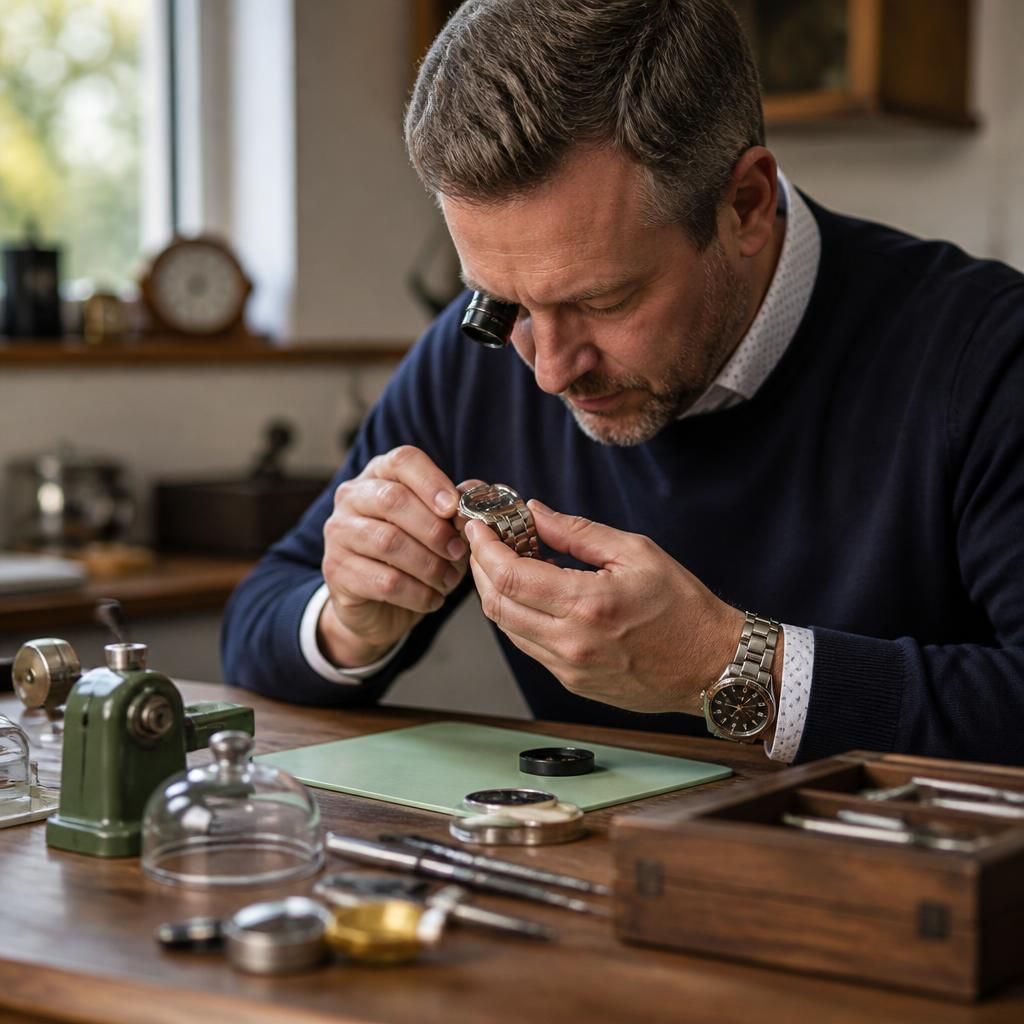
Maintenance for a used Rolex GMT-Master II should begin with a professional condition assessment, not an automatic assumption that the movement needs a full service. The watchmaker should check timekeeping, power reserve, winding, the independent GMT hand, date change, bezel, crown, crystal, case and bracelet, while looking for signs of moisture, impact or previous repair work.
This inspection helps distinguish essential mechanical work from cosmetic wear. A watch with light marks may be mechanically sound, while a clean-looking watch with no reliable service history may need attention to its movement, seals or water resistance. Any recommended work should be explained clearly, with replaced parts, test results and future maintenance advice recorded for your records.
Arrange a Professional Rolex GMT-Master II Service Assessment
Arrange a professional Rolex GMT-Master II service assessment to check its timekeeping, water resistance, movement, seals and external condition. We can explain which work is necessary, which parts may be retained and what maintenance should be recorded for future reference.