What considerations should be made when selecting an engagement ring to match personal style?
When selecting an engagement ring to match personal style, consider the wearer’s everyday lifestyle, preferred metal, diamond cut, setting, proportions and comfort, alongside durability and budget. Classic, minimalist, vintage-inspired and contemporary tastes can each be reflected through the combination of these elements, with bespoke details allowing the design to feel individual and meaningful.
Choosing an engagement ring to match personal style involves balancing appearance, comfort, lifestyle and long-term practicality. The most suitable design is not determined by the diamond or setting alone; it comes from how the stone’s shape, metal, proportions and details work together with the wearer’s existing jewellery and everyday habits.
Start with the wearer’s established style
Look at the jewellery they already choose to wear. Preference for fine, understated pieces may indicate that a slim band, modest central stone and simple setting will feel more natural than a large, highly detailed design. Someone who regularly wears bold jewellery may prefer stronger proportions, contrasting metals or a more distinctive setting.
Consider whether their taste is primarily:
- Classic: traditional round brilliant diamonds, balanced proportions and timeless solitaire or shoulder-set designs.
- Minimalist: clean lines, a plain band, a discreet setting and limited decorative detail.
- Vintage-inspired: milgrain edges, engraved shoulders, floral motifs, ornate galleries or antique-influenced diamond shapes.
- Contemporary: geometric lines, unusual stone arrangements, mixed metals or sculptural settings.
- Individual and expressive: a less conventional cut, coloured gemstones, asymmetry or bespoke details with personal significance.
These categories are useful starting points rather than strict rules. A classic round diamond can look modern in a bezel setting, while an emerald-cut stone can appear vintage when combined with fine engraving and tapered shoulders.
Match the ring to everyday lifestyle
The ring should be suitable for the activities it will encounter. A person who works with their hands, plays sport or regularly handles materials may need a lower-profile setting with fewer exposed edges. A bezel or rub-over setting can offer useful protection around the stone, while a well-made bezel, halo or shoulder-set design may reduce the likelihood of catching compared with a high, exposed setting.
Practicality does not mean compromising on style. A high setting can provide a light, elegant appearance and may allow a wedding ring to sit closely alongside it, but it needs to be assessed for stability, snagging and comfort. The height, shape and construction of the setting should be considered together with the wearer’s routine.
Choose a diamond cut or gemstone shape that reflects the desired character
The stone has a major influence on the ring’s visual style. Strictly speaking, a diamond’s cut refers to how it has been proportioned and finished to interact with light, while terms such as round, oval, pear and emerald usually describe its shape or outline. In everyday jewellery terminology, these are often discussed together as diamond cuts.
- Round brilliant: versatile, bright and conventionally timeless, making it suitable for both traditional and modern settings.
- Oval: elongated and elegant, with a larger-looking surface appearance than a round stone of similar weight.
- Emerald: defined by long step facets and a clear, glass-like appearance rather than intense scintillation. It suits understated, architectural designs.
- Princess or square brilliant: crisp and geometric, with strong contemporary appeal.
- Cushion: softer in outline, combining rounded corners with either brilliant or antique-style faceting.
- Pear and marquise: directional shapes that can create the impression of length, although their points require careful protection in the setting.
- Radiant: a rectangular or square outline with brilliant-style faceting, offering a balance between clean structure and lively sparkle.
The choice should take account of the wearer’s preferred balance between brilliance, outline, symmetry and individuality. A diamond with strong sparkle may suit a more traditional style, whereas a step-cut stone can be appropriate for someone who values clarity of form and subtle reflection.
Consider the setting as part of the design
The setting controls how much of the stone is visible, how securely it is held and how the ring sits on the finger. A solitaire places emphasis on the central stone and often suits a clean, uncluttered style. Shoulder-set or three-stone designs add detail and may create greater presence across the hand. Halo settings can increase the visual impact of a centre stone, while a bezel setting gives a streamlined outline and additional protection around the edges.
Prong or claw settings allow light to enter from several directions and can make a stone appear more open. They require sound construction and periodic inspection, particularly if the ring is worn continuously. Bezel settings cover more of the stone’s edge and can be especially appropriate for active lifestyles, but they create a more defined metal outline around the diamond or gemstone.
The setting should also suit the stone’s shape. Pointed shapes such as pear and marquise generally benefit from protective detailing at the tips. Step-cut stones often work well with settings that preserve their clean outline rather than obscuring it with excessive decoration. A halo must be proportioned carefully so that it complements, rather than overwhelms, the centre stone.
Select a metal that works with personal taste and wear
Metal colour affects the overall character of the ring. Platinum and white gold provide a cool-toned, contemporary appearance and can create a bright frame around a colourless diamond. Yellow gold gives a warmer, more traditional look, while rose gold adds a softer pink tone. Mixed-metal designs can provide contrast and may help combine the ring with jewellery already worn in different colours.
Durability, maintenance and skin sensitivity are also relevant. Platinum is dense and naturally white, while gold alloys vary in hardness and colour according to their composition. White gold may require periodic refinishing to maintain its bright surface. The choice should be discussed in relation to how frequently the ring will be worn and the type of work or activities it will experience.
Check proportions, finger shape and comfort
A ring can look substantially different on the finger from how it appears in a display case or photograph. The width of the band, the height of the setting and the size and shape of the stone should be considered together. Elongated stones can create a lengthening effect, while wider bands and horizontal designs can give a stronger, more substantial appearance.
Comfort is equally important. Check that the inside of the band feels smooth, that the setting does not press against adjacent fingers and that the ring does not rotate excessively. If the wearer intends to add a wedding ring later, allow for the two designs to sit comfortably together. Some engagement rings are shaped or raised to accommodate a wedding band, while others are designed to be worn alone or paired with a fitted ring.
Set a realistic budget around priorities
A personal-style decision should be guided by priorities rather than by a single feature. Decide whether the greatest importance lies with the diamond’s size, cut quality, colour, clarity, metal, setting detail or bespoke workmanship. A well-proportioned design with a carefully selected stone can be more successful than a larger stone in a setting that does not suit the wearer.
It is also sensible to allow for ongoing care. Regular checks, cleaning, resizing, repairs and valuations may be needed over the life of the ring. Designs with delicate details or exposed settings can require closer inspection, whereas simpler constructions may be easier to maintain.
Include meaningful and ethical details
Personal style can be expressed through details that are not immediately obvious, such as an engraved message, a hidden birthstone, a distinctive gallery or a design reference drawn from an existing family piece. Remodelling suitable jewellery can also preserve sentimental material while creating a ring with a more current shape.
Ask where the metal and gemstone have come from and what information is available about their sourcing. Ethical considerations may affect the choice between natural and lab-grown diamonds, recycled or newly refined metals, and gemstones with documented provenance. These decisions should be considered alongside appearance, durability and budget rather than treated as separate from personal style.
Use a consultation to test the complete design
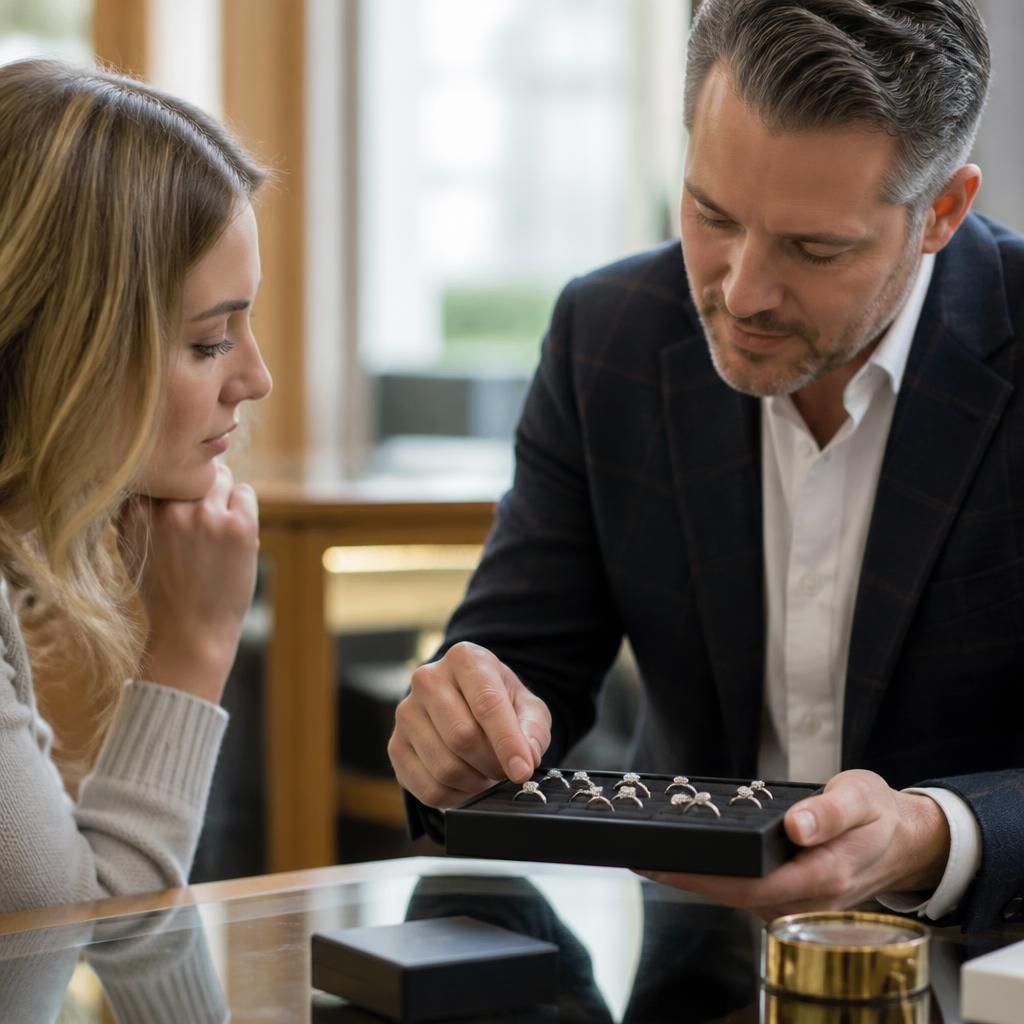
Before making a final decision, compare complete ring designs rather than assessing a stone, setting or metal in isolation. Try different widths and profiles, view the ring under varied lighting and consider how it looks alongside the wearer’s usual jewellery. A bespoke consultation can refine the proportions, adjust the setting for comfort and incorporate details that make the design individual without reducing its practicality.
The strongest choice is a ring whose visual character reflects the wearer, whose construction suits everyday life and whose materials and aftercare have been properly considered. Reviewing style, stone shape, setting security, metal, comfort and future wear together provides a more reliable basis for selecting an engagement ring than following a trend or focusing on one feature alone.
Matching an engagement ring to personal style means assessing how its stone, setting and metal fit the wearer’s existing jewellery and everyday routine. A person who prefers understated pieces may feel most comfortable with a slim band and a simple solitaire, while someone drawn to bolder jewellery may prefer a halo, shoulder-set or mixed-metal design.
Style should also be considered alongside practicality. A lower-profile bezel or rub-over setting can suit an active lifestyle, whereas an elevated claw setting may better showcase a stone but needs greater care to avoid knocks and snagging. Compare the complete ring on the hand, including its width, height and comfort, rather than choosing the diamond or setting in isolation.
Arrange an Engagement Ring Style Consultation
Arrange an engagement ring style consultation to compare diamond cuts, settings and metals against the wearer’s personal style, daily routine and preferred proportions. We can also discuss bespoke details, ethical sourcing and the practicalities of pairing the ring with a wedding band.