What factors should I consider when selecting a jeweller in the Jewellery Quarter for luxury Rolex timepieces?
When selecting a Jewellery Quarter jeweller for a luxury Rolex timepiece, assess the watch’s authenticity, provenance, condition and documentation, alongside the jeweller’s expertise, transparency and aftercare provision. A reputable specialist should explain the model’s history and service needs clearly, provide appropriate paperwork and offer dependable guidance before and after purchase.
The key considerations are authenticity, provenance, condition, documentation, specialist knowledge and the level of service provided before and after purchase. A luxury Rolex timepiece should be assessed as both a precision instrument and a valuable piece of jewellery. The jeweller you choose should explain the watch’s identity and history clearly, disclose any restoration or replacement parts, and give you enough information to make a properly informed decision.
Confirm the jeweller’s expertise. Rolex models can differ significantly in movement, case construction, dial configuration, bracelet, production period and collectability. Choose a jeweller who can discuss the relevant reference, explain the features that affect desirability and identify details that may indicate modification or inconsistency. Experience with luxury watches is particularly important when considering vintage, discontinued or pre-owned pieces, where originality and condition can have a substantial effect on value.
Establish authenticity and provenance. Ask how the watch was sourced and what checks have been carried out. The serial and reference markings, movement, dial, hands, bezel, bracelet and clasp should be consistent with the model and its period. Supporting material may include the original warranty card, purchase documentation, service records, box and booklets, although the absence of an accessory does not automatically mean that a watch is not genuine. Provenance should be presented accurately rather than used as a substitute for proper inspection.
A reputable jeweller should be willing to discuss the watch’s history without making unsupported claims. If a piece has been polished, repaired, serviced or fitted with replacement components, those details should be disclosed. For older watches, originality is often more significant than a superficially flawless appearance, so ask whether components are original, period-correct or later replacements.
Examine condition and servicing. Inspect the case for excessive polishing, worn edges, deep marks or signs of damage. Check the crystal, bezel, dial, hands, bracelet and clasp, and ask whether the watch has been tested for timekeeping and water resistance. A watch can look excellent while still requiring mechanical attention, so the movement’s service history matters. Find out when it was last serviced, what work was completed and whether a future service is likely to be needed.
Service intervals should not be treated as a fixed rule for every watch. They depend on the model, age, use, storage and previous maintenance. A responsible jeweller will distinguish between a watch that has received a documented service and one that has merely been inspected or cleaned. Any warranty or guarantee should state clearly what it covers, for how long and where remedial work will be carried out.
Review the paperwork and terms of sale. Before committing, check that the description, reference, serial information, condition and included accessories are recorded accurately on the invoice. The price should be explained in relation to the model, age, condition, originality, service history and current demand. Be cautious if documentation is vague, if important details are unavailable or if you are pressured to make a quick decision.
Ask about your rights if an undisclosed issue is found after purchase, as well as the arrangements for returns, repairs and authenticity concerns. You should also receive guidance on safely storing and insuring the watch. An independent valuation may be useful for insurance purposes, particularly where the purchase price and replacement value differ.
Consider the quality of the consultation. The right jeweller should first establish how you intend to wear the watch, whether you are seeking a daily timepiece or a collectible example, and which features matter to you. This helps distinguish between options that may look similar but differ in size, movement, bracelet, practicality and long-term maintenance. Clear advice should include limitations as well as advantages; no pre-owned watch should be described as entirely risk-free or guaranteed to appreciate.
A private, secure appointment can be valuable when viewing a high-value timepiece. You should be allowed reasonable time to examine the watch, ask questions and compare suitable alternatives without pressure. The consultation should remain confidential and proportionate to the value and sensitivity of the purchase.
Check aftercare and servicing arrangements. Ask whether the jeweller can assist with bracelet adjustment, cleaning, inspection, repairs, valuation and future servicing. Confirm who undertakes technical work and whether specialist repairs are referred to an appropriately qualified watchmaker. Good aftercare should include practical advice on winding, setting, water resistance, storage and avoiding unnecessary wear.
It is also worth asking how the jeweller handles issues such as a loose bracelet, damaged crystal, reduced water resistance or loss of timekeeping accuracy. A clear process for assessment and quotations makes ownership more straightforward and helps protect the watch from unsuitable work.
Assess trust, transparency and professional standards. Look for a clearly established business, written documentation, secure handling of valuable items and a willingness to answer detailed questions. Professional membership, appropriate insurance and a well-defined complaints process can provide additional reassurance, but they should complement—not replace—your own checks of the watch and its paperwork.
Finally, compare the complete proposition rather than the headline price alone. A cheaper watch may have a shorter service history, non-original components or limited aftercare, while a higher-priced example may be justified by condition, originality and documentation. Selecting a Jewellery Quarter jeweller who combines Rolex expertise with transparent advice, careful authentication and dependable aftercare gives you the best basis for a confident purchase.
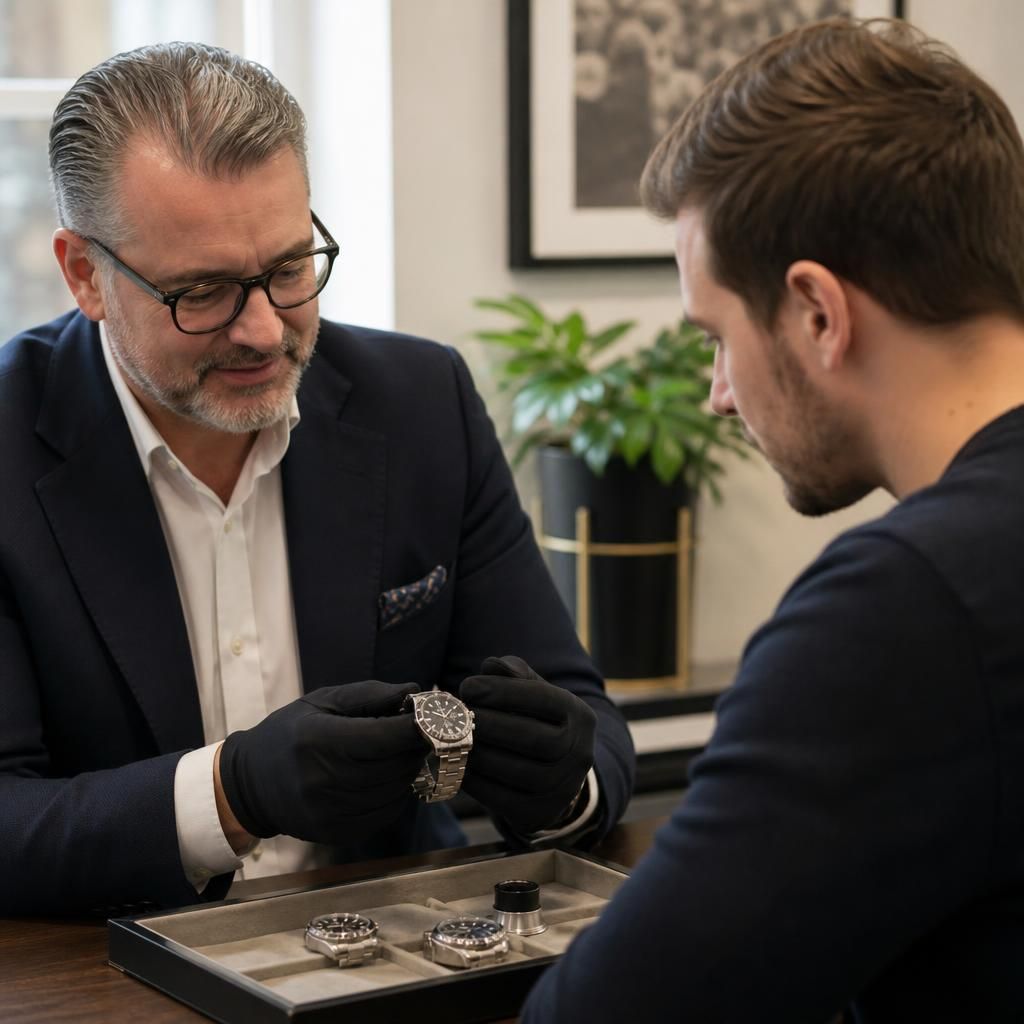
Authenticity should be the first consideration when selecting a Jewellery Quarter jeweller for a luxury Rolex timepiece. A reputable specialist will assess the watch as a complete object, checking the reference and serial markings against the movement, case, dial, hands, bezel, bracelet and clasp. These components should be consistent with the model and its production period.
Ask for a clear explanation of the watch’s provenance, service history and any replacement or restored parts. Original warranty cards, receipts, service records, box and booklets can support the history, but paperwork alone does not prove authenticity. The jeweller should also disclose polishing, repairs or later components, record the condition accurately and provide written details of what is included with the sale. This level of transparency helps you distinguish a genuine, properly represented timepiece from one that may require costly investigation or remedial work.