
What factors should be considered when choosing between new and pre-owned luxury watches for purchase?
When choosing between a new and pre-owned luxury watch, compare its condition, authenticity, provenance, servicing history, warranty, price and likely long-term value. A new watch offers current specifications and manufacturer support, while a carefully authenticated pre-owned watch may provide greater choice or value but requires thorough checks of its documentation, originality and aftercare.
The choice between a new and pre-owned luxury watch should be based on condition, authenticity, provenance, warranty, servicing, price, availability and your intended use. A new watch usually provides the latest specification, clear manufacturer support and an unbroken ownership history. A carefully authenticated pre-owned watch can offer wider choice, discontinued models and a more favourable purchase price, but it requires closer checks of originality, documentation and aftercare.
Condition and originality
A new watch should be unused and supplied in the condition expected from the manufacturer, although it is still sensible to check that the model, dial, hands, bracelet, clasp and functions are correct. For a pre-owned watch, assess both its visible condition and whether its components remain original. Scratches, dents, bracelet stretch, worn clasps, damaged seals and signs of polishing can affect desirability and future value. Polishing is not automatically a fault, but excessive or uneven polishing may soften the case edges and alter the watch’s original proportions.
Check that the dial, bezel, hands, crown, bracelet and movement are appropriate for the reference and production period. Replacement parts may be genuine and professionally fitted, but they should be disclosed because they can affect collectability, value and servicing decisions. A specialist inspection is particularly important where the watch is valuable, rare or described as fully original.
Authenticity and provenance
Whether new or pre-owned, the watch should be sourced through a reliable, established channel and examined by someone with appropriate expertise. For a pre-owned purchase, ask how the watch was acquired and whether there is supporting ownership or service history. Provenance may include the original purchase receipt, dated warranty card, service invoices, valuation records and previous ownership documentation. These documents do not prove authenticity on their own, but they help establish a consistent history.
Do not rely solely on a serial number, presentation box or paperwork. Genuine accessories and documents can be separated from their original watch, and counterfeit watches may be supplied with convincing packaging. The watch itself, including its movement and construction, must be assessed. Any mismatch between the reference, serial details, paperwork and physical features should be resolved before purchase.
Warranty and aftercare
A new watch will generally be supplied with the manufacturer’s current warranty, subject to its terms and exclusions. Confirm when the warranty began, what it covers, where warranty work can be carried out and whether the warranty documentation is correctly completed. A pre-owned watch may have remaining manufacturer warranty, an independent dealer warranty or no warranty. These offer different levels of protection, so establish precisely what is covered and for how long.
Ask about the process for dealing with faults, including who pays for inspection, postage and repairs. A warranty may exclude accidental damage, water ingress, wear to external components or work carried out by an unauthorised person. Good aftercare should also include guidance on servicing, bracelet adjustment, water-resistance testing, repairs and future valuations.
Service history and mechanical condition
With a new watch, the servicing history is not usually a concern, although the manufacturer’s recommended maintenance schedule should be understood. A pre-owned watch should be assessed according to its age, use and service records rather than age alone. A documented service by the manufacturer or a suitably qualified watchmaker is useful, but a recent service does not remove the need to check the watch’s current performance.
Depending on the model, an inspection may consider timekeeping, power reserve, winding, date changing, chronograph operation, water resistance and the condition of the movement. If the watch has no reliable service history, allow for the possibility of a service after purchase and factor that cost into the decision. Avoid assuming that a watch described as “working” has been fully serviced or is suitable for exposure to water.
Price and total cost
Compare like-for-like watches rather than comparing the headline prices of new and pre-owned examples. The specification, reference, material, complications, condition, accessories, warranty and service history can all affect value. A pre-owned watch may have a lower initial price, but the cost of servicing, replacing worn components, restoring water resistance or sourcing missing paperwork can reduce that apparent saving.
For a new watch, consider whether the price includes the full manufacturer’s warranty, correct accessories and any necessary sizing or delivery arrangements. For a pre-owned watch, confirm whether the price includes authentication, professional inspection, servicing, insurance during delivery and aftercare. A suspiciously low price should be treated as a reason for further checks rather than an automatic bargain.
Availability and model choice
Buying new may be preferable when you want the latest movement, materials, dial configuration or manufacturer specification. It can also be the better option when you require an untouched example and straightforward warranty support. However, availability may be limited for sought-after models, and current production may not include the exact design or size you want.
The pre-owned market can provide access to discontinued references, older dial variations, unusual materials and models no longer available new. It may also offer more choice across different conditions and price points. That wider choice makes accurate comparison more important: two watches with the same model name can differ substantially in age, originality, condition and completeness.
Intended use and risk tolerance
Consider how the watch will be worn. A daily watch may need a robust case, dependable water resistance, a secure clasp and readily available servicing. A dress watch or collectible may be judged more heavily on originality, condition and completeness. If you intend to wear the watch for swimming or other water-based activities, confirm its water resistance through appropriate testing rather than relying on age or appearance.
A new watch can reduce uncertainty about its previous use, while a pre-owned watch involves a greater need to verify its history and condition. This does not make every pre-owned watch less reliable; a well-maintained example with a documented service history may be an excellent purchase. The important distinction is whether the risks have been identified, explained and reflected in the price and warranty.
Documents and accessories
Check which items are included before agreeing to buy. Depending on the watch, these may include the warranty card, instruction booklet, service records, original box, spare links, tags, receipts and other model-specific accessories. Missing items do not necessarily make a watch unsuitable, but they should be disclosed and considered when comparing it with a complete example.
Make sure the paperwork identifies the correct model and, where applicable, corresponds with the watch’s serial details. For an online purchase, request clear photographs and a written description of the watch, its accessories, condition and warranty. Do not send payment until you are satisfied that the seller, watch and transaction arrangements have been properly verified.
Security and the transaction
Use a reputable seller with a physical presence, transparent terms and a clear returns or inspection policy. Confirm the seller’s identity, obtain a written invoice and use a payment method that provides appropriate protection. Be cautious if you are pressured to pay quickly, asked to use an unusual payment method or discouraged from having the watch independently examined.
For a face-to-face purchase, arrange an appointment in a professional and secure setting. For delivery, confirm the insurance and tracking arrangements, inspect the parcel and watch promptly, and retain all packaging and documentation until the transaction has been fully checked. These precautions apply equally to new and pre-owned purchases.
Making the decision
Choose new when current specifications, manufacturer warranty, untouched condition and predictable support are your priorities. Choose pre-owned when access to a discontinued model, a particular reference, broader availability or potential value is more important, provided the watch has been authenticated and its condition, history and aftercare are clear.
Before committing, compare the complete package rather than the watch alone: originality, condition, provenance, service history, warranty, accessories, total cost and the seller’s ability to support you after the sale. An experienced jeweller or watch specialist can explain any replacement parts, assess mechanical condition and identify the checks that are appropriate for the specific model. This gives you a sound basis for choosing the watch that best matches your expectations and intended use.
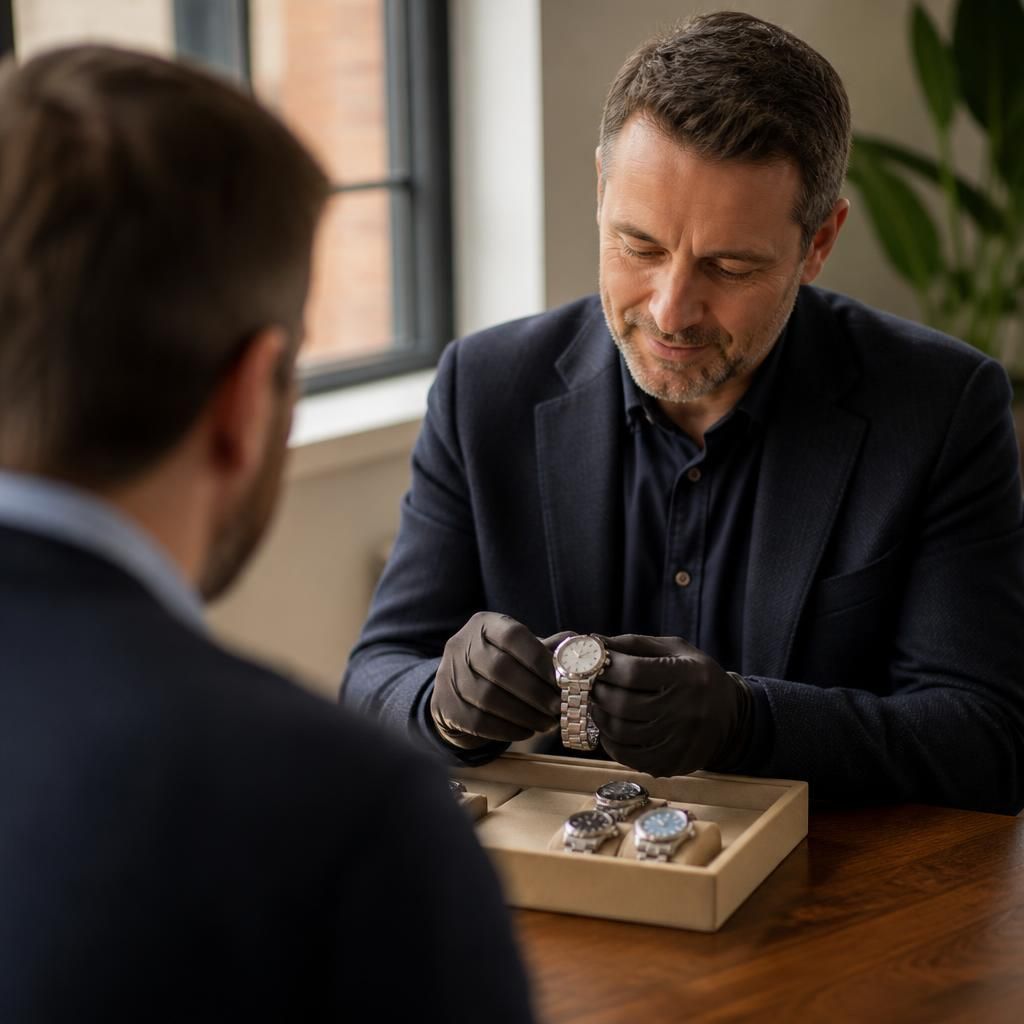
When comparing new and pre-owned luxury watches, condition and originality are often more important than age alone. A pre-owned watch may offer excellent value, but its case, dial, hands, bezel, bracelet and movement should be checked against the correct specification for its reference and production period.
Look for disclosed signs of polishing, bracelet stretch, worn clasps, replacement components and previous repairs. Genuine replacement parts may be properly fitted, but they can affect collectability, future servicing and resale value. Ask for service records and a clear explanation of any work carried out, then compare the watch’s condition with its price, warranty and expected aftercare. A specialist inspection is advisable where originality or mechanical condition is uncertain.