How can I confirm the authenticity and provenance of a pre-owned Rolex GMT Master II?
Confirm a pre-owned Rolex GMT Master II’s authenticity and provenance by comparing its serial and reference details with the watch, checking its purchase and service records, and having the movement, case and bracelet examined by a qualified Rolex specialist. Documentation supports the history, but an expert physical inspection is essential because serial numbers, boxes and papers can be copied or matched to another watch.
To confirm the authenticity and provenance of a pre-owned Rolex GMT-Master II, the watch itself must be examined alongside its serial and reference details, original or replacement documentation, and available ownership and service records. Papers, box and serial numbers are useful evidence, but they are not conclusive on their own because counterfeit documents can be produced and genuine parts can be combined with an unrelated watch. A qualified Rolex specialist should inspect the case, movement, dial, bezel, bracelet and clasp before you commit to the purchase.
Start by matching the watch to its identifying details. The reference number identifies the model and configuration, while the serial number identifies the individual watch. Depending on the age of the GMT-Master II, these details may be found between the lugs, on the rehaut or in the accompanying records. Their location and format vary across production periods, so the expected position should be assessed in context rather than treated as a simple pass-or-fail test.
- Check that the reference corresponds with the case shape, bezel type, dial configuration, bracelet and movement expected for that model.
- Check that the serial number is clearly and correctly engraved, with appropriate depth, alignment and finishing for the period.
- Compare the serial and reference numbers on the watch with the warranty card, purchase receipt, service documentation and any valuation.
- Be cautious if numbers appear altered, poorly engraved, obscured, inconsistent or associated with documentation from a different model.
A matching serial number does not prove authenticity. Counterfeit watches can carry copied or fabricated numbers, and genuine papers may have been separated from the watch to which they originally belonged. Treat documentation as supporting evidence, not as a substitute for examining the watch and movement.
Examine the movement and construction. A specialist should open the case using the correct tools and inspect the movement, engravings, finishing, rotor, screws and internal architecture. The movement should be appropriate for the stated GMT-Master II reference and should show the quality and layout expected of a genuine Rolex calibre. The examination can also reveal replacement, non-original or incorrectly fitted components, which may affect both authenticity and value.
The external inspection should include:
- The dial printing, coronet, hour markers, date window and date magnification.
- The hands, hand stack and GMT hand, including their shape, finish and alignment.
- The ceramic or aluminium bezel insert, numerals, graduations, colour and bidirectional or unidirectional operation as appropriate to the model.
- The case profile, lugs, crown guards, crown and Triplock winding system, with particular attention to excessive polishing or incorrect proportions.
- The laser-etched crown and rehaut engraving on models where these features should be present, while recognising that quality varies by age and that these details alone are not proof of authenticity.
- The Oyster or Jubilee bracelet, end links, clasp, coronet, reference markings and signs of replacement or excessive wear.
For a GMT-Master II, the 24-hour hand, independently adjustable hour hand, date change and bezel operation should also be tested. Incorrect hand movement, a poorly aligned bezel, weak or uneven printing, an unsuitable movement or an abnormal winding feel can indicate a counterfeit, incorrect assembly or a watch that has been modified.
Assess provenance through a consistent paper trail. The most useful records usually include the original purchase invoice, warranty card, dated service invoices, insurance valuations, repair records and documentation showing how the current seller acquired the watch. A service history is particularly valuable when it identifies the watch by serial number and describes the work carried out. Ask whether the watch has had a replacement case, dial, hands, bezel, bracelet or movement, and whether those parts were supplied during an authorised service or fitted independently.
Provenance is not limited to having a box and papers. Consider whether the seller can explain:
- When and where the watch was purchased.
- Whether it has been serviced, repaired, polished or modified.
- Whether the serial number appears consistently across the records.
- Whether the seller has checked that the watch is not reported lost or stolen.
- Whether the sale will include a written invoice identifying the watch and the agreed condition.
A missing box or warranty card does not automatically mean that a GMT-Master II is counterfeit. Conversely, a complete set does not guarantee authenticity. Vintage and heavily used watches may have legitimate replacement parts or incomplete records, but these facts should be disclosed clearly because they affect originality, serviceability and value.
Use an independent specialist inspection before finalising the purchase. The inspection should be carried out by a watchmaker or established luxury-watch specialist with experience of Rolex sports models. If possible, arrange this before payment becomes non-refundable. The specialist should compare the serial and reference details, assess originality, inspect the movement, test basic functions and document any replaced or aftermarket parts. Photographs are helpful for an initial review, but they cannot reliably confirm movement authenticity or the condition of internal components.
Rolex service records or a service carried out by Rolex can provide useful evidence of the watch’s history, but they should still be read alongside the physical watch and the seller’s invoice. A service may replace worn components, and a serviced watch is not necessarily identical in every respect to its original factory configuration. If originality is important, ask specifically which parts were replaced and retain the service documentation.
Be particularly careful when:
- The price is substantially below comparable examples without a clear explanation.
- The seller will not provide clear photographs of the watch, serial area, clasp and documents.
- The seller discourages an inspection or insists on immediate payment.
- The watch has a serial number but no credible explanation of its history.
- The papers appear altered, contain mismatched details or identify a different reference.
- The dial, bezel, hands or bracelet are described vaguely as “custom”, “aftermarket” or “service” parts.
- The watch is being sold without a proper invoice or with unclear return and inspection terms.
Before completing the purchase, obtain a written invoice that records the make, model, reference number, serial number, condition, included accessories, disclosed replacement parts and the seller’s details. Keep copies of all correspondence, photographs and inspection findings. If the seller cannot establish a coherent link between the watch, its documents and its ownership history, postpone the purchase until the discrepancy has been resolved.
The safest conclusion comes from several consistent forms of evidence: a physically genuine watch, correctly matched reference and serial details, a movement and components appropriate to the model, credible service or ownership records, and a seller willing to support an independent inspection. No single feature, document or online serial-number search is sufficient by itself.
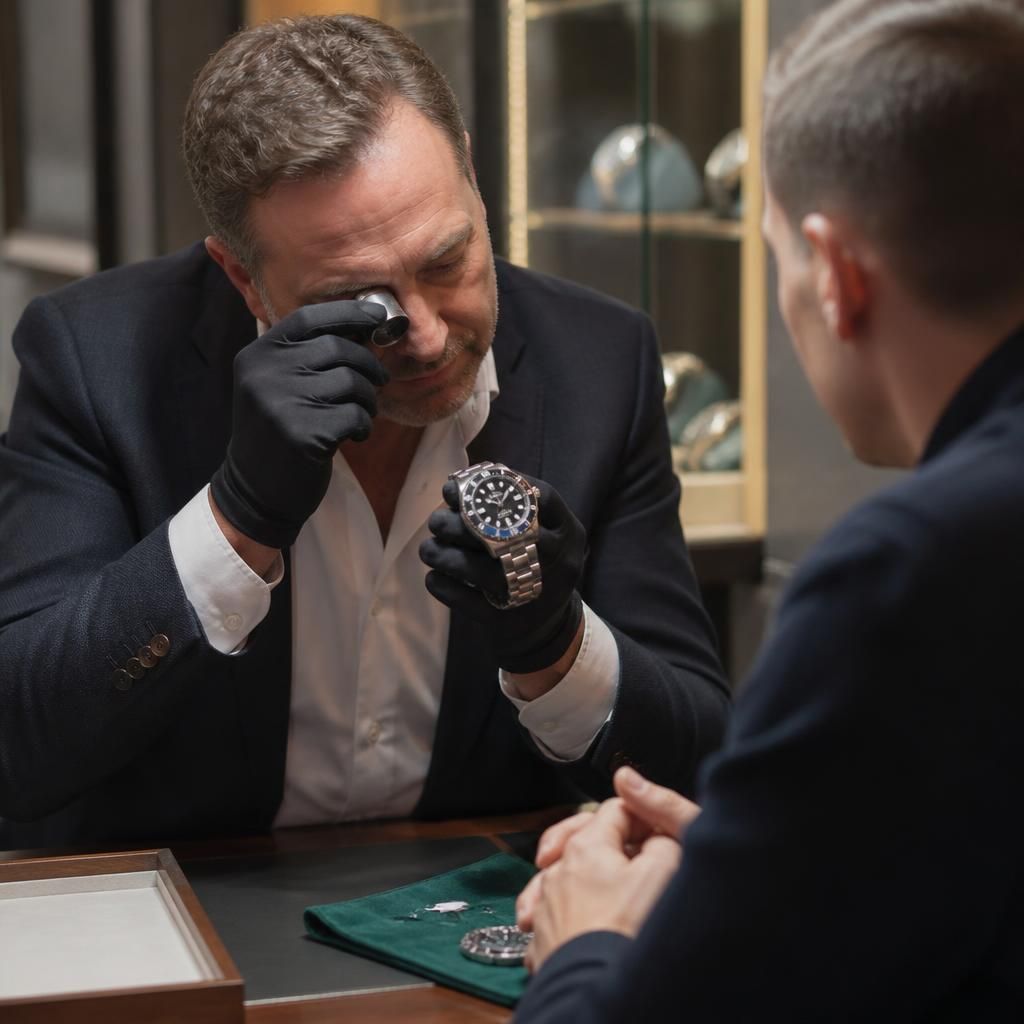
A matching serial number does not, by itself, confirm that a pre-owned Rolex GMT-Master II is authentic. Serial numbers, warranty cards and boxes can be copied, altered or separated from the watch they originally accompanied.
The most reliable check combines the watch’s reference and serial details with an examination of its movement, dial, bezel, case, bracelet and functions by an experienced Rolex specialist. Ask for the findings in writing, including any replacement or aftermarket parts, before completing the purchase.
Arrange an expert Rolex authenticity check
Arrange an expert authenticity check with Steven Charles Quance before completing your purchase. We can assess the Rolex GMT-Master II’s movement, case, dial, bezel, bracelet, identifying details and supporting documents, including any disclosed replacement or aftermarket parts.