What types of jewellery items can be laser engraved?
Laser engraving can be applied to many jewellery items, including rings, wedding bands, pendants, necklaces, bracelets, bangles, charms, earrings and suitable watch components. The result depends on the item’s material, available engraving surface, thickness and curvature, which should be assessed before personalisation.
Laser engraving can be carried out on many types of jewellery, including rings, wedding bands, pendants, necklaces, bracelets, bangles, charms, earrings, cufflinks and suitable watch components. Whether an item is suitable depends on its material, finish, thickness, shape and the amount of accessible surface available for the engraving.
Rings and wedding bands are among the most frequently laser engraved items. Engraving may be placed on the inside of a band for a discreet message, date, initials or personal inscription, or on the outside where the design is intended to be visible. A laser is particularly useful for small lettering and detailed symbols, although the available space inside a narrow or heavily shaped band will determine how much can be included.
Rings with stones can often be engraved, but the setting and construction need to be assessed first. A jeweller will consider whether the ring can be held securely, whether the engraving area is sufficiently separate from the setting and whether heat or vibration could affect delicate components. Eternity rings, patterned bands and rings with highly curved profiles may offer less uninterrupted space than a plain band.
Pendants and necklaces are well suited to personalisation, particularly when the pendant has a flat or gently curved front or reverse. Discs, bars, hearts, lockets, plaques and other simple shapes can accommodate names, dates, initials, coordinates, handwriting, symbols or a short message. A reverse side can be used when the front has a decorative finish or an existing design. The chain itself is not usually the main engraving surface, but a detachable pendant or tag can be personalised instead.
Bracelets and bangles can be engraved on flat plaques, identity-style panels, hinged sections or individual links, depending on their construction. A solid bangle may be marked on the inside or outside, while a chain bracelet may require a suitable charm or plate. Curved surfaces can be engraved, but the curvature affects how the item is positioned and how large and readable the finished design will be.
Charms and keepsakes are practical choices for small personal messages. Initials, dates, initials combined with a symbol, or a short name can often be added to individual charms. Where a charm is very small, the design may need to be simplified so that it remains clear rather than crowded. Existing decoration, a textured surface or a hollow construction can also limit the available area.
Earrings may be suitable when they include a flat drop, disc, bar or other sufficiently sized component. The front, reverse or side may be considered, depending on how the earrings are worn. Studs and small hoops generally provide less space, so engraving is more likely to be limited to a discreet initial or simple mark.
Watches and watch accessories can sometimes be laser engraved on a case back, clasp, buckle or removable component. A case back with a flat metal surface is usually easier to personalise than a highly curved case or a surface containing existing markings. The watch must be inspected carefully before work begins, as seals, glass, movement components, coatings and manufacturer markings should not be disturbed. Engraving an important watch may also affect its future servicing or resale considerations, so the intended placement should be discussed in advance.
Cufflinks, tie bars and other jewellery accessories may also be engraved where they have a suitable metal surface. Cufflinks with a plain face can accommodate initials, a monogram or a short date, while tie bars and small plates may be better suited to a simple design than a long inscription.
The material is an important part of the assessment. Precious metals such as gold, silver and platinum, along with some stainless steel and titanium items, may be suitable for laser engraving. Results vary according to the precise alloy, surface treatment and colour. Plated, coated, lacquered or heavily textured items may produce a different appearance, and engraving can expose the underlying material rather than creating a mark in the original surface alone.
The item’s construction matters just as much as its material. Before accepting an engraving request, the relevant points include:
- the size and thickness of the engraving area;
- whether the surface is flat, cylindrical, domed or irregular;
- whether the jewellery is solid, hollow, plated or made from joined components;
- the presence of gemstones, settings, hinges, clasps or moving parts;
- any existing engraving, polishing, texture or decorative finish; and
- how the item will be positioned and held safely during engraving.
Laser engraving is suitable for both text and detailed artwork, but the design must be proportionate to the item. Fine handwriting, fingerprints, line drawings and intricate symbols may need to be adjusted for scale so that small details remain legible. Longer messages are generally more readable when placed on a larger pendant, plaque or case back rather than a narrow ring.
Not every item should be engraved. Very thin jewellery, fragile antique pieces, hollow forms, heavily curved surfaces and items with vulnerable coatings may carry a greater risk of distortion or an uneven result. Some gemstones and decorative materials also require specialist assessment, particularly where the laser could affect the stone, treatment or setting. In these cases, an alternative surface, a detachable component or traditional hand engraving may be more appropriate.
The best choice is therefore based on the item and the intended message rather than on the jewellery category alone. Steven Charles Quance can assess the material, construction and engraving area before confirming what is practical, how the design should be prepared and where it will be most clearly displayed. This helps protect the jewellery and ensures that the final personalisation is appropriate for its size, finish and long-term use.
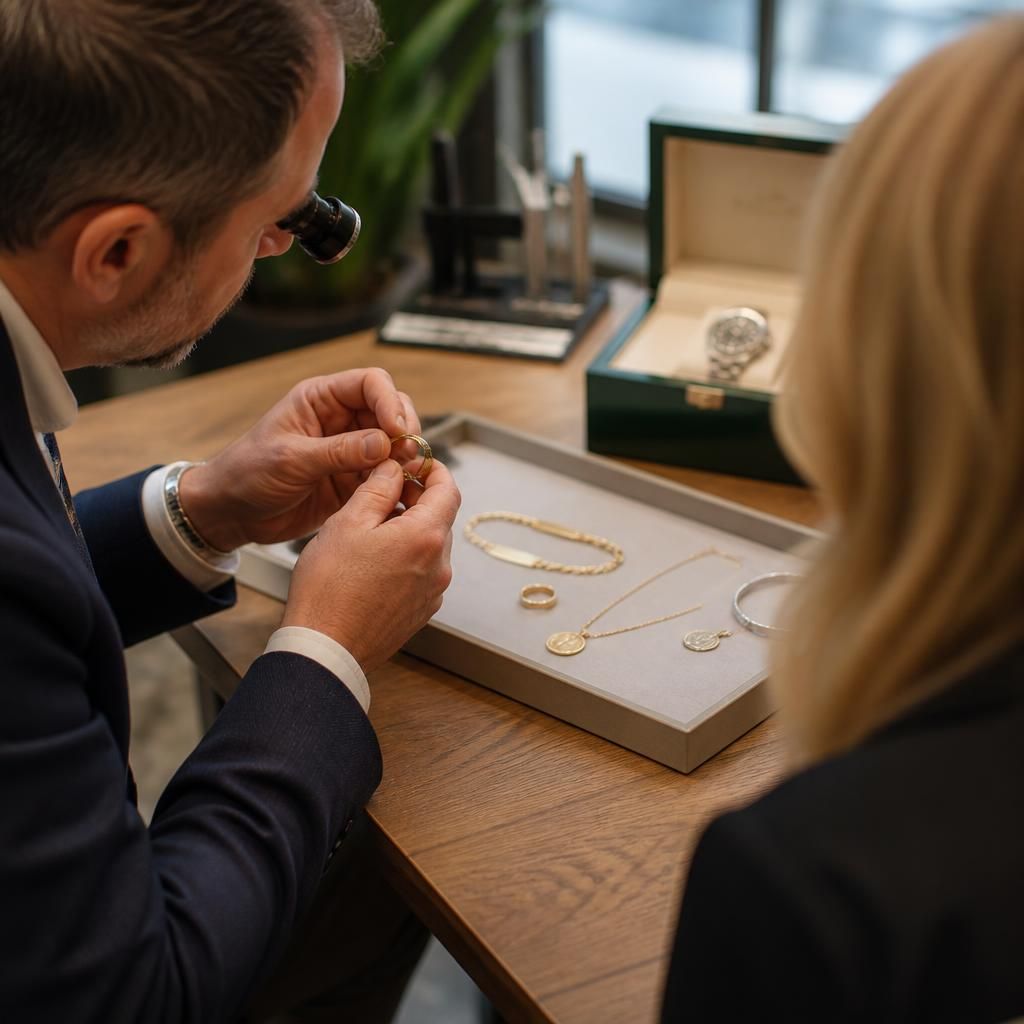
Laser engraving can personalise many jewellery items, including rings, wedding bands, pendants, bracelets, bangles, charms, cufflinks and suitable watch components. Whether an item is suitable depends on its material, thickness, shape, finish and the amount of accessible surface available.
Flat or gently curved areas usually provide the clearest result. For example, a ring may carry a discreet inscription inside the band, while a pendant, bracelet plaque or watch case back can accommodate initials, dates, symbols or a short message. Very small, thin, hollow or heavily textured items may require a simplified design, an alternative engraving area or a different approach.